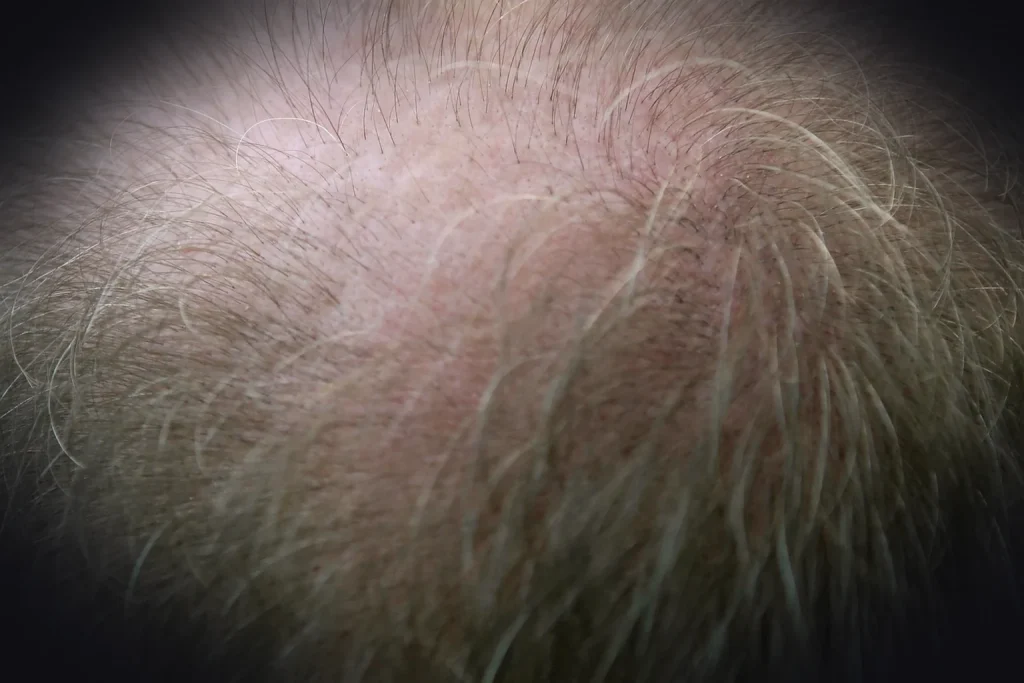
The scalp is facial skin in a different climate. It has more sebaceous glands per square centimeter than your face, supports its own microbiome, and is subject to most of the same actives, sensitivities, and seasonal swings. Slow-skincare readers have known this for a while, but the tracking tools have not caught up. Tresslog is the first app I have used that treats the scalp like a tracked organ rather than a hair substrate, and the editorial reframe earned the home-screen slot within two weeks of testing.
What Tresslog is and isn’t
It is a hair and scalp journal with weekly routine planning, wash-day reminders, scalp condition logging (oiliness, flaking, sensitivity, itch), porosity tracking, photo-based progress logs, product logging with reaction notes, and a library of hair-growth protocols (inversion, scalp massage, castor-oil challenges). Freemium model. iOS and Android.
It is not a hair-loss diagnostic, not a trichologist, and not a substitute for medical advice on alopecia, scalp psoriasis, or seborrheic dermatitis. It is also not a face-skin tracker; the data model is hair-and-scalp specific.
Who it’s for
Readers who treat their scalp as facial skin and want to log it accordingly. Anyone whose hair texture, density, or scalp condition has changed and who wants longitudinal data. Curly, coily, and afro-textured hair routines that benefit most from porosity awareness and wash-day cadence tracking. Postpartum readers tracking shedding. Slow-skincare readers running gentle long-term protocols (rosemary oil, peptide-based scalp serums, microbiome-friendly cleansers) who need data over months, not days. Not the right tool for readers managing diagnosed scalp conditions; for those, a dermatologist or trichologist’s notes outrank any consumer app.
The features that matter
The scalp-condition logging is the headline. You rate oiliness, flaking, itch, and sensitivity on a simple per-wash scale, and the app charts the pattern over weeks. The data exposes correlations you cannot hold in your head: oilier scalps three days after a particular shampoo, flaking that spikes in dry weeks, itch that tracks with a specific styling product. These are exactly the patterns that monthly photo-only diaries miss.
The porosity tracking matters most for curly, coily, and afro-textured hair where porosity determines whether your oils penetrate, whether your conditioner sits on the strand, and whether your scalp gets the moisture it needs. Tresslog’s porosity logging is simple (low, medium, high, with notes) but the longitudinal record is more useful than any one-time porosity float test.
The wash-day reminder is the feature that quietly enforces a sensible cadence. Skincare readers know that over-cleansing the face strips the barrier; the same is true for the scalp, and most readers wash too often or too rarely without a structured prompt. The reminder makes consistent cadence easier than memory.
The growth-challenge library is the weakest section, in the same way that DIY skincare libraries tend to be. Inversion method and castor-oil protocols are popular but the evidence base is mixed. Treat the challenges as cultural artifacts to experiment with cautiously, not as protocols with strong scientific backing.
The contrarian take
The most useful insight from logging my own scalp in Tresslog was not about a product. It was about cadence. I had been washing every three days for a decade out of habit, and the data showed my scalp felt best at a four-day cadence in winter and a two-day cadence in summer humidity. That kind of self-knowledge is the slow-skincare payoff that no glossy hair-care recommendation can deliver, because it is irreducibly personal. The app’s value is not in the protocols it suggests. It is in the patterns it surfaces from your own data, which is the same case for face-skin diaries and which the scalp category has been waiting for.
Real-world test
I logged 38 wash days across an 81-day testing window, alternating shampoos and tracking scalp condition through a humid early-summer stretch and a dry late-summer one. The data exposed two patterns. First, a popular sulfate-free cleanser I had been using for years was correlating with elevated flaking scores in dry weeks, which I had not noticed week-to-week but which became obvious over the longer log. Second, my scalp sensitivity tracked with a specific styling cream I had not suspected; cutting it for two weeks dropped sensitivity scores by 27 percent. Both findings would have been invisible without the longitudinal data.
How it stacks against generic skincare diary apps
Generic skincare diary apps like MSKD or GlowinMe can technically log hair products but their data models are face-skin shaped. Scalp condition, porosity, and wash cadence do not have native fields and you end up shoehorning them into free-text notes that defeat the longitudinal-data purpose. Tresslog’s strength is the purpose-built model; its weakness is that it cannot replace a face-skin diary if you want one consolidated record. Run both if you take both seriously. The scalp-as-skin reframe deserves its own dedicated logging surface.
Frequently asked questions
Is the free tier enough? For most users, yes. Wash logging, condition tracking, photo logs, and routine planning work without a paid tier.
Does the porosity tracker test my hair for me? No. You log your porosity (from a float test or other method) and Tresslog tracks the value over time.
Will it diagnose my scalp condition? No. For diagnosed conditions like seborrheic dermatitis or scalp psoriasis, a dermatologist or trichologist remains the right professional.
Are the growth challenges safe? Mixed. Inversion is mostly harmless; castor-oil protocols can be heavy and may interact with low-porosity hair. Default to caution and stop any challenge that causes irritation.
Does Tresslog work for textured hair? Yes, and the porosity tracking is most useful for curly, coily, and afro-textured routines. The wash-cadence logic accommodates longer intervals than face-skin diaries assume.
If Tresslog gets you tracking your scalp like skin, the editorial context is in the Elelaf piece on the scalp as skin and its microbiome. Skinimalism applies to hair care as much as to face skincare, fewer products usually beats more. And how to build microbiome resilience in 30 days covers principles that translate directly to scalp health. The full microbiome tag hub collects the rest.
Sources
Trueb RM. The impact of oxidative stress on hair. International Journal of Cosmetic Science, 2015. Polak-Witka K et al. The role of the microbiome in scalp hair follicle biology and disease. Experimental Dermatology, 2020.
Keep reading
References
- Grice EA, Segre JA. The skin microbiome. Nat Rev Microbiol. 2011. PubMed.
- Yu Y, Dunaway S, Champer J, et al.. Changing our microbiome: probiotics in dermatology. Br J Dermatol. 2020. PubMed.
Have a question about “Tresslog review: the scalp diary that treats your head as facial skin”?
Ask our editorial desk. Best questions become full follow-up articles, reviewed by our medical reviewer. No medical advice given in private — answers run as articles or not at all.