Free tool · 90-second decoder
Honest acne face map decoder.
The face-mapping charts that say "forehead acne means liver problems" or "cheek acne means lung issues" — those are folk medicine, not dermatology. The actual reasons your breakouts cluster where they do are far more boring and far more fixable. Pick a zone below.
The face-mapping charts that say "forehead acne means liver problems" or "cheek acne means lung issues" are folk medicine, not dermatology. The actual reasons your breakouts cluster where they do are far more boring — and far more fixable — than the Pinterest charts suggest.
Where the face-mapping myth came from
The face-mapping charts you've seen on Pinterest and beauty blogs come from a misinterpretation of Mien Shiang, a Chinese face-reading tradition. Mien Shiang originated as a system of physiognomy — reading personality, emotional state, and life events from facial features. It was never intended as medical diagnosis.
The transformation into "face mapping for acne" happened gradually through 1990s and 2000s wellness magazines, and the specific zone-to-organ associations vary wildly between sources because they were largely invented along the way. There is no version of Mien Shiang that originally claimed forehead acne meant liver problems — that connection was added later, with no clinical basis.
What dermatology actually says about acne by zone
Acne forms through four interacting factors that operate the same way regardless of where on the face the breakouts appear:
- Excess sebum production driven by androgen signaling
- Follicular hyperkeratinization — dead skin cells clogging the pore
- Cutibacterium acnes proliferation in the clogged follicle
- Inflammatory response
Where breakouts cluster is determined by four practical inputs — and none of them involve internal organs:
- Sebaceous gland density — the nose, forehead, and chin have the highest concentration on the face, which is why the T-zone is naturally oilier and more prone to comedones
- Mechanical irritation — pressure, friction, contact transfer of bacteria and products from external surfaces
- Localized product accumulation — hair products migrating onto the forehead, lip balm around the mouth, pillowcase residue on whichever cheek you sleep on
- Hormonal signaling — the one face-zone correlation that does have published evidence: chin and jawline acne in adult women, driven by androgen sensitivity in those specific follicles
That's the whole list. There's no spleen zone. There's no liver zone. The forehead is not a window into your gut.
Real causes for each face zone
Forehead and hairline acne
Hair product migration is the dominant cause — sometimes called pomade acne. Silicones, oils, and styling products run from the scalp onto the forehead, especially during sleep when your hair is in contact with the pillow. Trapped sweat under hats, helmets, or fringe is the secondary cause. Fringe friction is the tertiary cause. Tie your hair back at night for two weeks and observe the difference — most people see meaningful improvement.
Temple acne
Same hair-product cause as the forehead, plus glasses arms accumulating sebum and bacteria, plus phone bacteria if you press your phone to one side of your face daily. Asymmetric temple breakouts almost always reveal the phone side.
Cheek acne
Pillowcase, phone, dirty makeup brushes, mask line. The strongest single test: which side do you sleep on, and which side do you press your phone to? Compare the two cheeks. The asymmetry is your answer. Wash pillowcases weekly minimum on hot. Wipe your phone with alcohol daily.
Nose acne
The nose has the highest sebaceous gland density of any face zone. This is anatomy, not a problem to "cure." Most "nose blackheads" are actually sebaceous filaments — structural, normal, present in everyone, and refill within hours of extraction. A daily salicylic acid 2% formula keeps the pores clear without over-stripping; pore strips don't help long-term.
Chin and around-mouth acne
This is where hormonal acne lives in adult women. If your chin breakouts cluster in the week before your period, that's luteal-phase progesterone driving sebum output. Lip balm and toothpaste migration are the secondary causes. Some "chin acne" is actually perioral dermatitis — if the rash has a clear margin around the lips, that's a different condition with a different protocol.
Jawline acne
The textbook hormonal zone for adult women. Jawline acne in your 20s through 40s is almost always androgen-driven. The dermatology workhorses for this pattern are spironolactone (oral, prescription-only), hormonal birth control adjustment, and topical clascoterone (Winlevi). Topical retinoids help but don't fully address the hormonal driver alone. Friction from collars, helmet chinstraps, instruments (violin, clarinet) creates a secondary localized pattern.
Neck acne
Collar friction is the primary cause. Hair product runoff in the shower is the secondary — conditioner runs down your neck and chest, especially if you have long hair. Hard water residue accumulates more on the neck than the face (gravity + collar contact). Fragranced laundry detergent is a real and underappreciated cause.
T-zone acne (forehead + nose + chin together)
This is oily-skin anatomy. Use a daily BHA 2% across the T-zone, avoid heavy moisturizers that trap sebum, and accept that the T-zone will always be oilier than your cheeks. It's not a problem to cure, it's an anatomy to manage.
U-zone acne (cheeks + jaw + neck together)
U-zone breakouts in adult women are usually hormonal — and the most likely pattern to require prescription intervention rather than topical-only management.
The one valid hormonal correlation
Adult women with persistent chin and jawline acne almost always have an androgen-driven pattern. This is real, peer-reviewed, and treatable. The diagnostic giveaways:
- Cyclical breakouts in the luteal week (the week before your period)
- Deep cysts rather than surface whiteheads
- Concentrated on chin and jawline, not forehead
- Worsens with stress (cortisol amplifies androgen effects)
- Often accompanied by other hormonal symptoms — irregular cycles, weight changes, facial hair shifts, perimenopausal markers
For this pattern, topical actives alone usually plateau. A dermatology or endocrinology workup is the right next step.
Cystic acne and sudden adult acne
Cystic acne — deep, painful nodules under the skin — scars permanently if left untreated. If you have cysts, see a dermatologist sooner rather than later. Isotretinoin works exceptionally well for this pattern when prescribed early enough.
Sudden severe acne in adulthood (going from clear to severely broken out in 1-3 months without obvious cause) is a separate flag. The endocrine causes worth investigating: polycystic ovary syndrome (PCOS), thyroid shifts, medication side effects, sudden contraception changes, late-onset congenital adrenal hyperplasia. This is an endocrine workup question, not a face wash question.
How to use the face map decoder
This isn't a diagnosis. It's a starting point for understanding what's actually driving your breakouts in a specific zone. The most useful thing the tool does is rule out the folk-medicine explanations (your liver is not the problem) and surface the real mechanical and hormonal causes — which are the ones you can actually do something about. Pick your zone below.
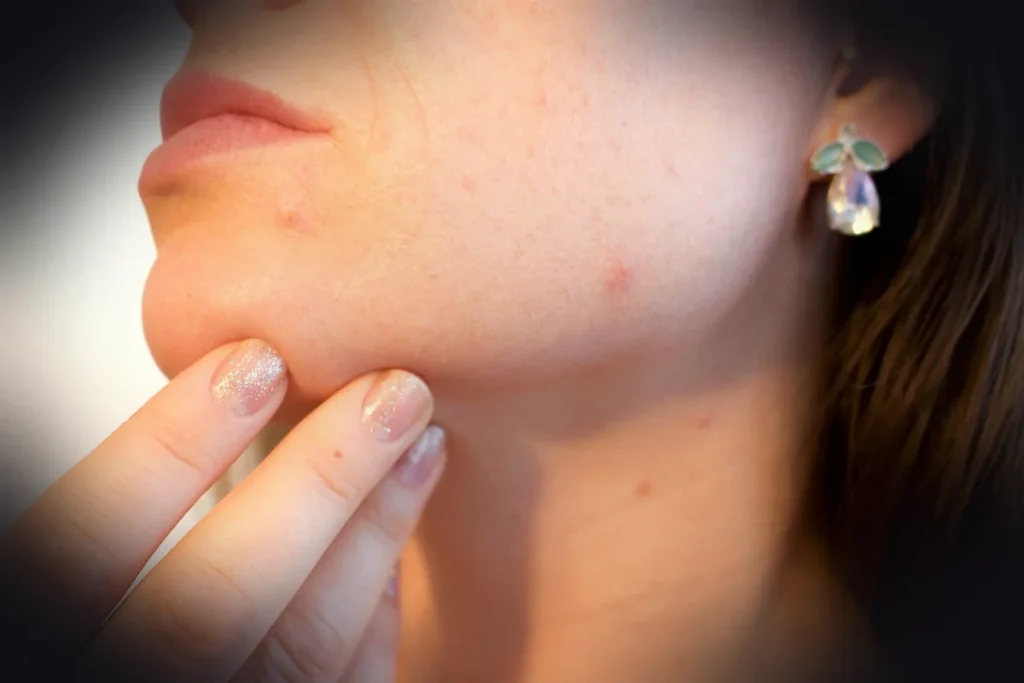
Common questions about face mapping
Is face mapping based on science?
The traditional version (forehead = liver, cheek = lungs, etc.) is not supported by dermatology research. It comes from Mien Shiang, a Chinese face-reading practice not intended as medical diagnosis. The actual reasons acne clusters by zone are mostly mechanical (hair products, friction, phone contact) or hormonal (jawline and chin specifically). The one valid correlation: jawline acne in adult women is strongly hormonal.
Why do I always break out on my chin?
Three main causes. First: hormonal — luteal-phase progesterone shifts, perimenopause, PCOS. Chin and jawline are the textbook hormonal acne zones in adult women. Second: lip balm and toothpaste migration — both can trigger perioral dermatitis or comedonal acne in this area. Third: chin-touching (we all do it more than we realize) transfers bacteria and friction from hands.
Why is forehead acne so common?
The most common cause is pomade acne — hair products (silicones, oils, leave-in conditioners, dry shampoo) running onto the forehead from the hairline. This is the single most fixable forehead-acne cause and the most ignored. Second cause: trapped sweat under hats, helmets, or fringe. Third: fringe friction itself. Take your hair off your face for two weeks and see what happens — most people see major improvement.
Does cheek acne mean I have lung problems?
No. Zero clinical evidence links cheek acne to respiratory or digestive health. The real cheek-acne causes are mechanical: pillowcase residue (wash weekly minimum), phone bacteria (you press a touched-all-day surface against your face), unwashed makeup brushes, and mask line / chin strap pressure. Try the one-side test: which side of your face do you sleep on / hold your phone to? Compare the two cheeks — that's usually your answer.
When should I see a dermatologist about acne?
If you have deep cystic acne (painful nodules under the skin), scarring acne, or moderate-to-severe acne that hasn't improved after 12 weeks of consistent over-the-counter actives (benzoyl peroxide, salicylic acid, or topical retinoid). Also: sudden severe acne in adulthood, especially with other hormonal symptoms (irregular cycles, facial hair, weight changes) — that's an endocrine workup, not a face wash problem.
Does diet cause acne in specific face zones?
Diet can influence acne overall — high-glycemic foods and skim dairy have the strongest evidence — but no peer-reviewed study has linked specific foods to specific face zones. If your forehead breaks out after pizza, the pizza didn't go to your forehead; the systemic inflammation contributes globally and the localized cause is something else (probably hair-product migration or friction in that area).