Free tool · personalized retinoid pick
Retinol strength selector — which one is actually right for you?
"Retinoid" covers eight different ingredients at strengths from 0.025% to 1%. The wrong starting strength is the #1 reason people quit retinoids within a month — too weak and you waste 6 months seeing nothing; too strong and you burn your barrier. Eight questions; we return the right retinoid family, the right starting strength, the ramp-up schedule, and specific brand picks at three budget tiers.
Retinoids are the most-evidence-based anti-aging ingredient in dermatology — but the category covers everything from prescription tretinoin (the gold standard) to weak retinyl palmitate (mostly cosmetic). The potency ladder, roughly: tretinoin > tazarotene > adapalene > retinaldehyde > retinol > retinyl palmitate. Each step down is approximately 10x weaker. Starting at the wrong rung is the most common reason people fail with retinoids — too high and you peel for weeks then quit, too low and you see nothing in 6 months and conclude they don't work.
The retinoid family — strongest to weakest
Tretinoin (Retin-A, all-trans retinoic acid) — prescription
The bioactive form. All other retinoids convert to this in the skin (with efficiency loss at each conversion step). Strengths: 0.025%, 0.05%, 0.1% creams; 0.01%, 0.025%, 0.05%, 0.1% gels. The gold standard for anti-aging and acne. Strong initial irritation typical. 12-16 weeks for visible improvements, 6-12 months for full effect. Pregnancy contraindicated.
Tazarotene (Tazorac) — prescription
Even stronger than tretinoin. Strengths: 0.05%, 0.1% creams. Used for acne and psoriasis. More irritating; rarely first-line. Pregnancy contraindicated.
Adapalene (Differin) — prescription and OTC
Differin 0.1% gel went OTC in the US in 2016 — major change. Approximately 1/3 to 1/2 the potency of tretinoin but much better tolerated. Stable in benzoyl peroxide (most retinols aren't). 0.3% adapalene is prescription. Strong evidence for acne; some evidence for aging.
Retinaldehyde (retinal) — OTC
One conversion step away from tretinoin in the skin — so approximately 1/10 to 1/20 as potent as prescription tretinoin. Significantly stronger and faster-acting than retinol but with much less irritation. Excellent middle option. Strengths: 0.025%, 0.05%, 0.1%. Brand examples: Avene RetrinAL, Medik8 Crystal Retinal.
Retinol — OTC
Two conversion steps away from tretinoin. Approximately 1/20 to 1/100 as potent as prescription tretinoin. Most common OTC retinoid. Strengths: 0.1%, 0.25%, 0.3%, 0.5%, 1%. Brand examples: The Ordinary Retinol in Squalane, Paula's Choice 1% Retinol Treatment, SkinMedica Retinol Complex.
Retinyl esters (retinyl palmitate, retinyl acetate, retinyl propionate) — OTC
Three conversion steps from tretinoin. Approximately 1/300 to 1/1000 as potent. Mostly cosmetic. If a product lists "retinol" but it's actually retinyl palmitate, expect minimal real-world benefit. Look at the INCI list — the actual active matters.
Bakuchiol — plant alternative
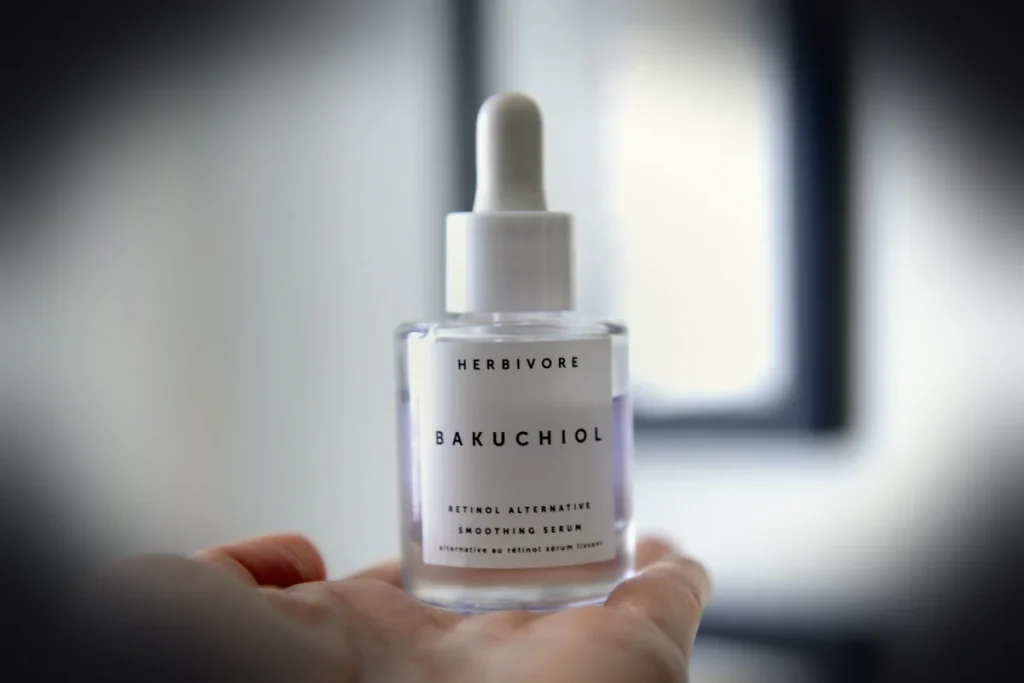
Not a retinoid chemically, but acts on similar pathways. Modest clinical evidence (~1/4 the effectiveness of retinol). Pregnancy-safe. Good option for retinol-intolerant skin or pregnancy. Brand examples: Herbivore Bakuchiol Retinol Alternative, Paula's Choice Bakuchiol.
Starting strength — the rule
The mistake is starting at the highest strength your skin can theoretically tolerate. The right approach: start at the lowest strength that produces noticeable (mild) irritation by week 4, ramp up by 4-week steps if tolerated. The skin retinizes over 4-12 weeks — building tolerance. Pushing too fast breaks the barrier.
The starter ladder for retinoid-naive users
- Most sensitive / rosacea-prone: bakuchiol 1% → retinaldehyde 0.025% → retinaldehyde 0.05% → retinaldehyde 0.1%
- Sensitive / first-time user: retinol 0.1% → retinol 0.25% → retinol 0.5% → retinol 1% (or up to retinaldehyde 0.05-0.1%)
- Normal / tolerant skin, anti-aging focus: retinol 0.25% → retinol 0.5% → retinol 1% → consider prescription tretinoin 0.025%
- Acne-focused: adapalene 0.1% OTC (Differin gel) — start daily after a tolerance week
- Skin of color with PIH focus: retinaldehyde 0.05% or adapalene 0.1% — both have less PIH-flare risk than higher retinol
Frequency ramp-up schedule
Frequency matters as much as strength. The standard introduction:
- Week 1-2: 1-2 nights per week. Apply on completely dry skin (wait 15-20 min after washing).
- Week 3-4: 2-3 nights per week if no irritation. If irritation, hold or step back.
- Week 5-8: every other night if tolerated.
- Week 9-12: nightly if tolerated.
- Week 16: consider stepping up strength or moving to next category in the ladder.
The sandwich method reduces irritation dramatically: thin layer of moisturizer → retinoid → second layer of moisturizer. Especially useful for first 4-8 weeks.
What to expect — the retinization phase
- Weeks 1-4: dryness, peeling, mild redness expected. This is normal retinization, not failure. Drop frequency if severe.
- Weeks 4-8: skin adjusts; peeling subsides. Initial acne purge (existing micro-comedones surfacing) may occur during this window.
- Weeks 8-12: first visible improvements — smoother texture, smaller pores, brighter tone.
- Weeks 12-24: pigmentation and fine line improvements visible.
- 6-12 months: collagen-driven changes — firmness, deeper line softening.
Combining retinoids with other actives
- AHA/BHA: never same night. Alternate nights or use skin cycling.
- Vitamin C: AM works fine. Same PM routine generally OK but adds irritation potential — separate by AM/PM.
- Niacinamide: pairs well, can layer same night.
- Hyaluronic acid / hydrating serums: pairs well; "sandwich" method.
- Benzoyl peroxide: most retinols are oxidized by BPO. Use BPO in AM, retinol in PM. Adapalene 0.1% is stable with BPO — Epiduo is a prescription combination product.
- Azelaic acid: pairs well, often used together for acne and pigmentation.
Hard contraindications
- Pregnancy and breastfeeding: all topical retinoids are contraindicated. Use azelaic acid 15-20% or bakuchiol as alternatives.
- Active eczema or perioral dermatitis flare: pause retinoid until skin is calm.
- Sun exposure planned: retinoids increase photo-sensitivity. Use PM only; mineral SPF daily; pause 5-7 days before significant sun (vacation, beach).
- Concurrent oral isotretinoin: skip topical retinoids.
The "retinol uglies" — why people quit at week 6
Acne purge plus mild peeling makes weeks 4-8 the hardest part of starting retinoids. Skin can briefly look worse before it gets better — existing micro-comedones surface, dead skin sheds in patches, fine lines look more visible from dryness. The protocol that helps:
- Drop frequency to 1-2x weekly
- Sandwich method with extra moisturizer
- No other actives — just retinoid + ceramide moisturizer + sunscreen
- Photo-document weekly under consistent lighting
- Push through to week 10-12 before judging results
Most people who quit retinoids do so during weeks 4-8. Those who push through usually see the first visible improvement by week 12 and the major change by month 6.
Common questions
What strength of retinol should a beginner start with?
For a first-time user with no known sensitivities: retinol 0.1-0.25%, applied 2 nights per week to start, building up to every other night over 8-12 weeks. The Ordinary Retinol 0.2% in Squalane ($11) is a good starter at the budget tier. After 12 weeks of tolerance, step up to 0.5%. Sensitive skin or rosacea: start with retinaldehyde 0.025% or bakuchiol instead — both gentler than retinol with comparable benefit at the lower end. Avoid starting with 1% retinol — too aggressive for most beginners and the leading cause of "retinol uglies" that make people quit.
Is retinaldehyde better than retinol?
Retinaldehyde (retinal) is one conversion step closer to active tretinoin in the skin, making it approximately 10-20x more potent than retinol at the same percentage but with similar or less irritation. So 0.05% retinaldehyde is roughly equivalent to 0.5-1% retinol in effect but with better tolerability. It's an excellent middle option between OTC retinol and prescription tretinoin. Brands: Avene RetrinAL 0.05 ($45), Medik8 Crystal Retinal ($55-80). The downside is cost — retinaldehyde is more expensive than retinol.
How long does it take to see results from retinol?
Visible texture and tone improvements: 8-12 weeks. Pigmentation fading: 12-16 weeks. Fine line improvement: 16-24 weeks. Collagen-driven changes (firmness, deeper line softening): 6-12 months. The "retinol uglies" phase of weeks 4-8 (dryness, possible purge) is the most common reason people quit before results show. Pushing through to week 12 minimum is critical. Photo-document weekly under consistent lighting — changes are easier to see in comparison than day-to-day.
Can I use retinol during pregnancy?
No. All topical retinoids — tretinoin, tazarotene, adapalene, retinaldehyde, retinol, retinyl esters — are contraindicated during pregnancy and generally during breastfeeding. Oral isotretinoin is strongly teratogenic (causes birth defects); the topical risk is theoretically much lower but still avoided. Pregnancy-safe alternatives: bakuchiol 1% (plant retinol-mimic, ~1/4 effectiveness of retinol but no contraindication), azelaic acid 15-20% (for acne and pigmentation), vitamin C (for brightening), niacinamide (for tone and barrier support).