Free tool · paste-and-check
Pregnancy-safe skincare checker by trimester.
"Pregnancy-safe" is more nuanced than most lists make it sound. Some actives are off-limits the entire pregnancy. Others are conditional by trimester. Some are conditional by breastfeeding. Some you'd never guess (like high-dose salicylic acid in body washes). Paste your routine — we tell you what to pause, what to swap, and what's actually fine, by your specific stage.
Pregnancy changes what your skin needs and what your skin can tolerate. About 60% of pregnant people develop a new skin concern (melasma, hormonal acne, sensitivity, hyperpigmentation) — and the same actives that would solve those concerns in a non-pregnant body (retinoids, hydroquinone, strong salicylic acid) are off-limits. The "what can I use" question has clear evidence-based answers, but they\'re scattered across OB literature, dermatology consensus, and country-specific regulatory guidance.
The clear no-go list (entire pregnancy)
Strong consensus across ACOG (American), UK Teratology Information Service, and Australian NDPSC:
- All topical retinoids — tretinoin (Retin-A), adapalene (Differin OTC), tazarotene. The teratogenic risk evidence is strongest for oral retinoids, but topical retinoids carry enough systemic absorption that all major guidelines list them as contraindicated.
- Oral retinoids — isotretinoin (Accutane), acitretin. Absolute contraindication. Severe teratogenic risk.
- Hydroquinone — used for hyperpigmentation. 35-45% systemic absorption when applied topically. Off-limits during pregnancy and breastfeeding per most guidelines.
- Salicylic acid above 2%, including high-strength chemical peels and body washes with concentrated BHA. Low-strength facial cleansers (under 2%) are generally considered acceptable but skip in the first trimester to be conservative.
- Oral tetracyclines (doxycycline, minocycline) — commonly prescribed for rosacea and acne. Off-limits for the duration of pregnancy and breastfeeding due to fetal/infant bone development risk.
- Hydrocortisone above 1% long-term or on large body areas. Brief use on small areas is acceptable.
- Topical minoxidil (for hair loss). Off-limits.
The yes-go list (pregnancy-safe alternatives)
- Azelaic acid 10-20% — the workhorse pregnancy active. Anti-acne, anti-rosacea, anti-PIH, anti-melasma. Naturally produced by skin yeast, minimal systemic absorption. See our AzA finder.
- Niacinamide 5% — anti-inflammatory, brightening, oil control. Safe throughout pregnancy and breastfeeding.
- Glycolic acid 5-10% — at low concentrations, acceptable per ACOG guidance. Higher percentages (15%+ professional peels) skip.
- Lactic acid 5-10% — same low-concentration rule as glycolic.
- Hyaluronic acid — completely safe. Hydration baseline.
- Vitamin C (L-ascorbic acid, MAP, SAP) — safe throughout. Useful for melasma + general brightness when retinoids are off-limits.
- Ceramides, peptides — safe, hydrating, barrier-supportive.
- Sunscreens — mineral (zinc oxide, titanium dioxide) recommended. Chemical filters are generally considered safe but several pregnant patients prefer mineral.
- Benzoyl peroxide 2.5-5% — generally considered acceptable in spot treatment for acne. Some practitioners advise pausing in the first trimester out of conservatism.
- Tranexamic acid topical — emerging evidence supports safety, particularly useful for pregnancy-onset melasma.
The conditional / trimester-specific list
Some actives are acceptable in some trimesters but not others, or in some doses but not others. This is where most online lists oversimplify.
First trimester (weeks 1-12)
The highest sensitivity period — fetal organ formation. Most conservative approach: pause anything ambiguous. Salicylic acid even at 2% in cleansers, low-strength AHAs, and benzoyl peroxide all get paused by some practitioners in this trimester. Default to: cleanser, moisturizer, sunscreen, and azelaic acid if needed for acne or pigmentation.
Second trimester (weeks 13-27)
Lower sensitivity window. Most of the "yes-go" list expands. Mild AHA peels (under 30%) are sometimes considered acceptable. Most pregnancy-onset melasma protocols start here, using azelaic acid + niacinamide + tranexamic acid + sunscreen.
Third trimester (weeks 28-40)
Similar to second. The main consideration: anything that would be problematic for the newborn if absorbed pre-delivery should be tapered before delivery. Most topical skincare is fine throughout, but heavy systemic actives (oral antibiotics including tetracyclines) should be wound down per the OB\'s instructions.
Breastfeeding considerations
Most pregnancy-safe topicals remain safe during breastfeeding. The main additions to the no-go list during nursing:
- Retinoids — still off-limits during breastfeeding due to systemic absorption
- Hydroquinone — still off-limits
- Tetracyclines — off-limits during nursing of infants under 8
- High-strength salicylic acid — pause during nursing
- Topical steroids — avoid application to chest/breast area before nursing sessions
Common pregnancy skin concerns and what to use
Pregnancy melasma ("chloasma" or "mask of pregnancy")
The pattern of brown patches on the cheeks, forehead, and upper lip during pregnancy. Triggered by estrogen + progesterone + sun exposure. Treatment during pregnancy: azelaic acid + tranexamic acid + niacinamide + daily mineral SPF 30+ with iron oxides. Most cases improve postpartum, but daily SPF + iron-oxide-tinted protection is critical because visible light is a major trigger.
Pregnancy acne
Common in the first and second trimesters. Treatment: azelaic acid 10-20% + low-strength glycolic in cleanser + non-comedogenic moisturizer + mineral SPF. Skip benzoyl peroxide in the first trimester if conservative; otherwise spot treatment is acceptable. Severe cases that warrant oral treatment in non-pregnant patients require OB + dermatology coordination — sometimes oral erythromycin is used cautiously.
Stretch marks (striae gravidarum)
Honest answer: no topical reliably prevents or treats stretch marks. The genetic component is dominant. Daily moisturization may marginally help skin elasticity. Tretinoin works on existing stretch marks (post-pregnancy only). Cocoa butter is a popular hope, with no real evidence of efficacy.
Itchy belly / pregnancy itching
Common from skin stretching. Treatment: heavy ceramide moisturizers, oatmeal-based balms. If itching is severe, generalized, or worst on palms/soles, see your OB — it could be intrahepatic cholestasis of pregnancy, which needs medical management.
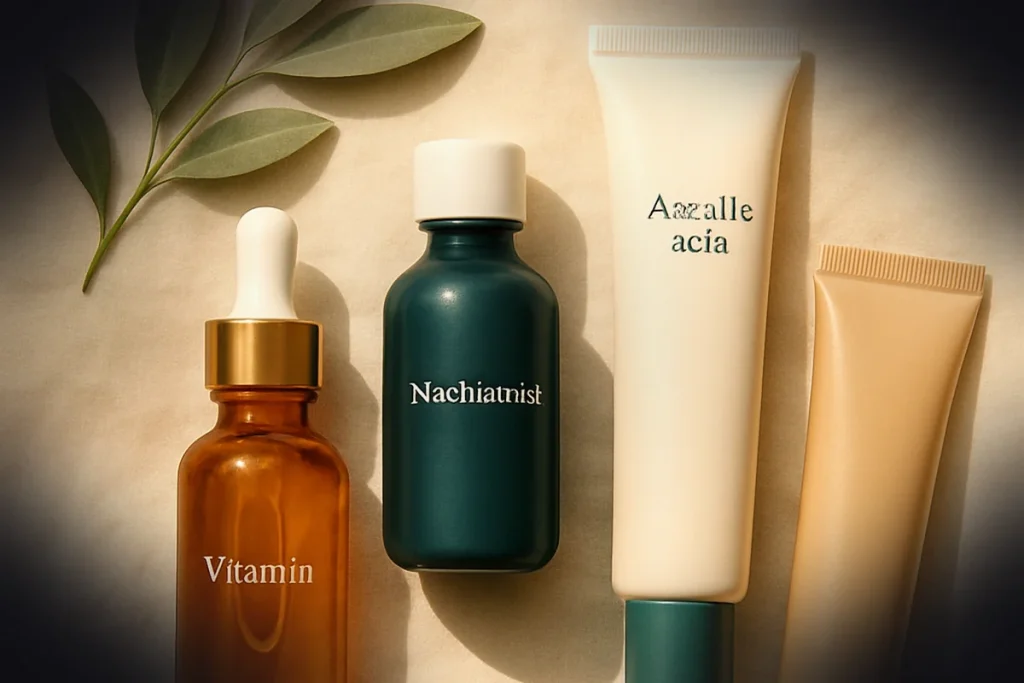
Common questions about pregnancy skincare
What skincare ingredients should I avoid during pregnancy?
All retinoids (tretinoin, adapalene, tazarotene, retinol), hydroquinone, salicylic acid above 2%, oral tetracyclines (doxycycline, minocycline), topical minoxidil, and oral isotretinoin. Some practitioners also recommend pausing benzoyl peroxide in the first trimester. The safest alternatives that handle the same concerns: azelaic acid (anti-acne, anti-pigment, anti-rosacea), niacinamide, low-strength glycolic acid, hyaluronic acid, vitamin C, ceramides.
Is azelaic acid safe during pregnancy?
Yes — azelaic acid is one of the very few active ingredients explicitly considered safe by ACOG, the UK Teratology Information Service, and Australian guidelines throughout pregnancy and breastfeeding. It\'s naturally produced by yeast on healthy skin, has minimal systemic absorption, and is often the only workable option for managing pregnancy acne, melasma, or rosacea since retinoids and hydroquinone are off-limits. See our azelaic acid finder for protocol details.
Can I use vitamin C during pregnancy?
Yes — topical vitamin C (L-ascorbic acid 10-15%, MAP, SAP) is considered safe throughout pregnancy and breastfeeding. It\'s particularly useful during pregnancy because retinoids and hydroquinone are off-limits, leaving vitamin C as one of the strongest remaining brightening and antioxidant options. Pair with daily mineral SPF for synergistic effects on pregnancy melasma.
What about pregnancy melasma — how do I treat it?
Combination approach: azelaic acid 10-20% (the safest pregnancy brightener) + tranexamic acid topical + niacinamide 5% + daily mineral SPF 30+ with iron oxides (the iron oxides block visible light, which is a major melasma trigger). Hydroquinone and retinoids — the standard non-pregnancy melasma options — are off-limits. Most pregnancy melasma improves postpartum but persistent cases benefit from continued treatment after the baby arrives.