Free tool · personalized 4-night schedule
Skin cycling calculator — your personalized rotation.
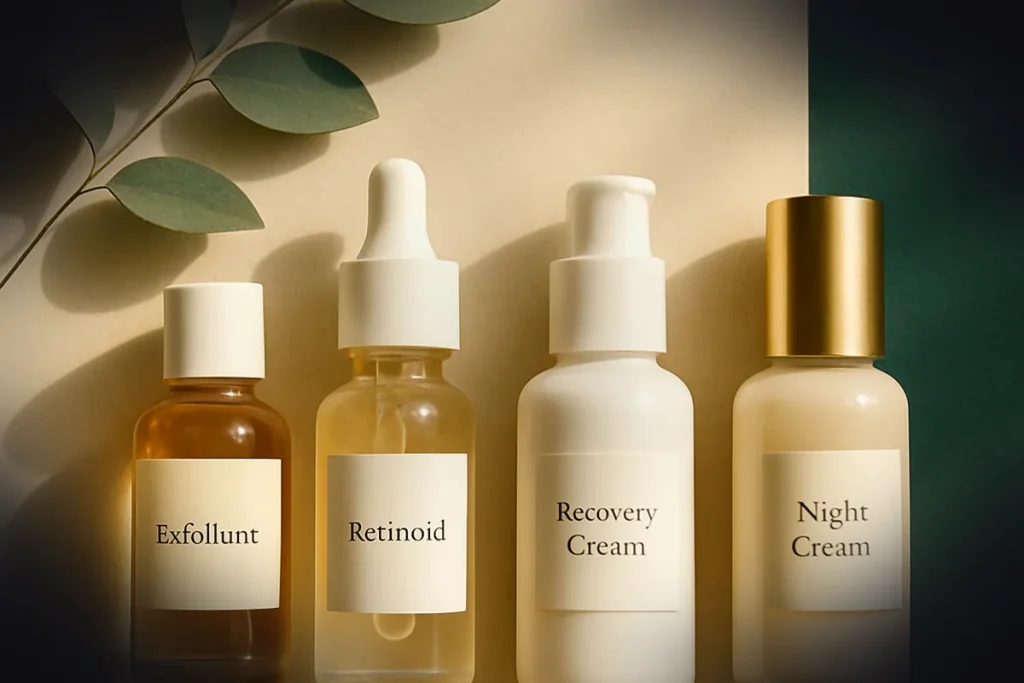
Skin cycling is a 4-night rotation: exfoliate, retinoid, recover, recover. It works because skin needs recovery time between active ingredients — not back-to-back hits. Most viral cycling guides assume you've been using actives for years. This calculator adjusts the schedule for your tolerance, current routine, and main concern. Eight questions; a night-by-night plan with specific product picks at three budget tiers.
Skin cycling is one of the few skincare trends with solid logic behind it. The 4-night rotation — exfoliant, retinoid, recovery, recovery — alternates active ingredients with rest nights so the skin barrier can repair between hits. Dermatology has used this principle for decades; the rebrand made it accessible to home users. The mistake most beginners make is starting with the full pro rotation when they've never used either active. This calculator adjusts the cycle for your actual tolerance.
The principle: actives need recovery time
Two of the most-effective skincare ingredient categories — chemical exfoliants (AHA, BHA) and retinoids — both disrupt the skin barrier as part of how they work. Exfoliants thin the dead-cell layer; retinoids accelerate cell turnover. Used daily, they exceed the skin's ability to recover, causing irritation, redness, peeling, and often a permanent sensitivity. Used in rotation with recovery nights, both deliver visible results without breaking the barrier.
The standard cycle popularized by dermatologist Whitney Bowe in 2022 runs four nights:
- Night 1 — Exfoliation: AHA (glycolic, lactic) or BHA (salicylic) cleanses dead cells and unclogs pores.
- Night 2 — Retinoid: prescription tretinoin or OTC retinol. Cellular turnover and collagen support.
- Night 3 — Recovery: just cleanser + hydrating serum + moisturizer. No actives.
- Night 4 — Recovery: same as night 3.
- Then repeat.
Beginner adjustments — most people should NOT start with the pro cycle
The Bowe cycle assumes years of active-ingredient tolerance. If you've never used a retinoid, jumping into one every fourth night is too aggressive. Start with a 7-night cycle:
- Night 1 — Exfoliant (lowest strength: lactic 5% or salicylic 0.5%)
- Night 2 — Recovery
- Night 3 — Retinol (lowest strength: 0.1-0.25%)
- Nights 4-7 — Recovery
After 4 weeks at this frequency without irritation, drop one recovery night. After 4 more weeks, drop another. Most people don't actually need to reach the full 4-night cycle — a 5- or 6-night cycle delivers most of the benefit with less risk.
Sensitive-skin and rosacea adjustments
For sensitive skin, rosacea, or compromised barriers, even the beginner cycle is too aggressive. A modified 10-14 day cycle is appropriate:
- One exfoliant night per week (lactic 5% or PHA only — never glycolic)
- One retinol night per week (retinaldehyde or encapsulated retinol)
- All other nights: barrier-repair recovery only
Rosacea: avoid daily glycolic acid even in cycling. BHA salicylic acid is generally tolerated. Retinoids should be introduced under dermatologist guidance — they can flare rosacea before they improve it.
What goes on recovery nights — and why "just moisturizer" misses the point
Recovery isn't passive. The goal is active barrier support so the skin gains ground between active nights. Recovery night routine:
- Gentle cleanser — cream or low-foaming, no exfoliating action.
- Hydrating serum on damp skin — hyaluronic acid, glycerin, panthenol, beta-glucan. Apply within 30 seconds of cleansing.
- Barrier-repair moisturizer — ceramides (CeraVe Moisturizing Cream, La Roche-Posay Toleriane), squalane, or niacinamide-based formulations.
- Occlusive in dry climates — thin layer of Aquaphor or petrolatum-based balm over the moisturizer in winter, only if your skin trends dry.
Niacinamide is a great recovery-night active because it's tolerated by almost everyone and actively supports the barrier rather than disrupting it. Add a 5% niacinamide serum to recovery nights for additional benefit without breaking the cycle.
Morning routine on a cycle
Cycling only changes PM. Mornings stay consistent regardless of which night phase you're in:
- Cleanser or rinse
- Antioxidant serum (vitamin C or niacinamide) — daily
- Moisturizer
- Mineral SPF 30+ — non-negotiable, especially during retinoid nights when skin is photo-sensitive
The single biggest reason cycling fails for new users is skipping morning SPF. Retinoids and AHAs both increase UV sensitivity. Daily mineral sunscreen is the foundation that makes everything else work.
When to NOT cycle
Cycling isn't for everyone. Skip it if:
- You're currently treating active acne with prescription benzoyl peroxide or topical antibiotics — these have their own rotation logic.
- You're using prescription tretinoin or tazarotene daily — these protocols don't need exfoliant nights on top.
- You have active eczema, perioral dermatitis, or sebderm — the barrier is already compromised; cycling can worsen it.
- You're pregnant or nursing — retinoids are contraindicated.
How long until results
- Weeks 1-2: skin should feel less irritated than daily active use. No visible change expected.
- Weeks 4-6: smoother texture; smaller-looking pores; less congestion.
- Weeks 8-12: visible improvement in pigmentation, fine lines, breakouts depending on your concern.
- Months 4-6: collagen-driven changes — firmness, finer pores, fewer fine lines. These are slow but durable.
Photo-document under consistent lighting at week 0, week 6, and week 12. Changes are easier to see in side-by-side than day-to-day.
Common questions
What is skin cycling?
Skin cycling is a 4-night PM routine that alternates active ingredients with recovery nights: night 1 is exfoliation (AHA or BHA), night 2 is retinoid, nights 3-4 are recovery (cleanser + moisturizer only). The cycle repeats. The principle is that active ingredients need barrier-recovery time between uses; back-to-back daily use exceeds the skin's repair capacity and causes irritation. The trend was popularized by dermatologist Whitney Bowe in 2022, but the underlying logic — alternating actives with recovery — has been used in dermatology for decades.
Does skin cycling actually work?
The principle is sound — alternating actives with recovery nights does protect the barrier and let exfoliants and retinoids work without causing chronic irritation. There aren't randomized trials comparing skin cycling specifically against other regimens, but the underlying science (barrier recovery time, retinization, controlled exfoliation) is well-established. Results are similar to other well-paced active routines: visible improvement in texture and pigmentation in 4-6 weeks, collagen-driven changes in 4-6 months. It works best for people who were over-using actives daily and burning their barriers.
Can beginners start with skin cycling?
Yes, but not with the standard 4-night cycle. Beginners should start with a 7-night cycle: one exfoliant night, one retinol night, five recovery nights. After 4 weeks without irritation, drop one recovery night to make a 6-night cycle. The standard 4-night cycle (one exfoliant, one retinoid, two recovery) is appropriate after 8-12 weeks of consistent active use. Skipping the easing-in phase is the most common reason people get retinoid-burn and quit.
Can you use niacinamide every night during skin cycling?
Yes — niacinamide doesn't disrupt the barrier and is actively beneficial on recovery nights. A 5% niacinamide serum on top of cleansed skin, under your moisturizer, on every night of the cycle is well-tolerated by almost everyone. Avoid combining niacinamide directly with pure L-ascorbic acid (vitamin C) due to potential interaction; if you use both, put niacinamide in PM and vitamin C in AM. Niacinamide pairs well with both exfoliant and retinoid nights as a barrier-supportive layer.