TL;DR: Centella asiatica is the plant. Asiatic acid, madecassic acid, asiaticoside, and madecassoside are four specific compounds inside that plant, each with different biology. The Korean skincare market has spent fifteen years isolating, concentrating, and labeling them, often interchangeably, often without clinical justification for the substitution. Here is what each one actually does, what the studies show, and how to read a centella label without falling for the marketing.
I have a folder of Korean centella products from the last four years. The labels alone are an education. One brand lists “Centella asiatica extract” at three percent. Another lists “madecassoside” at point-one percent. A third lists “asiaticoside” at two percent. A fourth, my favorite, lists all four triterpenoids plus a separately-named ratio called “Cica complex” that is not on the INCI list of any other product I own. They are all marketed for the same use. They are not the same product.
This piece is about that gap. Centella asiatica is one of the most heavily marketed botanicals in skincare, and the variant question is one that most consumer-facing copy avoids because the answer is complicated and the marketing is cleaner if it is not. The four major active compounds inside the plant have different molecular weights, different penetration profiles, different proposed mechanisms, and meaningfully different evidence bases. They are sometimes interchangeable. They are sometimes not. And the percentage that matters is not the centella percentage on the label. It is the percentage of the specific compound the formula contains.
What centella asiatica actually is
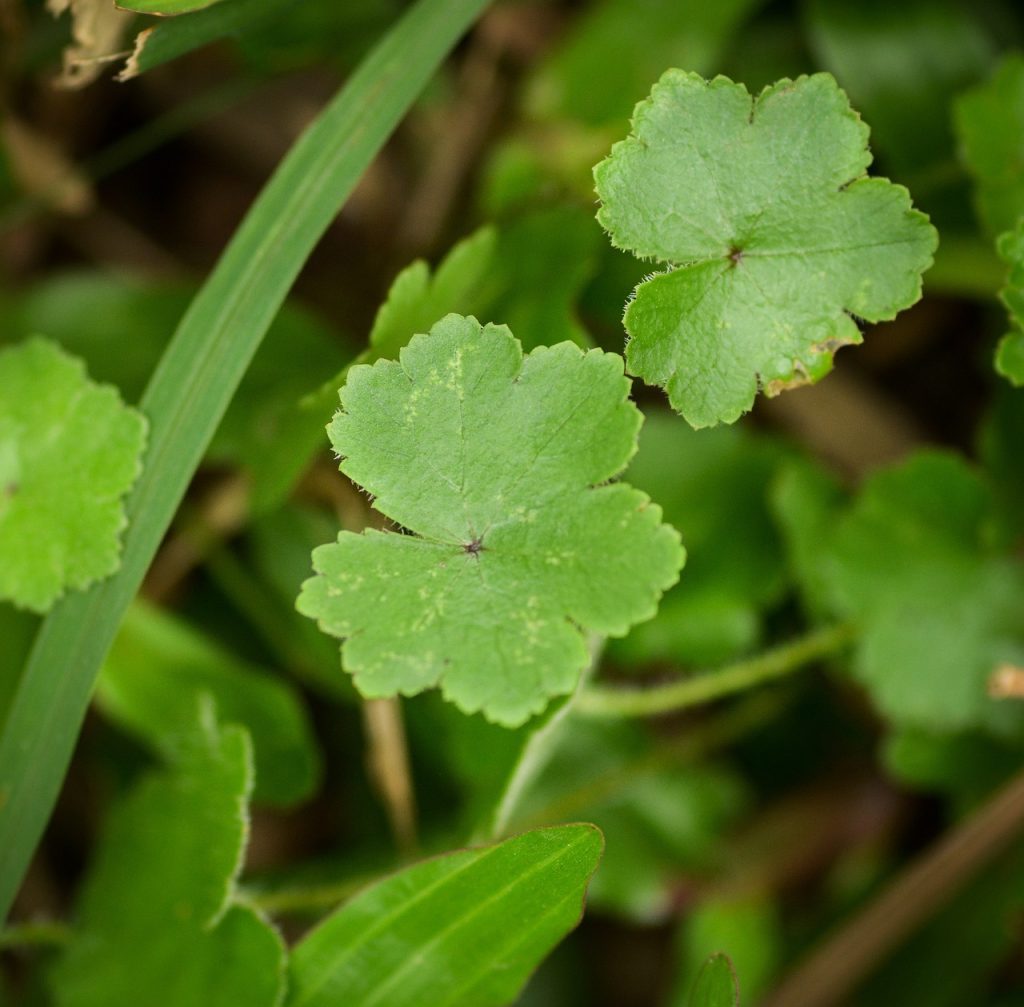
Centella asiatica is a perennial herb in the Apiaceae family. It grows across South and Southeast Asia, has been used in traditional medicine systems for centuries, and contains a class of compounds called pentacyclic triterpenoids that are responsible for most of its dermatologic effect. The four most studied of these triterpenoids are asiatic acid, madecassic acid, asiaticoside, and madecassoside.
The relationship between the plant and these compounds is the key chemistry to understand. Asiaticoside is asiatic acid with a sugar attached. Madecassoside is madecassic acid with a sugar attached. The sugar-bearing forms are called glycosides; the sugar-free forms are called aglycones. The glycosides are typically more water-soluble and have different penetration behavior than the aglycones. In the plant, all four occur together in varying ratios depending on the cultivar, growing conditions, and extraction method.
A whole-plant Centella asiatica extract contains all four, plus a number of other compounds, in ratios that depend on what part of the plant was used and how it was processed. An “asiaticoside-standardized” extract has been processed to a defined percentage of that single compound. A “TECA” preparation (titrated extract of Centella asiatica) is the standardized pharmaceutical-grade version, with a defined ratio of asiatic acid, madecassic acid, and asiaticoside, used clinically in some European markets for wound healing.
This matters because “Centella asiatica extract” on an INCI list could be any of these things at any concentration of any active. Without further specification, it is not a meaningful claim about the formula.
What the studies actually show
The wound-healing literature on centella is the strongest part of the evidence base. Somboonwong and colleagues’ 2012 animal study (PMID: 22817824) compared different extract preparations in incision and burn wound models. The whole-plant ethanolic extract and the asiaticoside-enriched fraction both accelerated healing. The asiaticoside-enriched fraction showed faster collagen organization at the wound site. This is in line with the broader animal and tissue-culture literature, which has consistently shown that asiaticoside and madecassoside upregulate collagen I and III synthesis at the wound bed.
Bonté and colleagues’ 1994 paper (PMID: 8202564) is one of the foundational studies on the specific collagen biology. They tested asiatic acid, madecassic acid, and asiaticoside on human fibroblast cultures and measured collagen I synthesis. All three increased collagen production. Asiatic acid and madecassic acid (the aglycones) produced larger effects per unit dose than asiaticoside (the glycoside). This is one of the few head-to-head molecular-level comparisons in the literature, and it suggests that the aglycones, when they reach the fibroblasts, are more potent. The catch is that the aglycones penetrate skin differently than the glycosides, so the in-vitro potency does not directly translate to in-vivo efficacy.
Ratz-Łyko, Arct, and Pytkowska’s 2016 paper (PMID: 27168678) is the closest thing to a consumer-relevant clinical study. They tested a cosmetic formulation containing Centella asiatica extract for moisturization and anti-inflammatory properties in healthy human volunteers. The formula improved hydration and reduced TEWL compared with vehicle, and the effect was attributed to the centella component. The trial did not separate which specific triterpenoid was driving the effect. This is the typical limitation of the cosmetic literature: the studies are on the finished product, not on the isolated active.
Bylka and colleagues’ 2013 cosmetology review (PMID: 24278045) summarizes the larger picture. The dermatologic uses with the best evidence are wound healing, scar management, and anti-inflammatory support in compromised barrier states. The proposed mechanisms include collagen synthesis upregulation, anti-inflammatory effects via TNF-alpha and interleukin modulation, and modest antioxidant activity. The review is honest about the limits: most clinical trials are small, the formulations are heterogeneous, and head-to-head comparisons of the different triterpenoids in humans are rare.
Hashim and colleagues’ 2011 paper (PMID: 21278681) is useful background on the compositional variability of the plant itself. Different Centella asiatica cultivars produce different ratios of the four major triterpenoids, and the growing region affects the totals as well. The Madagascar-sourced material that drove much of the European pharmaceutical literature has a different profile than the Indonesian and Sri Lankan material that drives much of the Korean cosmetic supply. This is the kind of detail that the consumer-facing marketing skips entirely.
How the Korean market changed the conversation
The Korean cosmetics industry took centella, which was already a well-established botanical in European pharmacy, and did something specific with it. They isolated, concentrated, and branded the individual triterpenoids in ways that the European pharmaceutical market had not. The “Cica” naming convention, the asiaticoside-percentage labels, the madecassoside-only serums, and the four-triterpenoid complexes that appear on shelves in Seoul are the result.
Some of this isolation is real chemistry, and some of it is marketing repackaging of compounds that may not need to be isolated to do the work. The clinical evidence for the whole-plant extract is strong. The clinical evidence for isolated madecassoside as a superior alternative to the whole extract is thinner. The clinical evidence for the four-triterpenoid complex as superior to a well-formulated whole-plant extract is, as far as I can find, absent from the peer-reviewed literature in any defensible form. The marketing claims often run ahead of the comparative data.
What the Korean market did get right, in my view, is the formulation work. The vehicle matters in centella products as much as the active. A poorly formulated whole-plant extract in a stripped, alcohol-heavy base may deliver less than a well-formulated single-triterpenoid serum in a barrier-supportive vehicle. The Korean brands that have invested in formulation have produced products that work well clinically, even when the active-percentage claims on the label are not directly comparable across brands.
The aglycone-glycoside question
This is the chemistry detail that the consumer marketing rarely addresses. Asiaticoside and madecassoside are larger molecules than asiatic acid and madecassic acid. They are more water-soluble and have different membrane-penetration kinetics. In the skin, glycosides are slowly hydrolyzed to their aglycone forms by endogenous enzymes, so a glycoside applied topically can act as a slow-release reservoir of the aglycone over time. This is potentially useful from a formulation standpoint: a madecassoside serum may deliver madecassic acid to the fibroblasts over a longer window than a madecassic acid serum, because the slow hydrolysis effectively extends the residence time.
This is, however, a mechanism inference, not a clinically demonstrated head-to-head outcome difference. We do not have a randomized trial of madecassoside versus madecassic acid in human skin over time. We have in-vitro data showing different penetration profiles and an assumption that this translates to different clinical effect. It might. The honest framing is that we do not know.
The asiaticoside-versus-madecassoside question has a similar gap. Both are well-tolerated. Both have collagen-upregulating effects in tissue culture. The choice between them in a consumer product is largely driven by supply, formulation preferences, and marketing rather than by demonstrated superior efficacy of one over the other.
What this means for picking a product
The single most useful question you can ask of a centella product is: what is the specific compound and what is the percentage. “Contains Centella asiatica extract” is not informative. “Five percent Centella asiatica extract standardized to ten percent asiaticoside” is informative. “Point-two percent madecassoside” is informative. The combination products are harder to evaluate because the percentages of individual triterpenoids are often not disclosed.
For barrier-compromised skin recovering from over-exfoliation, retinoid retinization, or a recent flare, a whole-plant extract at three to five percent in a supportive base is the default I reach for. The Etude House Soonjung line and the Cosrx Cicapair products are reasonable consumer-grade approximations. I am not endorsing these specifically; the formulations change and the company orientations shift.
For more targeted use on scars, post-acne marks, or post-procedural recovery, the isolated triterpenoid serums have a plausible case. Asiaticoside-standardized or madecassoside-standardized formulations at the higher concentrations the Korean market sells (point-one to point-five percent of the isolated compound) are the closest consumer products to the clinical pharmaceutical preparations.
For routine “cica” use as a calming additive in a daily routine, the difference between a well-formulated whole-plant extract and an isolated triterpenoid is probably modest. The bigger variables are the rest of the formulation, the fragrance load, and whether the product is being asked to do too much in combination with other actives.
The honest uncertainty
The clinical comparative data is thinner than the marketing suggests. We have decent evidence that centella, across the preparations that have been tested, is useful for wound healing, barrier support, and anti-inflammatory effect in compromised skin. We have weaker evidence that isolated madecassoside is superior to whole-plant extract for cosmetic skin uses. We have very thin evidence on the relative merits of the four-triterpenoid complex versus a well-formulated single-active or whole-plant product.
This does not mean the products do not work. It means the rank ordering between products in the same category is harder to defend on evidence than the marketing implies. A Korean cica essence and a European whole-plant centella cream may produce similar clinical outcomes despite labeling differences. The differences within the centella category are smaller than the differences between centella and a vehicle-only comparator.
What I would tell my past self
Read the actual INCI, not the marketing copy. The compound that matters is the one named on the ingredients list with a percentage attached, not the one named on the front of the bottle in stylized type. “Cica” is a marketing term. The chemistry is in the back-of-pack.
For most everyday barrier-support and post-flare recovery use, a whole-plant centella extract at three to five percent is a perfectly reasonable choice and does not need to be replaced with an expensive isolated-triterpenoid product. The marginal benefit of isolation, at consumer-relevant concentrations, is not well-demonstrated in human trials.
For targeted scar or post-procedural use, the isolated triterpenoids have a stronger theoretical case and are worth the modest premium. The pharmaceutical-grade TECA preparations have the best evidence in this category, and they are available in some European markets without prescription.
The Korean market has done good formulation work. The marketing has run ahead of the comparative data. Both things are true. The path through is to pay attention to the rest of the formulation, the vehicle, the fragrance load, and the rest of the routine the product is going into, not to chase the latest triterpenoid name.
FAQ
Is madecassoside better than asiaticoside?
Not on the available human evidence. Both upregulate collagen synthesis in tissue culture. Both are well-tolerated topically. The marketing differentiation often runs ahead of the comparative clinical data, which is sparse.
Can I use centella with retinol?
Yes. Centella is one of the better botanicals to pair with retinoid retinization. The anti-inflammatory effect can blunt the initial irritation period without interfering with the retinoid’s mechanism.
How long until I see results from a centella product?
For barrier recovery and post-flare calming, days to two weeks. For scar or pigmentation effects, the evidence supports four to twelve weeks, and the effect is modest. Centella is not a fast-acting active for scar revision.
What is the difference between “cica” and “centella” on a product label?
“Cica” is a marketing term derived from “cicatrize” (to scar over) and refers to Centella asiatica-based products generally. There is no chemical difference between a product labeled “cica” and one labeled “centella.” The compound on the INCI list is what matters.
Is the four-triterpenoid complex worth the premium price?
Probably not, on the available evidence. A well-formulated whole-plant extract contains all four triterpenoids in natural ratios. The clinical superiority of the standardized complex over a good whole-plant formulation has not been demonstrated in head-to-head human trials.
Related Elelaf tools
Sources
- Bylka W, Znajdek-Awiżeń P, Studzińska-Sroka E, Brzezińska M. ‘Centella asiatica in cosmetology.’ Postępy Dermatologii i Alergologii, 2013;30(1):46-49. PMID: 24278045.
- Somboonwong J, Kankaisre M, Tantisira B, Tantisira MH. ‘Wound healing activities of different extracts of Centella asiatica in incision and burn wound models: an experimental animal study.’ BMC Complementary and Alternative Medicine, 2012;12:103. PMID: 22817824.
- Ratz-Łyko A, Arct J, Pytkowska K. ‘Moisturizing and antiinflammatory properties of cosmetic formulations containing Centella asiatica extract.’ Indian Journal of Pharmaceutical Sciences, 2016;78(1):27-33. PMID: 27168678.
- Bonté F, Dumas M, Chaudagne C, Meybeck A. ‘Influence of asiatic acid, madecassic acid, and asiaticoside on human collagen I synthesis.’ Planta Medica, 1994;60(2):133-135. PMID: 8202564.
- Hashim P, Sidek H, Helan MH, et al. ‘Triterpene composition and bioactivities of Centella asiatica.’ Molecules, 2011;16(2):1310-1322. PMID: 21278681.
Related: Snail mucin filtrate: the glycoprotein profile most reviews skip.
References
- Bylka W, Znajdek-Awizen P, Studzinska-Sroka E, Brzezinska M. Centella asiatica in cosmetology. Postepy Dermatol Alergol. 2013. PubMed.
- Won JH, Shin JS, Park HJ, et al.. Anti-inflammatory effects of madecassic acid. Phytother Res. 2010. PubMed.
Have a question about “The Centella variants: Centella asiatica vs Madecassoside vs Asiaticoside”?
Ask our editorial desk. Best questions become full follow-up articles, reviewed by our medical reviewer. No medical advice given in private — answers run as articles or not at all.