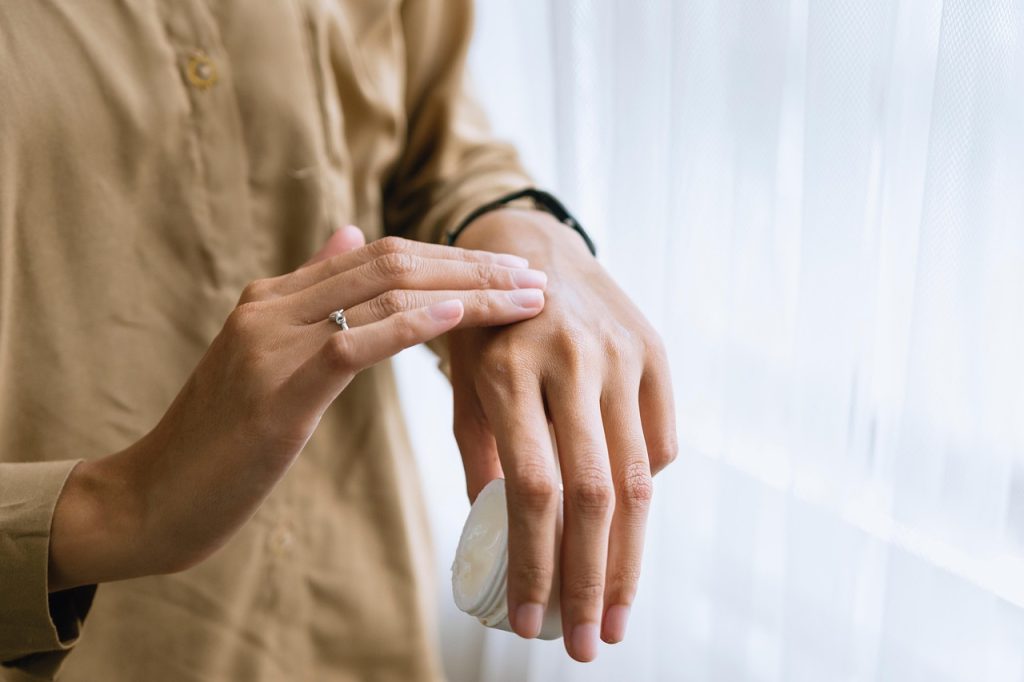
TL;DR: The fastest-growing patient population I see for barrier damage is teenagers. Twelve and fourteen year olds with the same constellation of redness, perioral irritation, and inflammatory acne, all of them using three or four actives a day they learned about on TikTok. The studies that justified those actives were not done on developing skin. Here is what we actually know, what we do not, and how to course-correct.
A reader’s daughter, fourteen, came in last fall with what her pediatrician had called rosacea. It was not rosacea. It was the predictable result of an eight-step routine the patient had assembled from social media. Salicylic cleanser, BHA toner, niacinamide serum, vitamin C in the morning, glycolic exfoliant three nights a week, retinol on alternate nights, and a benzoyl peroxide spot treatment used over the whole face because, in her words, the acne kept coming back. Her mother had asked her to stop. She had not stopped.
The skin that walked into the clinic was inflamed, papular, with a perioral component and a barrier that had not been intact in months. We took her off everything for six weeks. The acne resolved. The redness resolved. The cycle she had been in was not an acne cycle. It was a damage cycle disguised as one.
I am writing this piece because she is not unusual. She is the median teenage patient I see now, and the dermatology literature has not caught up to what the over-the-counter consumer market has made available to twelve to sixteen year olds in the last five years. The studies that produced the actives in those products were not done on her skin. The recommendations she is reading online are not from people who treat developing skin. And the people selling her the products are not, in most cases, people who would let their own children use what they are selling.
What is actually happening in teen skin
Adolescent skin is not adult skin scaled down. It is its own physiological state, driven by an endocrine environment that does not exist in any other window of life. Androgen levels rise sharply in early puberty for both boys and girls. Sebum production increases. The follicular keratinization pattern shifts. The microbiome composition changes in ways that have only recently been characterized. And the barrier function, while broadly comparable to adult skin in healthy teens, has its own response curve to insult that is faster and more reactive than what you see in stable adult skin.
The acne that teenagers get is, in most cases, a direct consequence of this. The American Academy of Dermatology’s 2016 acne management guidelines (PMID: 26897386) lay out the framework. Inflammatory acne in adolescence is driven by sebaceous activity, follicular keratinization, Cutibacterium acnes colonization, and inflammation, in that approximate sequence. The first-line evidence-based treatments are well-characterized: topical retinoids (adapalene, tretinoin), benzoyl peroxide, topical antibiotics where appropriate, and, in moderate to severe cases, oral options including hormonal management or isotretinoin. The dose, frequency, and combination matter.
What the AAD guidelines do not endorse is the layered, multi-active over-the-counter routine that has become standard among teenage skincare consumers. Niacinamide on top of glycolic on top of salicylic on top of retinol is not a guideline-supported protocol. It is a marketing-driven assembly that produces, in many cases, the appearance of the very condition it is being used to treat.
This is the part I find clinically frustrating. The conditions teenage patients arrive with often look like acne. The papules are real. The redness is real. The patient’s belief that they have a worsening acne problem is sincere. But a meaningful subset of what walks through the door is not pure acne. It is acne plus an iatrogenic dermatitis from the routine, and the dermatitis component is what is driving the visible inflammation. Pull the routine and the dermatitis component resolves, which reveals what the underlying acne actually looks like, which is usually milder than the patient or parent feared.
What the studies actually show
The retinoid literature is the cleanest place to start. Mukherjee and colleagues’ 2006 review (PMID: 18046911) is the foundational document. The retinoid trials, including the ones that led to adapalene’s over-the-counter approval, were done in patients aged twelve and up. The data supports topical retinoid use in adolescents at appropriate concentrations and frequencies. What the data does not support is combining a topical retinoid with two or three other actives in the same routine, in a developing barrier, on a daily basis, without clinical supervision. The trials did not test that combination because no responsible study designer would.
The acid literature has similar boundaries. The salicylic acid trials in adolescent acne are mostly at two percent, applied once or twice daily, often as a leave-on or a brief-contact cleanser. The benzoyl peroxide trials in the same population are at two-and-a-half to five percent, applied once daily. Both have decent evidence in this population at these concentrations and frequencies. Neither was studied stacked on top of a glycolic exfoliant and a retinoid and a niacinamide serum and a vitamin C.
Del Rosso and Levin’s 2011 paper on stratum corneum function (PMID: 21938268) is the one I would have every parent of a teenage user of skincare actives read. It is a careful walk through what the barrier does, how it is measured, what insults compound, and why barrier dysfunction looks like and is often misdiagnosed as other dermatologic conditions. The clinical pattern they describe, in adults, is the pattern I see weekly in teens now. The reason it shows up earlier and more frequently is that the chemical insult load is higher and the user is less able to discriminate normal acne from barrier-mediated inflammation.
Levin and Maibach’s 2008 buffering paper (PMID: 18412552) is the technical complement. It documents the skin’s capacity to recover from acid exposure and how that capacity is overwhelmed by repeated, layered acid use. The recovery time after a single acid application is in the hours. The recovery time after a routine that applies acids in three of four steps, daily, is in weeks of removal. This is the pharmacokinetic basis for why the six-week reset I described above works.
Tan, Schlosser and Paller’s 2017 paper on adult female acne (PMID: 29872679) is technically outside the adolescent question, but it is relevant because it documents the same iatrogenic dermatitis pattern in a slightly older population. The clinical phenotype is consistent. Over-treatment of acne with multi-active routines produces a sustained inflammatory state that mimics the original condition. The intervention is removal, not addition.
The marketing has run ahead of the medicine
This is not, to be clear, the fault of the patient or the parent. The skincare industry sells actives to teenagers because the market is enormous and the regulation, in the cosmetic category, is thin. The Glow Recipe and Bubble and other brands targeting fourteen to twenty-two year olds are not selling supervised dermatologic protocols. They are selling products. The compliance question is not part of the marketing.
The platforms compound it. TikTok skincare routines are not curated by dermatologists, and the algorithm rewards complexity and novelty over evidence and restraint. A twelve-step routine looks more impressive on video than a three-step routine. The fourteen-year-old patient I described above had not invented her routine. She had assembled it from videos with millions of views, each of which she had reasonable confidence in.
The dermatology profession has its own contribution to make here. The guideline documents are dense and not patient-facing. The over-the-counter retinoid approval, while clinically justified, made adapalene available to a teenage user without the consultation that comes with a prescription. The consumer education that should have accompanied that decision has not been adequate.
I do not think the answer is to forbid teenagers from using skincare. That is neither practical nor evidence-based. The answer is restraint in what the routine contains, attention to the barrier response, and a willingness to subtract when the skin is not responding to addition.
What the routine should actually look like at fourteen
The minimum effective routine for a fourteen-year-old with mild to moderate acne is short. A gentle non-stripping cleanser, once or twice daily depending on activity level and sebum. A non-comedogenic moisturizer. A daily mineral or chemical sunscreen, broad-spectrum, SPF 30 or higher. One active, not three. If the active is benzoyl peroxide, at two-and-a-half to five percent, once daily, on affected areas only. If the active is adapalene, at zero-point-one percent, applied in pea-sized amount to the affected zones, three to four nights a week initially, increasing as tolerance allows. If the active is salicylic acid, at one to two percent, as either a cleanser or a leave-on serum, not both.
That is the routine. Five products. One active. No combinations.
The escalation, if escalation is needed, comes from a dermatologist, not from another bottle. Combination topical prescriptions like adapalene-benzoyl peroxide exist, were studied as combinations, and have evidence in adolescent acne. The over-the-counter assembly of multiple actives is not the same thing as a studied combination protocol, even when the individual ingredients overlap.
For hormonal acne in older teenage patients, particularly those on or considering oral contraceptives or with cycle-tied flare patterns, the conversation belongs with a dermatologist or pediatrician, not a fifteenth bottle.
The honest uncertainty
I am framing this as if the diagnosis is always clear. It is not. A fourteen-year-old with red, papular, inflamed skin could have moderate inflammatory acne. They could have iatrogenic dermatitis from over-treatment. They could have perioral dermatitis, which is increasingly common in this age group and is often misdiagnosed as acne. They could have early rosacea, though this is rare under sixteen. They could have a combination. Pulling the routine and observing the six-week recovery is, in my clinical experience, the most useful first step in disambiguating. It is also the step the patient and parent are most reluctant to take, because doing nothing feels like giving up.
The other honesty. Some teenage patients do need multi-active treatment. Severe nodulocystic acne in a fifteen-year-old is not going to respond to gentle cleanser and moisturizer alone. That patient belongs in a dermatology clinic, not in a self-assembled routine, and the treatment will likely include systemic options that no over-the-counter product approximates.
What I am pushing back on is not active use in adolescence. It is the indiscriminate stacking of actives without supervision, without barrier monitoring, and without the patience to evaluate one change at a time.
What I would tell my past self, and what I tell my patients’ parents
Restraint is the protocol. If your teenager has acne, one active at a time, the simplest reasonable choice for the severity, and a willingness to evaluate over eight to twelve weeks before adding anything else. Most of the worsening you are watching is not the underlying condition. It is the routine compounding on itself.
The barrier matters more than the active. A teenage barrier under sustained insult will produce inflammation, redness, and papules that look exactly like acne and are not. The diagnostic test is removal, and the timeline is four to six weeks.
Get a dermatologist involved earlier than you think. The over-the-counter market has made it feel like a dermatology consultation is for severe cases. It is not. For an adolescent on more than one active, or with persistent redness, or with a pattern that has not responded to four to six weeks of conservative treatment, the consultation is worth it.
The phone is part of the routine. The algorithmic recommendations a fourteen-year-old gets are not curated for their skin. Talking through that, without dismissal, is part of the parental role I have come to think is non-negotiable in this category.
FAQ
Is adapalene safe for a thirteen-year-old?
Yes, with appropriate use, at zero-point-one percent, in the over-the-counter formulation, applied conservatively three to four nights a week to tolerated areas. The original studies included adolescent patients. The combination with other actives is where the safety profile breaks down.
Should teenagers use retinol?
Adapalene is the better choice in this population. The over-the-counter retinol products are less studied in adolescent skin, vary widely in concentration and formulation, and are usually marketed without the dosing guidance that a topical retinoid actually requires. If a retinoid is indicated, adapalene at zero-point-one percent is the evidence-based default.
What about niacinamide and vitamin C for teens?
Both are reasonable single additions. Niacinamide at four to five percent is well tolerated. Vitamin C is reasonable in the morning with sunscreen. Neither should be added to a routine that already contains two other actives. Subtract before you add.
My teenager’s skin got worse after starting a routine. What does that mean?
It can mean retinization (the expected initial irritation period from a retinoid). It can mean barrier compromise from multi-active use. It can mean perioral or contact dermatitis from a specific ingredient. The clinical test is to simplify the routine for four weeks and observe what changes. If the worsening was barrier-mediated, the skin will improve. If it was disease progression, it will not, and that is when the dermatology consultation matters.
Can teens use the same sunscreen as adults?
Yes. The sunscreen ingredients with the strongest safety data are appropriate at any age over six months. The variable is formulation: a heavy adult anti-aging sunscreen with multiple actives may be cosmetically poor on teenage skin, and the right product is the one a teenager will actually use daily.
Related Elelaf tools
Sources
- Zaenglein AL, Pathy AL, Schlosser BJ, et al. ‘Guidelines of care for the management of acne vulgaris.’ Journal of the American Academy of Dermatology, 2016;74(5):945-973. PMID: 26897386.
- Tan AU, Schlosser BJ, Paller AS. ‘A review of diagnosis and treatment of acne in adult female patients.’ International Journal of Women’s Dermatology, 2017;4(2):56-71. PMID: 29872679.
- Del Rosso JQ, Levin J. ‘The clinical relevance of maintaining the functional integrity of the stratum corneum in both healthy and disease-affected skin.’ Journal of Clinical and Aesthetic Dermatology, 2011;4(9):22-42. PMID: 21938268.
- Mukherjee S, Date A, Patravale V, et al. ‘Retinoids in the treatment of skin aging: an overview of clinical efficacy and safety.’ Clinical Interventions in Aging, 2006;1(4):327-348. PMID: 18046911.
- Levin J, Maibach H. ‘Human skin buffering capacity: an overview.’ Skin Research and Technology, 2008;14(2):121-126. PMID: 18412552.
Related: The 50s skin shift: when your routine has to undo thirty years of habits.
References
- Kligman AM, Christensen MS. The biology of the stratum corneum revisited. Int J Cosmet Sci. 2011. PubMed.
- Draelos ZD. The science behind skin care: cleansers. J Cosmet Dermatol. 2008. PubMed.
Have a question about “The teens-and-acids problem: why 14-year-olds are stripping their barriers”?
Ask our editorial desk. Best questions become full follow-up articles, reviewed by our medical reviewer. No medical advice given in private — answers run as articles or not at all.