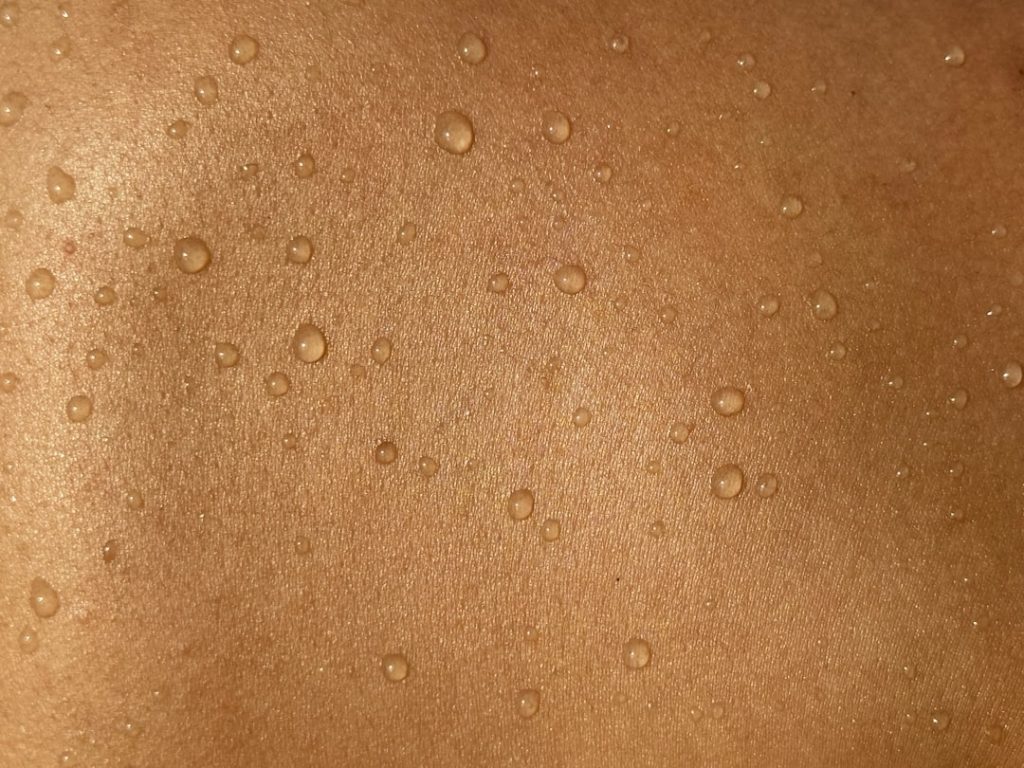
TL;DR: The chest gets a fraction of the sebum production of the face, less than a third of the sunscreen, and almost none of the active ingredients. By 45 it is usually two decades older-looking than the face it sits below. I have been treating my own chest for three years and the protocol that works is shorter and cheaper than anything sold as a “neck and décolleté” product. This is the anatomy that explains why and what to do about it.
A reader sent me a photo of her face next to a photo of her chest. The face was smooth, evenly toned, well moisturised. The chest had visible sun damage, crepey texture across the sternum, and dark patches between the breasts where the skin folds when she sleeps on her side. She had been using a $90 eye cream and a tretinoin protocol on her face for six years. Her chest had never seen anything except body lotion.
“Why does my chest look ten years older than my face?” she asked.
It probably is ten years older, in the sense that aged skin is measured by photographic comparison. The chest receives less attention than any other visible body area and the anatomy is set up to age faster than the face anyway. Most people who care about their faces do not realise that the skin two inches lower is on a completely different trajectory.
This is what I wish someone had told me five years ago.
Why the chest is anatomically disadvantaged
The chest has fewer sebaceous glands per square centimetre than the face. The Tagami review of aged skin function noted that the upper chest and forearms have approximately one-third of the sebaceous output of the central face (Tagami, Acta Dermatovenerol Croat 2008, PMID: 18926125). This means the natural protective lipid film is thinner. The skin loses water faster, the barrier is more permeable to environmental insult, and recovery from UV damage is slower.
The chest also has thinner skin than people assume. Epidermal thickness on the upper sternum is about 0.07 to 0.10 mm versus 0.12 to 0.15 mm on the cheek. Dermal thickness on the chest declines faster with age than dermal thickness on the face, partly because the chest accumulates more cumulative UV exposure (it is exposed in most weather, almost every season, and most outfits) and partly because the skin sits over bone with little fat padding, which means small amounts of collagen loss produce visible crepey texture earlier.
The third factor is sleep position. People who sleep on their side spend six to eight hours a night with one half of the chest folded over the other. The mechanical compression creates lines that become permanent over years. These are the parallel diagonal lines you sometimes see on the chest of someone in their fifties, more pronounced on the side they sleep on.
I think this is the most overlooked aging factor on the chest. The face has a similar sleep-line phenomenon (which is why side sleepers develop deeper nasolabial folds on one side) but the chest version is more pronounced because the skin is thinner and the folds are deeper.
The UV problem nobody talks about
The Krutmann review of skin aging exposome listed the cumulative UV exposure of the chest as comparable to or greater than the face for women in temperate climates (Krutmann et al., J Dermatol Sci 2017, PMID: 28169114). The face gets sunscreen daily for women who care about aging. The chest gets sunscreen on beach days and weddings.
The math of this is brutal. If you assume 365 days of UV exposure per year and sunscreen on the face for 320 of them and sunscreen on the chest for 30 of them, the chest accumulates roughly ten times more UV damage per year than the face. Over twenty years the differential is enormous. By 45 the face looks 45 and the chest looks 60.
This is the dominant cause of visible chest aging in light skin. In darker skin tones the UV damage manifests less as wrinkling and more as uneven pigmentation, especially between the breasts where shadow and friction combine. The mechanisms differ but the underlying neglect is the same.
I started wearing sunscreen on my chest daily three years ago. The change is not dramatic visually because what is already done is done, but the rate of new damage has clearly slowed. The mottled pigmentation has stopped getting worse, which it had been doing for years.
What the “neck and décolleté” products actually contain
I went through the ingredient lists of fourteen products marketed specifically for the neck and décolletage area, priced between $35 and $180. The active concentrations in most of them sit at the bottom end of the cosmetic range. A “firming” cream sold for $120 contained 0.5 percent vitamin C and 1 percent niacinamide. A “wrinkle correcting” cream for $85 contained 0.05 percent retinyl palmitate, which is the weakest of the cosmetic retinoids and does almost nothing without much higher concentrations than the formula contained.
The pattern is consistent. The pricier the product, the more elegant the packaging, the more marketing imagery of women in their thirties holding wine glasses, and the weaker the actives relative to comparable face products. The category exists because women have been trained to think the chest needs different products than the face. Anatomically this is not really true. The chest needs the same actives, possibly at slightly lower concentrations for tolerance, and used consistently.
The reason for the consistency is that the chest is much harder to use actives on than the face. The skin is thinner and more reactive. Tretinoin at 0.05 percent on the chest causes more irritation than tretinoin at 0.05 percent on the face for many people. Acids cause more irritation. Vitamin C in unstable formulations causes more burning. So the cosmetic category settled on weak formulas that nobody reacts to and that also do not work.
I think the right approach is the same actives as the face, started at lower frequencies and built up.
What I do on my chest
For three years I have used the following protocol. None of these products are sold as chest products. All of them work on the chest.
Morning: a mineral sunscreen with zinc oxide, SPF 30 or higher, applied from the jawline to the bra line every day regardless of weather or outfit. The most-missed spot is the small triangle just above where most shirts sit, which sees sun whenever the neckline drops.
Evening, three nights a week: tretinoin 0.025 percent (a step lower than the 0.05 I use on my face) applied to the chest in a thin layer. Started at one night a week and built up to three over six months.
Evening, two non-tretinoin nights a week: azelaic acid 15 percent (Finacea, which is also what I use on my face). Helps with the uneven pigmentation more than tretinoin alone does.
Every night after the active: a basic ceramide cream (Cerave Cream, same as the face). Heavier than the face requires because the chest dries out faster.
Total cost: about $40 in chest-relevant product per year. The chest looks better at 45 than it did at 42, which is the opposite trajectory it was on before.
This is not a complicated protocol. It is the face protocol slightly modified for the chest’s lower tolerance. The category marketing has nothing on it.
The contrarian section: the sleep line problem
The deepest creases on most chest skin come from sleep position, not from sun or aging. They are mechanical creases reinforced over thousands of nights. No topical fixes them once they are deep. The only mechanical solutions are sleeping on your back (which is the recommendation almost nobody follows because side sleeping is what most people prefer) or using a chest pad designed to hold the skin flat overnight.
I tried the chest pads (silicone adhesive patches sold for this purpose) for six weeks and stopped. They worked while I was wearing them, with measurably smoother skin in the morning, and the smoothing lasted into the early afternoon. But the adhesive irritated my skin and I did not like the feel of them. I have accepted my side-sleeper chest lines. I think this is honest.
The alternative I have not tried is back sleeping. I have not been able to retrain. I know people who have, with chest pillows that prevent rolling. They report better chest skin. They also report worse sleep quality for the first month, which is the trade-off.
The point is that the lines are not a skincare problem. They are a sleep posture problem. No cream changes them. The serum that claimed to “rebuild lost firmness in the décolleté area” was making a claim that no topical can deliver.
What I would tell my past self
Start treating the chest like the face when you start treating the face. The mistake I made was assuming the face was the project and the chest would take care of itself. The chest does not take care of itself. It accumulates damage faster than the face because of the anatomy and the neglect, and by the time you notice the damage it is harder to reverse than it would have been to prevent.
If you start in your thirties, the chest can be maintained at the same visual age as the face for a long time. If you start in your fifties, the damage is mostly photographable, and the best you can do is slow the rate of new damage. The earlier the better.
The cheapest version of this protocol is sunscreen daily and a basic moisturiser. Even just the sunscreen, applied every day, will outperform any “neck and décolleté” cream you can buy. The active does not need to be expensive. It needs to be on the skin.
Frequently asked
Does tretinoin work on the chest? Yes, but expect more irritation than on the face. Start at half the concentration and half the frequency, and build up over six months. Many people tolerate it well within a year.
Is the chest worth treating after 50? Yes. The rate of new damage can be slowed at any age. Existing damage is harder to reverse but pigmentation often responds to azelaic acid and retinoids over six to twelve months. Wrinkling responds less because the dermal component is collagen loss that topicals do not rebuild.
What about laser for the chest? Fractional lasers (Fraxel, similar) work on chest skin and have a stronger track record than topicals for established sun damage. They are expensive (around $1,000 per session, multiple sessions usually needed) and have downtime. For severe chest sun damage they are the most effective intervention available. For mild to moderate damage, topicals are usually enough.
Should I use sunscreen on my chest in winter? Yes if you go outside. UVA penetrates clouds and the chest is often partially exposed at the V of a shirt or coat. The lower angle of winter sun does not exempt the area. Year-round sunscreen on the chest is the single highest-yield intervention.
Does the neck need a different product from the chest? No. The neck is anatomically similar (thin skin, low sebum, high UV exposure) and responds to the same protocol. The mistake is thinking each body area needs its own labeled product. They need the same actives applied consistently.
Related Elelaf tools
Sources
- Knaggs HE, Holland DB, Morris C, Wood EJ, Cunliffe WJ. Quantification of cellular proliferation in acne using the monoclonal antibody Ki-67. J Invest Dermatol 1994. PMID: 7508390.
- Marks R. The stratum corneum barrier: the final frontier. J Nutr 2004. PMID: 15042021.
- Krutmann J, Bouloc A, Sore G, Bernard BA, Passeron T. The skin aging exposome. J Dermatol Sci 2017. PMID: 28169114.
- Tagami H. Functional characteristics of aged skin. Acta Dermatovenerol Croat 2008. PMID: 18926125.
References
- Kligman AM, Christensen MS. The biology of the stratum corneum revisited. Int J Cosmet Sci. 2011. PubMed.
- Draelos ZD. The science behind skin care: cleansers. J Cosmet Dermatol. 2008. PubMed.
Have a question about “The Chest Skin Nobody Treats: Why Décolletage Ages First”?
Ask our editorial desk. Best questions become full follow-up articles, reviewed by our medical reviewer. No medical advice given in private — answers run as articles or not at all.