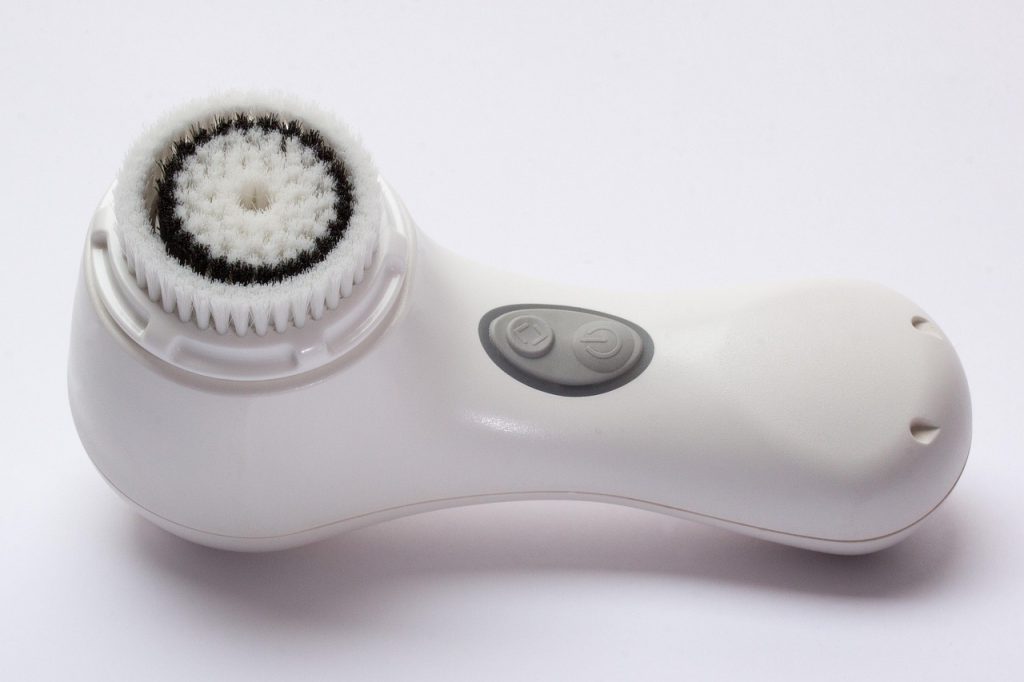
TL;DR: The Clarisonic launched in 2004, peaked around 2013, and was discontinued by L’Oreal in 2020 after sixteen years on the market. In between, the dermatology literature accumulated steady evidence that twice-daily sonic-brush use produced barrier disruption, irritant contact dermatitis, and bacterial bristle colonisation. Mayes 2014 was the paper that started the consumer-side reconsideration. I walk through what happened, what the studies actually show, and what survives of the category.
A reader in Vancouver sent me a photo last September of her Clarisonic Mia, still in its charging cradle, untouched for three years. She had bought it in 2014, used it twice daily from 2014 to 2016, developed chronic perioral redness in 2017, stopped the brush in 2018 on a dermatologist’s advice, and the redness had resolved over the following nine months. She wanted to know whether the new generation of silicone-bristle brushes (Foreo Luna, mostly) were any safer. The honest answer is that the silicone generation is meaningfully gentler than the original nylon-bristle generation, but the category as a whole has settled into a much narrower set of legitimate use cases than the 2010s marketing suggested.
This is a story about a category that rose, peaked, was studied, and was partly invalidated, and it is worth telling because the same arc is happening now with several other tool categories (LED masks, microcurrent devices, some at-home microneedling tools), and the lessons from cleansing brushes apply.
I bought my first Clarisonic in 2013. I used it for two years. I quit in 2015 when my cheeks would not stop being inflamed and my dermatologist asked what was new in my routine. The brush was the only new thing. The redness resolved in about six weeks after stopping. I have not used a sonic brush since.
What the studies actually show
Mayes et al. (2014, J Cosmet Dermatol) was the paper that put a dent in the category. The study was small and observational, but it documented a pattern of irritant contact dermatitis in patients using motorised cleansing brushes that resolved upon brush discontinuation. The mechanism the paper proposed was mechanical disruption of the stratum corneum lipid lamellae, which Bouwstra and Ponec (2006) had previously characterised as the primary determinant of barrier function. The lamellar lipid organisation is delicate; mechanical disruption from repetitive bristle action produces a measurable increase in TEWL (Fluhr et al. 2008 documents the baseline cleansing-related TEWL changes).
Akridge and Pilcher (2007) had earlier looked at bristle hygiene specifically. They found that sonic brush bristles harboured significant bacterial colonies if not cleaned and dried between uses, and that the moist enclosed environment of the typical bathroom-stored brush was conducive to bacterial and fungal growth. The implications for facial application were never fully studied, but the colonisation finding alone suggested that twice-daily face application of a moist bristle head was not the sterile cleansing the marketing implied.
Ramos-e-Silva et al. (2016) reviewed the mechanical cleansing device literature and found that the evidence for efficacy (better cleansing than manual application) was thin, while the evidence for barrier disruption was accumulating. The review concluded that mechanical cleansing devices “should be used selectively and with caution in patients with sensitive skin, rosacea, atopic dermatitis, or compromised barrier function.” This was a polite way of saying that the categories of skin the brushes had been marketed to (sensitive, acne-prone, post-treatment) were the ones most likely to be harmed by them.
The FDA MAUDE database (the medical device adverse event reporting system) accumulated reports of redness, burning, breakouts, and rosacea-like reactions associated with cleansing brushes through the 2010s. The volume was not catastrophic but the pattern was consistent. L’Oreal discontinued the Clarisonic line in September 2020, citing brand prioritisation reasons; the contemporaneous dermatology literature suggests the safety profile and the rising consumer awareness of barrier issues were also factors.
What happened in those seven years
Between roughly 2010 and 2017, sonic cleansing brushes moved from clinical-aesthetic use into mainstream consumer skincare. The peak was around 2013-2015. The marketing claim was that mechanical bristle action removed more debris, makeup, and dead cells than manual cleansing, and that this superior cleansing translated into clearer, brighter, better-functioning skin.
The clinical reality, as the studies accumulated, was that twice-daily mechanical cleansing produced measurable barrier disruption in most users within weeks, and meaningful inflammatory consequences in a subset within months. The barrier disruption was small enough that asymptomatic users would not notice it (slightly faster product absorption, slightly more sensitivity to actives), but enough to push borderline-sensitive skin into clinical sensitivity.
The category response, starting around 2017, was twofold. Silicone-bristle devices (Foreo Luna being the dominant example) replaced nylon bristles with softer, easier-to-clean silicone nodules. The mechanical action was gentler. The bacterial colonisation problem was reduced (silicone surfaces are easier to sanitise and dry faster). And the marketing repositioned from “deep cleansing” to “gentle massage” and “circulation.”
The other response was discontinuation. The original Clarisonic line ended in 2020. Several smaller brands followed. The category did not die, but it shrank.
What I read in the surviving literature now
The strongest case for mechanical cleansing is in two narrow populations.
People with persistent makeup or sunscreen residue who cannot adequately remove product with manual double-cleansing. This is a real use case, particularly for water-resistant sunscreens. A gentle silicone brush used occasionally (not daily) can improve removal in a meaningful way.
People with seborrheic dermatitis or fungal acne whose treatment plan includes mechanical exfoliation of scale or biofilm. This is a niche dermatologist-directed use case and not what mainstream cleansing brush marketing has ever targeted.
The case against cleansing brushes is in the populations they were most aggressively marketed to.
Acne-prone skin. Twice-daily mechanical cleansing exacerbates inflammation around active lesions. The bristle head can spread bacterial content from one comedone to a previously uninfected area. The barrier disruption increases sensitivity to acne treatments (BPO, retinoids) and makes the routine harder to tolerate.
Sensitive skin and rosacea. The mechanical action triggers neurogenic inflammation through TRPV1 and TRPA1 pathways. The repeated stimulation can sensitise the skin progressively over months. Several published cases of rosacea worsening with brush use exist in the literature.
Post-procedure skin (post-peel, post-microneedling, post-retinoid). Mechanical cleansing during the recovery window prolongs healing and increases the risk of post-inflammatory hyperpigmentation.
Mature skin with thinning stratum corneum. Older skin has reduced barrier resilience and recovers more slowly from mechanical insult.
What I would tell my past self
If I had read Mayes (2014) in 2014 instead of in 2017, I would have stopped the brush within months rather than two years. The redness I attributed to “skin getting used to retinol” or “stress” or “diet” was largely brush-induced. The chin perioral dermatitis I developed in 2015 was concurrent with peak brush use. The improvement after stopping was not coincidence.
The advice I now give to readers asking about cleansing brushes:
Skip them as a daily tool. If you want to use a silicone brush occasionally (once or twice a week, with a gentle cleanser, brief contact time) for the makeup-residue case, that is defensible. Daily use is hard to justify even with the gentler new generation.
Replace the brush habit with a better cleanser. Most of the perceived “deep clean” sensation from cleansing brushes was the mechanical removal of barrier lipids. A well-formulated oil cleanser followed by a gentle surfactant cleanser will remove makeup and sunscreen as effectively without the bristle action.
Sanitise the brush if you use one. The silicone-bristle versions clean more easily than the nylon-bristle versions did, but neither sanitises itself. A weekly soak in 70% isopropyl or a quick run through the dishwasher (top rack, no soap) keeps colonisation down.
Stop running tools through the routine because the marketing is exciting. The 2010s were a tool-heavy decade and most of the tools have been re-evaluated downward over the following ten years. Cleansing brushes are the cleanest example. LED masks and microcurrent are in earlier stages of the same arc.
FAQ
Is the Foreo Luna safer than the Clarisonic was?
Meaningfully yes, but not safe enough for daily use in sensitive skin. The silicone bristles are softer and easier to sanitise than the original Clarisonic nylon bristles, and the vibration pattern is different. The barrier-disruption risk is reduced but not eliminated. Foreo’s own recommended use frequency is more conservative than Clarisonic’s was, which is informative.
What about a soft konjac sponge?
Lower risk than any motorised brush. Konjac sponges are gentle, biodegradable, and disposable on a sensible timeline (every two to four weeks). They are not sterile and develop bacterial load with use, which is why the replacement schedule matters. For most users they are a reasonable middle path between manual cleansing and a brush.
Can I use a cleansing brush during active acne?
I would not. The case studies of acne worsening with brush use are consistent enough that I would treat active inflammatory acne as a contraindication. Once acne is controlled and the skin is stable, occasional use is defensible but rarely necessary.
Does the brush help with retinoid-induced flaking?
It can mechanically remove the flakes but the underlying problem is barrier disruption from the retinoid, and adding mechanical cleansing on top of retinoid-induced TEWL makes the barrier issue worse. The better approach is to slow the retinoid titration, add an occlusive, and let the flakes self-resolve over the retinization timeline.
Are dermaplaning tools in the same category?
Related but distinct. Dermaplaning removes vellus hair and superficial stratum corneum with a blade. The mechanism is different (sharp cut rather than vibrating bristle) and the risk profile is different (more about technique-induced microabrasion than chronic barrier disruption). The lessons about over-use generalise: weekly is probably fine in stable skin, daily is hard to justify, and the marketing claims about smoother and brighter results outpace the evidence.
Related Elelaf tools
Sources
- Mayes et al., 2014, J Cosmet Dermatol on motorised cleansing brushes and irritant contact dermatitis
- Akridge and Pilcher, 2007, J Cosmet Dermatol on sonic brush bristle counts and bacterial colonisation
- Ramos-e-Silva et al., 2016, Clin Cosmet Investig Dermatol on mechanical cleansing devices
- Bouwstra and Ponec, 2006, Biochim Biophys Acta on stratum corneum lipid organisation
- Fluhr et al., 2008, Skin Pharmacol Physiol on TEWL and cleansing
- FDA, MAUDE adverse-event database, Clarisonic product recall, 2020
Related: Gua Sha and Jade Rollers: 90% of the Benefit Is the Massage, 10% Is the Stone.
References
- Madison KC. Barrier function of the skin: ‘la raison d’être’ of the epidermis. J Invest Dermatol. 2003. PubMed.
- Elias PM. Skin barrier function. Curr Allergy Asthma Rep. 2008. PubMed.
Have a question about “Cleansing Brushes: The 7-Year Arc From Must-Have to Barrier-Buster”?
Ask our editorial desk. Best questions become full follow-up articles, reviewed by our medical reviewer. No medical advice given in private — answers run as articles or not at all.