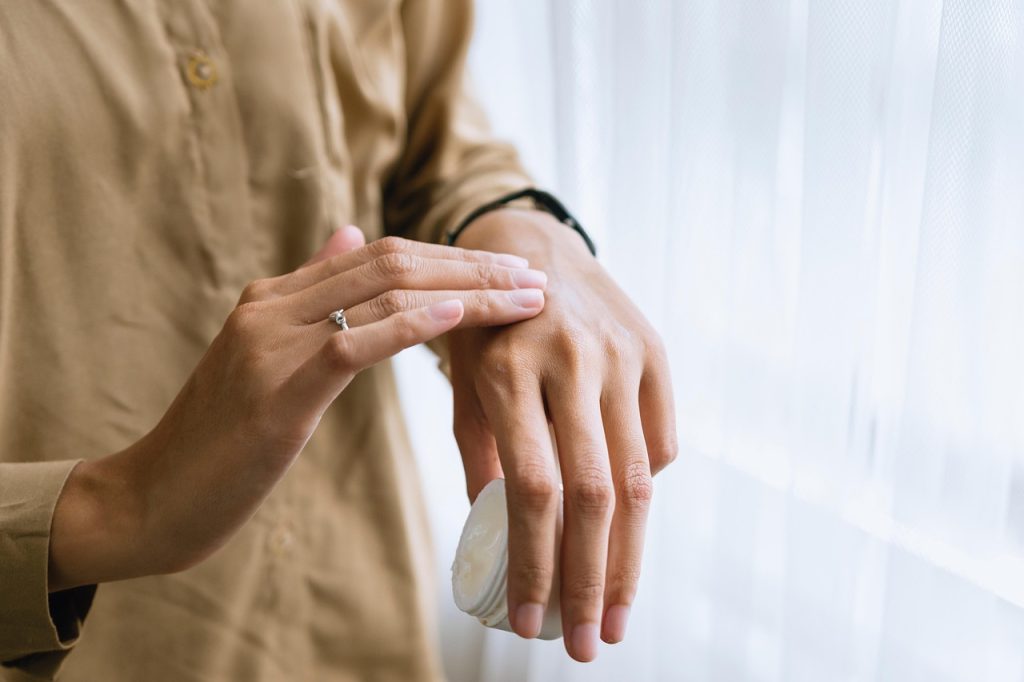
A reader sent me a photo of her cheek next to a moisturiser bottle and asked whether she should switch brands. Her cheek looked fine. Slightly matte, no flaking, no redness. She thought it was dehydrated because two influencers had told her so.
I asked her one question. What does your skin feel like ninety seconds after washing, before any product touches it. She said tight, then fine within a few minutes.
That answer is closer to a real barrier reading than any product review she had read that week. It is also, roughly, what dermatologists were chasing when they started measuring trans-epidermal water loss in the 1980s.
What TEWL actually is
Trans-epidermal water loss is the rate at which water passes from inside the body, through the stratum corneum, into the air. It is measured in grams per square metre per hour. A healthy adult cheek sits somewhere around 6 to 12 g/m²/h depending on humidity and temperature. Damaged barrier readings climb past 25. Severely compromised skin, like an active eczema patch, can exceed 40.
This is not a wellness number. It is the closest non-invasive proxy we have for stratum corneum integrity. When the brick-and-mortar structure of corneocytes and lipid lamellae works, water stays in. When it breaks, water escapes faster than the body can compensate.
The methodology was standardised in a paper I keep coming back to. Pinnagoda and colleagues at the European Society of Contact Dermatitis wrote the guidelines that almost every TEWL probe still references today (Pinnagoda et al., Contact Dermatitis 1990, PMID: 2138146). They specified the room conditions, the acclimatisation time, the probe orientation, the surrounding air movement. The point was that without those controls, your reading meant nothing.
The probe itself works on a simple principle. It measures the vapour pressure gradient between two sensors stacked above the skin. If water is leaving the skin quickly, the lower sensor reads higher humidity than the upper one. The instrument calculates a flux from the difference.
What the studies actually show
Berardesca and colleagues revisited the methodology in a 2018 review (Berardesca et al., Skin Res Technol 2018, PMID: 29516541). They confirmed that open-chamber probes like the Tewameter are still the practical standard, while closed-chamber probes give slightly different numbers in the same condition. They also catalogued the variables that contaminate readings: ambient humidity above 50 percent suppresses the gradient, skin temperature above 33°C inflates it, recent application of any occlusive within four hours invalidates the test.
The interesting finding from the literature is how poorly TEWL correlates with how skin looks. A face can appear dewy and still be losing water at twice the baseline rate. A face can look matte and have a perfectly intact barrier. Visual appearance and barrier function are two different measurements that marketing has collapsed into one.
Fluhr and colleagues published the most useful summary I have read on what actually drives TEWL changes in healthy adults (Fluhr et al., J Invest Dermatol 2006, PMID: 16439968). The list is shorter than expected. Surfactant exposure raises TEWL for hours after a single wash. Sustained exposure to humidity below 30 percent raises it further. Ablative procedures and tape-stripping raise it dramatically. Topical moisturisers lower it, but only while the occlusive film is intact, which for petrolatum is around six hours and for most lotions is closer to two.
What does not move TEWL in any meaningful way: most active ingredients at the concentrations they appear in finished products, drinking water, facial massage, jade rollers, or the cleanser pH debate that consumes so much skincare discourse.
The contrarian part
I bought a consumer-grade TEWL probe two years ago because I wanted to stop guessing. It cost more than I would like to admit and it taught me three things I had not expected.
The first was that my own TEWL fluctuated by 4 to 6 units across a single day with no products involved. Morning readings were lower than evening readings. After a workout the number climbed for forty minutes then came back down. After a long flight it stayed elevated for almost a day.
The second was that the moisturiser I had been using for a year, which I would have sworn was repairing my barrier, lowered TEWL for two hours then read the same as bare skin by hour four. The ceramide cream I switched to held the lower reading for nearly six hours. The visual difference between the two was zero. My skin looked identical on both. Only the probe knew.
The third was that the cleansers I had labelled as harsh, based on tightness sensation, did not raise TEWL much. The cleanser I had labelled as gentle, based on a creamy texture, raised it more than the foamy one. Tightness is a sensation driven by lipid disruption and protein contraction, and it does not map cleanly onto actual barrier damage.
This is where I have to be honest. Consumer TEWL probes are not research instruments. The variance is wider, the calibration is less reliable, and any single reading is meaningless. What I trusted was the pattern across forty days of measurements. If you do not have a probe and have no plans to buy one, the home version is the tightness-and-recovery test I asked the reader.
Wash your face with plain water. No cleanser. Pat dry. Wait ninety seconds. If your skin feels uncomfortably tight and stays that way for more than ten minutes, your barrier is probably running hotter than baseline. If it feels neutral within a few minutes, you are likely closer to normal than the influencer told you.
What changes the number, ranked by effect size
The honest ranking from the data, not from product marketing:
Procedural disruption sits at the top. Tape stripping, ablative laser, deep chemical peels, microneedling at depth. These can triple or quadruple baseline TEWL for days.
Sustained low-humidity exposure is next. Winter air below 30 percent humidity, long-haul flights, dry-climate travel. The barrier compensates, but slowly.
Surfactant frequency comes third. Twice-daily washing with sulphates over weeks raises baseline TEWL more than a single harsh wash. The cumulative damage is what matters.
Topical occlusives lower TEWL while they are present, but the effect ends with the film. Petrolatum lasts longest among the common ingredients. Silicones are intermediate. Most plant oils evaporate or get absorbed within an hour.
Ceramide and cholesterol formulations sit in their own category. They do not just occlude. The Elias group at UCSF demonstrated decades ago that ceramide replenishment supports actual lipid lamellae reconstruction, which is a slower and more durable effect than occlusion (Man et al., Arch Dermatol 1993, PMID: 8489699). The clinical implications still matter today.
What sits near the bottom of the effect-size list: most antioxidants at their consumer concentrations, peptides, exotic plant extracts, anything pitched as repairing the barrier through cellular signalling without a meaningful occlusive or lipid-replenishing fraction in the formula.
What I would tell my past self
Stop reading product reviews about barrier repair. The reviewer cannot measure TEWL. They are reporting how their face feels, which is one of the least reliable proxies in skincare.
Do the tightness-and-recovery test once a week for a month. Track your own baseline. You will start to see when your skin is actually compromised and when you are just reacting to a comparison photo.
Buy one good ceramide moisturiser and use it consistently before reaching for anything else. The product does not have to be expensive. The CeraVe and La Roche-Posay basics have published independent TEWL data behind them.
Stop using foaming cleansers twice a day if you have a normal-to-dry skin type. Once a day, evening, is enough for most adults who do not work in heavy makeup or visible dirt environments.
Do not chase a TEWL number. Chase consistency. A face that loses 10 g/m²/h every day for a year is a healthier face than one that swings between 6 and 22 because you keep changing routines.
Frequently asked
Do I need to buy a TEWL probe to do this properly?
No. Consumer probes are interesting toys, not diagnostic tools. The tightness-and-recovery test gives you most of what you need, and your eczema or rosacea flares will tell you the rest.
Does drinking water lower TEWL?
Not in any controlled study I have found. Adequate hydration matters for general physiology, but stratum corneum water content is regulated by what is happening in the top 20 microns of your skin, not by the water you drank an hour ago.
Is high TEWL the same as dehydrated skin?
They overlap but they are not identical. Dehydration is a description of low stratum corneum water content. High TEWL is a description of fast water flux. You can have a tight, intact barrier in a dry climate and still measure as dehydrated. Verdier-Sevrain wrote a useful clarification on this distinction (Verdier-Sevrain & Bonté, J Cosmet Dermatol 2007, PMID: 17524122).
Why did my moisturiser stop working?
Probably it did not. Your perception of it changed, or the seasonal humidity dropped, or you started using it inconsistently. Run the tightness test before swapping products. Most product-switching is driven by sensation, not measurement.
Can over-moisturising raise TEWL?
There is some evidence that chronic heavy occlusion downregulates the skin’s own barrier repair signalling. The clinical effect in healthy adults is small. The bigger risk is masking sensation cues that would tell you your barrier is changing.
Related Elelaf tools
Barrier damage test | Dehydrated vs dry skin | Slow skincare routine | Build from scratch plan
Sources
- Pinnagoda J, et al. Guidelines for transepidermal water loss measurement. Contact Dermatitis 1990;22(3):164-178. PMID: 2138146.
- Berardesca E, et al. Review of the open chamber TEWL technique. Skin Res Technol 2018;24(3):351-358. PMID: 29516541.
- Fluhr JW, et al. TEWL measurement guidelines. J Invest Dermatol 2006;126(7):1546-1549. PMID: 16439968.
- Man MQ, et al. Optimization of physiological lipid mixtures for barrier repair. Arch Dermatol 1993;129(6):728-738. PMID: 8489699.
- Verdier-Sevrain S, Bonté F. Skin hydration: a review on its molecular mechanisms. J Cosmet Dermatol 2007;6(2):75-82. PMID: 17524122.
Related: pH 5.5 Isn't Sacred: What the Real Skin pH Range Actually Looks Like.
References
- Madison KC. Barrier function of the skin: ‘la raison d’être’ of the epidermis. J Invest Dermatol. 2003. PubMed.
- Elias PM. Skin barrier function. Curr Allergy Asthma Rep. 2008. PubMed.
Have a question about “Trans-epidermal water loss: the metric your skin shows you before any product can claim a result”?
Ask our editorial desk. Best questions become full follow-up articles, reviewed by our medical reviewer. No medical advice given in private — answers run as articles or not at all.