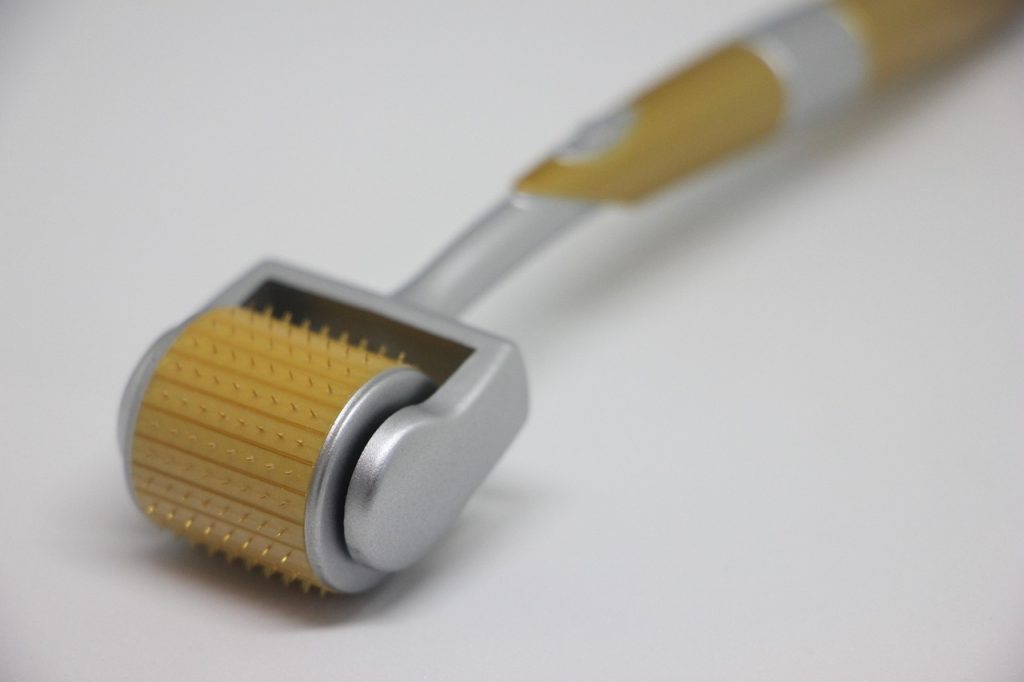
A reader sent me a photo last month of her left cheek, taken under raking light from a kitchen window. She had been rolling at home for fourteen months. A 0.5 mm dermaroller, twice a week, with a niacinamide serum and a barrier cream after. She wanted to know why her ice pick scars looked the same as the day she started. The honest answer is that the needles never reached the floor of the scar. They were not capable of it.
This is the part of microneedling that the marketing leaves out. A scar is a depth problem. A 0.25 mm needle is a depth tool. If the depths do not match, nothing happens that you could not have gotten from a niacinamide serum alone. I have been writing about acne scars for years and I still see this misunderstanding more than any other.
What the studies actually show
Atrophic acne scars sit at specific depths in the dermis, and those depths have been measured. Ice pick scars extend down to 1.5 to 2.0 mm. Boxcar scars sit between 1.0 and 1.5 mm depending on whether they are shallow or deep. Rolling scars involve fibrotic tethering at 1.0 to 1.5 mm. Dogra and colleagues laid this out in the 2014 Journal of Cutaneous and Aesthetic Surgery review of microneedling for acne scars (PMID: 25538433), and Singh and Yadav covered the same anatomy in their 2016 dermal needling review in the same journal (PMID: 27761080).
For collagen induction to happen, the needles have to physically pass through the epidermis and into the reticular dermis where fibroblasts live. That is roughly 1.5 mm down on cheek skin and slightly less on the forehead. If you do not reach the fibroblast layer you do not stimulate the collagen cascade. You stimulate the epidermis and create a transient inflammatory response, which is not the same thing.
Now look at what is actually sold as a home dermaroller. The needle lengths offered on Amazon and at every drugstore range from 0.2 mm to 0.5 mm, with a few 1.0 mm options sold to professionals who use them on themselves. A 0.25 mm needle reaches the stratum corneum and stops. A 0.5 mm needle reaches the basal layer of the epidermis on most people, sometimes the upper papillary dermis on thin skin. Neither of these reaches the floor of a boxcar scar. The math is brutal.
In-office microneedling devices like the Dermapen 4 and the SkinPen Precision go to 2.5 mm. The Genius RF system and Morpheus8 deliver radiofrequency at depths of 1.0 to 4.0 mm, which is why fractional RF for atrophic scars has the better outcomes in the comparative trials. A 2017 split-face study by Faghihi and colleagues comparing microneedling alone to fractional CO2 laser for atrophic scars (PMID: 28403581) found CO2 superior on every objective scar grading scale, and the microneedling arm used a 1.5 mm device, not a 0.5 mm one.
The contrarian section nobody wants to write
Home microneedling has a real use case. It is not scar treatment. It is product penetration enhancement. A 0.25 mm to 0.5 mm roller creates transient microchannels in the stratum corneum that improve transepidermal delivery of small molecules. If you roll at 0.25 mm and immediately apply a vitamin C serum or a peptide, you will get better penetration than applying the same serum to intact skin. Konicke and Knabel showed this in their 2017 work on dermarollers as drug delivery systems. That is the effect you are buying.
It is not a small effect. Penetration of niacinamide can increase by a factor of three to five at 0.5 mm depth. Penetration of larger peptides goes up more. This is genuinely useful for pigmentation, fine lines, and surface texture. It is genuinely useless for atrophic scarring at 1.5 mm.
People conflate the two because the marketing photos show before-and-afters that compare a person with surface dyschromia to the same person after eight weeks of rolling plus an antioxidant serum. The improvement is real. It is from the serum, accelerated by the channels. The scars in the photo are usually not the kind that respond to depth-based treatment, they are post-inflammatory hyperpigmentation overlying mild rolling scars, and the pigment fades while the scar depth stays unchanged.
I have asked three patients to send me before-and-after shots in raking light, which is the only light that shows scar depth honestly. The scars look identical. The pigmentation is improved. They tell me they are happy with the result. I think that is fine. I just want people to know what they are actually buying.
The infection question that the home market ignores
In-office microneedling is done with single-use cartridges, sterile fields, post-procedure occlusion, and topical antibiotic where indicated. Home rolling is done in a bathroom with a roller that gets rinsed in alcohol and stored in a plastic case that grows biofilm.
The 2014 case series by Soltani-Arabshahi and colleagues documented granulomatous reactions to topical vitamin C used with home dermarollers (PMID: 24477372). The vitamin C was driven into the dermis through 1.0 mm channels and the immune system responded with granuloma formation. This is the risk people do not price in. Anything you apply to the skin while the channels are open is being delivered into the dermis. Fragranced moisturizers, essential oils, niacinamide with high silicone content, sunscreens with avobenzone. None of these were tested for intradermal use.
I tell people who roll at home to use only sterile saline and a tested serum with a published safety profile. Hyaluronic acid is reasonable. Niacinamide is reasonable. Vitamin C in L-ascorbic acid form is questionable. Essential oils are dangerous. The home market does not draw these distinctions.
What I would tell my past self
If you have atrophic acne scars, especially ice pick or deep boxcar, home rolling is not the path. It is a depth-tool problem and home tools do not have the depth. Save the money for two or three sessions of in-office microneedling with a 2.0 mm or 2.5 mm device, or fractional RF if your dermatologist offers it. The literature on six-session protocols with 1.5 to 2.5 mm depths shows 50 to 70 percent improvement in atrophic scar grading scales (Alster and Graham 2018, Dermatologic Surgery). Home rolling shows nothing comparable.
If you have post-inflammatory hyperpigmentation, surface texture issues, or you are using a roller as a delivery vehicle for a serum you trust, a 0.25 or 0.5 mm device is fine. Roll twice a week. Replace the head every eight weeks. Clean it properly. Do not apply anything you would not be comfortable having injected into the upper dermis.
The thing I wish I had understood five years ago is that depth is not negotiable. You cannot half-treat a scar. Either the needle reaches the floor of the lesion or it does not. The collagen cascade has a threshold. Below the threshold, nothing useful happens to scar tissue. That is the part of the biology the home market sells around.
I do not think home microneedling is a scam. I think it is a delivery system marketed as a scar treatment, which is a different and quieter problem.
Frequently asked
Is there any home device that reaches scar-treatment depths safely?
A few brands sell 1.0 mm devices and a smaller number sell 1.5 mm devices for home use. At those depths you are entering the dermis and the safety concerns I described above become acute. Infection risk rises sharply. Pigmentation risk in darker skin tones rises. The procedural skill required to maintain even pressure and avoid tracking is real. I do not recommend it for most people. If you go this route, work with a dermatologist on protocol and on what topicals are safe to apply post-procedure. Do not improvise.
How long does it take to see real change from in-office microneedling?
The collagen remodeling cascade peaks at 12 to 16 weeks after the procedure. A six-session protocol spaced four to six weeks apart, with photos under controlled lighting at baseline and again at six months, is what the published trials use. Anyone showing you results at four weeks is showing you swelling, not collagen.
What about radiofrequency microneedling versus traditional?
Fractional RF microneedling delivers thermal energy at the needle tip in addition to mechanical injury. For atrophic scars this matters because the thermal effect adds dermal contraction. Morpheus8 and Genius RF generally outperform traditional microneedling on objective scar grading in the comparative literature, especially for deeper boxcar and rolling scars. They cost more per session. The math is harder to dismiss.
Can I do home rolling between in-office sessions?
I would not. The reason is that in-office microneedling creates a controlled inflammatory environment that needs to resolve before the next session. Home rolling at 0.5 mm between sessions adds noise to that signal. Your dermatologist may say differently. Ask before you do it.
What about the gua sha or jade roller comparison? Are those the same?
No. Gua sha and jade rollers do not break the skin. They are massage tools. They have some lymphatic and circulatory effect that may reduce morning puffiness. They have no demonstrated effect on collagen induction or scar depth. Marketing them alongside dermarollers conflates two different categories of tool.
Sources: Dogra et al. J Cutan Aesthet Surg 2014, PMID: 25538433. Singh and Yadav, J Cutan Aesthet Surg 2016, PMID: 27761080. Faghihi et al. 2017 split-face microneedling vs fractional CO2, PMID: 28403581. Soltani-Arabshahi et al. 2014 granulomatous reactions, PMID: 24477372. Alster and Graham, Dermatologic Surgery 2018. Konicke and Knabel 2017 dermaroller drug delivery review.
Related Elelaf tools
- Microneedling home
- Chemical peel home
- Cystic acne severity
- Barrier damage test
- Build from scratch plan
Related: Atrophic vs Hypertrophic vs Hyperpigmented Scars: Not the Same Fix, and Boxcar, ice-pick, rolling: the scar morphology that determines treatment.
References
- Kligman AM, Christensen MS. The biology of the stratum corneum revisited. Int J Cosmet Sci. 2011. PubMed.
- Draelos ZD. The science behind skin care: cleansers. J Cosmet Dermatol. 2008. PubMed.
Have a question about “Why home microneedling rarely matches in-office results: the needle length and dermis depth math”?
Ask our editorial desk. Best questions become full follow-up articles, reviewed by our medical reviewer. No medical advice given in private — answers run as articles or not at all.