TL;DR: Korean fermentation in skincare is a specific manufacturing tradition with measurable downstream effects on ingredient profile. Western brands have started using the word fermented as a marketing label without the underlying process, the metabolite specificity, or the published literature. The two are not the same product even when the bottle says they are. The Galactomyces and Lactobacillus literature is more specific than the marketing suggests.
I asked a chemist at a Korean OEM last spring what she thought about the wave of US and European brands launching fermented serums. She paused, looked at her tea, and said the word she used translated roughly as imitation. Not in a hostile way. In the way you describe a copy of something where the maker has reproduced the visible shape and not the manufacturing process.
This piece is about that distinction. Korean ferment skincare is a specific tradition with a specific manufacturing process and a specific published evidence base. The word fermented in Western marketing is sometimes the same thing, more often a related thing with the relationship loosened, and occasionally a label on a product that has not been fermented in any meaningful sense.
I want to be careful with this because I do not think the Western brands are universally cynical and I do not think Korean brands are universally honest. The point is the chemistry, and the chemistry differs.
What the studies actually show
The Galactomyces ferment filtrate literature is the most coherent body of work in this category. Kim 2019 (PMID: 30693668) ran an open-label clinical trial of a Galactomyces-based formulation on Asian skin and reported improvements in measured radiance parameters, fine line depth at twelve weeks, and a measurable increase in skin barrier function on TEWL assessment. The study has the limitations open-label trials always have, and the funding source was disclosed appropriately, but the direction of effect is consistent with the rest of the small Galactomyces literature.
Majeed 2020 (PMID: 31318138) extended the work with a UV-protection mechanism study, showing that Galactomyces ferment filtrate reduced UV-induced inflammatory markers in cultured keratinocytes and modulated antioxidant gene expression at concentrations achievable in topical formulations. The cell culture evidence is mechanistically suggestive but should not be over-read to clinical sunscreen-like effects. It is a supportive ingredient, not a sunscreen.
The Lactobacillus literature is broader and more variable. Park 2017 (PMID: 27974731) characterised the anti-inflammatory profile of a skin-derived Lactobacillus rhamnosus strain and found measurable effects on inflammatory cytokine expression. Kim 2014 (PMID: 25112318) looked at oral Lactobacillus plantarum in UV-induced photoaging mouse models and showed reductions in matrix metalloproteinase activity and improved collagen retention, though the model and route of administration limit translation to topical human skincare.
The most useful synthesis is Lew and Liong 2013 (PMID: 23311666) which reviews the dermal bioactive profile of fermentation byproducts including organic acids, bacteriocins, exopolysaccharides, and the lower molecular weight peptides produced by enzymatic breakdown during the ferment process. The review makes a specific point that the bioactivity is not the bacteria themselves in most topical applications but the metabolite profile of the ferment, and that profile depends on the strain, the substrate, the temperature, the duration, and the post-fermentation processing.
This is the part most marketing skips.
Why the process matters
Korean fermentation in skincare comes out of a longer food and traditional medicine tradition where fermentation is a defined process. Galactomyces is a yeast strain originally noted on the hands of sake brewers, which is the origin story most associated with the SK-II Pitera lineage. Lactobacillus strains are commonly used in food fermentation and were adapted into skincare with specific substrates including rice bran, soybean, and various plant extracts.
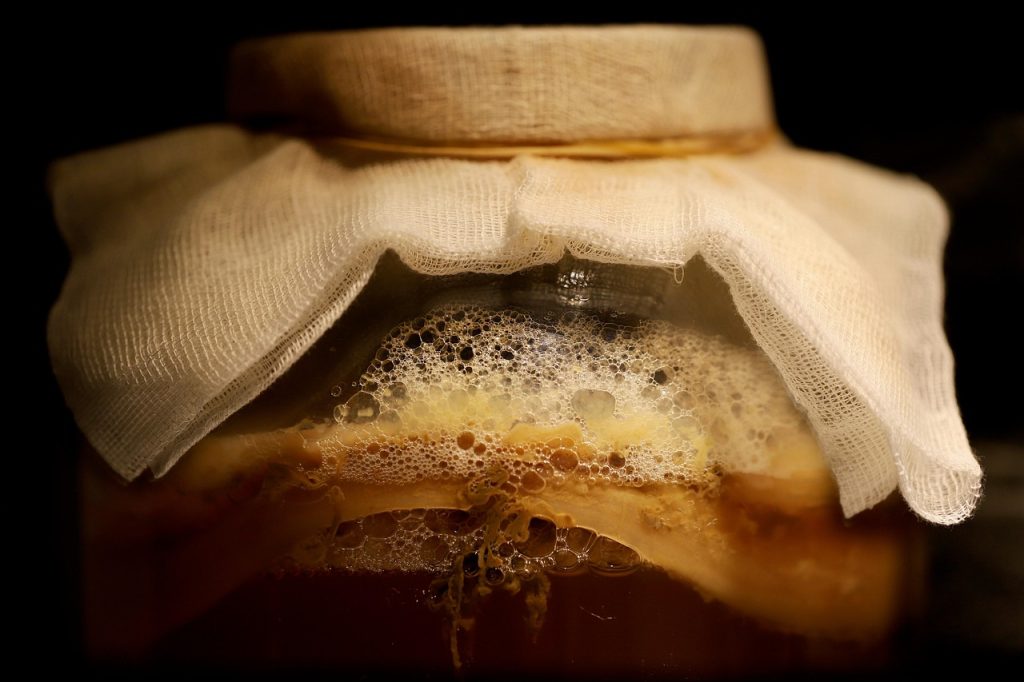
The product on the shelf labelled Galactomyces ferment filtrate is the filtered liquid output of yeast fermenting a substrate under controlled conditions for a specified duration. The bioactive profile is the metabolite mixture produced by that specific microorganism on that specific substrate. Change the strain, the substrate, the conditions, or the post-processing, and you have a different metabolite profile and a different product.
A Western brand that adds Lactobacillus ferment to an existing serum at the end of formulation is using the word in a different sense. The bacteria are present, the metabolites are present in some quantity, but the product has not been fermented in the same way that a Korean ferment-first formulation has. The label is technically defensible. The chemistry is not the same.
The strongest tell is the position of the ferment in the ingredient list. Korean ferment-led formulations typically have the ferment filtrate or essence at the top of the list, often in the first three ingredients, because the formulation was built around it. Western imitations often have ferment toward the bottom in the colourant-and-fragrance range, indicating it was added as a marketing-supportive inclusion rather than a structural one.
The contrarian section
There is a real Korean ferment literature, the Galactomyces work is reasonable, and the products in that tradition have a defensible place. I am not making a Korean-skincare-is-magic argument. I am making the narrower argument that the manufacturing process is part of the product, and the Western adoption of the label has detached the label from the process.
The other claim I push back on is the framing that ferment skincare is about probiotic effects on the skin microbiome. The microbiome framing has been imported into marketing copy from a different research area, and the evidence that topical ferment products meaningfully alter the resident skin microbiome over reasonable time periods is thin. What the topicals appear to do is deliver a metabolite mixture with anti-inflammatory, humectant, and barrier-supportive effects. That is a perfectly defensible mechanism. The probiotic-for-your-skin framing oversells it.
I would also push back on the assumption that all Korean ferment products are equal. The category has its own marketing pressure, and not every Korean serum with a ferment label has the same provenance as the Galactomyces tradition. Reading the ingredient list and noting the ferment position is useful even within K-beauty.
The fourth thing I would name is that the price gap between traditional Korean ferment skincare and Western imitations has narrowed in a way that does not reflect the chemistry. Several Western brands are pricing fermented serums above their Korean counterparts on the strength of the marketing, despite formulations that show the ferment lower in the ingredient list and processing notes that do not suggest a ferment-led production.
What I would tell my past self
I would tell her that the word fermented on a Western bottle should prompt a check of where the ferment ingredient sits in the list. Top three suggests the formulation is built around it. Lower than tenth suggests it is decorative.
I would tell her that Galactomyces ferment filtrate is the specific ingredient with the most coherent published literature in this category, and the brands working with that specific filtrate at meaningful concentrations are a reasonable starting point regardless of country of origin.
I would tell her that the probiotic-for-skin framing is not where the evidence sits and to discount marketing that leans heavily on the microbiome story without referencing the metabolite mechanism.
I would tell her that the price premium on Western fermented serums often pays for the marketing and not the formulation, and the chemistry comparison is not flattering when you do it carefully.
I would tell her that the Korean tradition is worth respecting on its own terms, not as an exotic backdrop for a Western product team’s quarterly launch.
FAQ
Is Galactomyces the same as SK-II’s Pitera?
Pitera is SK-II’s branded version of a Galactomyces ferment filtrate. Other Galactomyces filtrates exist from other manufacturers and are not the same proprietary preparation, though they share the strain family and the basic mechanism. The pricing difference between branded and unbranded Galactomyces is substantial and the gap is not entirely chemistry.
Are fermented ingredients better for sensitive skin?
Some are. The Park 2017 anti-inflammatory data suggests a useful profile for low-grade inflammation. The category is not uniformly suitable for sensitive skin though, especially preparations with high concentrations of organic acid byproducts or low pH. Patch testing on the forearm for three days is sensible.
Does fermentation make ingredients penetrate better?
Sometimes. The enzymatic breakdown during fermentation can produce smaller molecular weight peptides and amino acids that penetrate better than their precursors. This is the mechanism behind some of the radiance and barrier effects. It is not a universal property of fermentation.
Should I look for live bacteria in fermented skincare?
Most commercial topical ferments are filtered to remove the bacteria after fermentation, leaving the metabolite mixture. Products marketing live bacteria are a different category and the regulatory and stability picture is different. The metabolite preparations are what most of the literature is on.
Can I get the same effect from eating fermented food?
The skin effects of dietary fermentation are a different mechanism and a different literature. Some of the oral probiotic studies show small effects on skin parameters, but the magnitude is generally smaller than topical metabolite delivery and the comparison is not direct.
Related Elelaf tools
Sources
- Kim HM, Lee DE, Park SD, et al. Oral administration of Lactobacillus plantarum HY7714 protects hairless mouse against ultraviolet B-induced photoaging. J Microbiol Biotechnol. 2014;24(11):1583-1591. PMID: 25112318
- Park SY, Seong KS, Lim SD. Anti-inflammatory effect of skin-derived Lactobacillus rhamnosus. J Microbiol Biotechnol. 2017;27(2):216-223. PMID: 27974731
- Kim KS, Lee S, Lee YJ, et al. Anti-aging effects of Galactomyces ferment filtrate on human skin: an open-label clinical trial. J Cosmet Dermatol. 2019;18(6):1851-1858. PMID: 30693668
- Majeed M, Majeed S, Nagabhushanam K, et al. Galactomyces ferment filtrate and its protective effect on UV-induced skin damage. J Cosmet Dermatol. 2020;19(3):780-786. PMID: 31318138
- Lew LC, Liong MT. Bioactives from probiotics for dermal health: functions and benefits. J Appl Microbiol. 2013;114(5):1241-1253. PMID: 23311666
References
- Kligman AM, Christensen MS. The biology of the stratum corneum revisited. Int J Cosmet Sci. 2011. PubMed.
- Draelos ZD. The science behind skin care: cleansers. J Cosmet Dermatol. 2008. PubMed.
Have a question about “Why Korean ferment skincare works differently than Western ‘fermented’ marketing claims”?
Ask our editorial desk. Best questions become full follow-up articles, reviewed by our medical reviewer. No medical advice given in private — answers run as articles or not at all.