TL;DR
INCI order is mandatory in descending concentration only above 1 percent. Below 1 percent, brands can list ingredients in any order they want. This is where ‘hero’ actives get moved up front to look prominent at concentrations under 0.5 percent. Read the rules. Read the threshold. Read past the marketing.
The INCI list (International Nomenclature of Cosmetic Ingredients) is the most useful part of a label and the least understood. People scan the front of the bottle for claims, miss the INCI on the back, and never check whether the listed actives are present at meaningful concentrations.
Here is the rule everyone should know. Above 1 percent, ingredients must be listed in descending order by weight. Below 1 percent, the order is flexible. Brands use that flexibility to game perception.
The above-1% rule
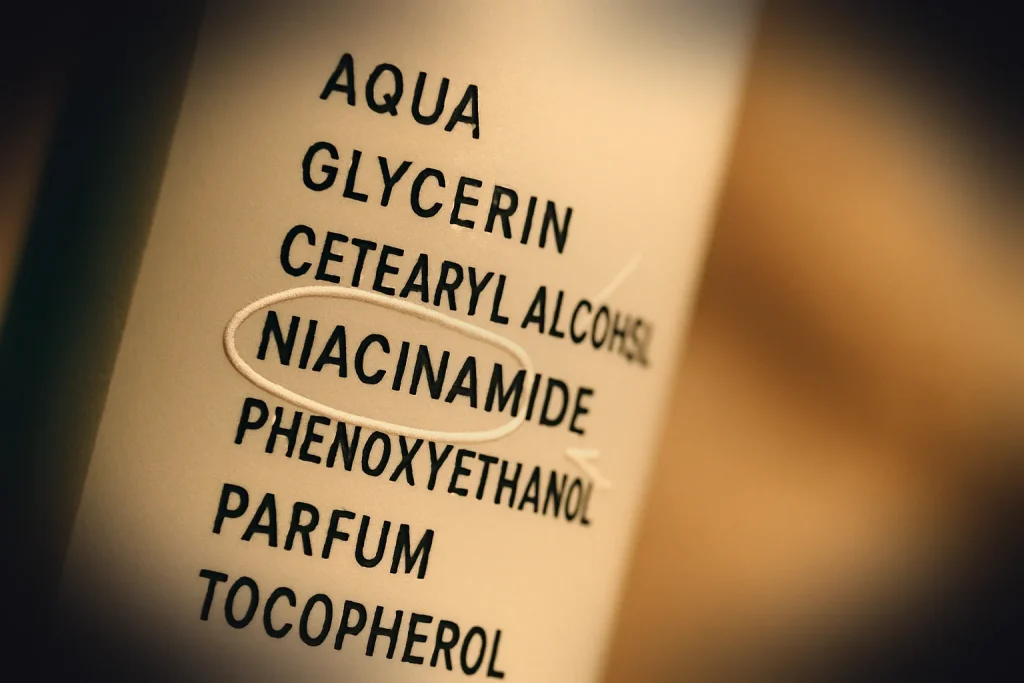
Codified in 21 CFR 701.3 (US) and Article 19 of EU Regulation 1223/2009. Ingredients above 1 percent of the formula appear in descending order. Water is almost always first in skincare because most products are 50 to 80 percent water by weight. Glycerin is often second or third. Emulsifiers, occlusives, and the bulk-volume actives follow. This part of the list is genuinely informative. Niacinamide listed second or third means it is present at a meaningful concentration.
The below-1% rule
This is where the games happen. Below 1 percent, order is at the brand’s discretion. A 0.3 percent retinol can be listed before a 0.8 percent niacinamide, even though there is roughly 2.5 times more niacinamide in the bottle. The brand uses the order to flag the marketing-hero ingredient.
This is also where the long tail of essences, plant extracts, and ‘hero peptides’ get clustered. Many of these are present at 0.001 to 0.1 percent, sometimes lower. They do not do much at those concentrations; they earn their place on the front of the label.
How to find the 1% line
Look for one of these markers. Preservatives like phenoxyethanol typically sit at 0.5 to 1.0 percent. Once you hit phenoxyethanol on the list, you are at or just below 1 percent. Everything below that line is fair game for reordering. Tocopherol (vitamin E) at 0.1 to 0.5 percent often appears near phenoxyethanol. Disodium EDTA is usually at 0.1 percent. These are your visual anchors.
A retinol listed below phenoxyethanol on an INCI is probably under 0.5 percent. A retinol listed above phenoxyethanol is probably at 0.5 percent or higher. The exact concentration is rarely disclosed, but the 1 percent line gives you a floor.
The contrarian take: position is not everything
I have to be honest. Some highly effective ingredients work at sub-1 percent concentrations. Retinoids work clinically at 0.025 to 0.1 percent. Peptides work at 1 to 10 ppm. The blanket rule that anything below 1 percent is window dressing is wrong. The skill is knowing which actives have established efficacy at low concentrations and which do not.
Niacinamide needs 2 to 5 percent to work. If it is below the 1 percent line, it is decorative. Vitamin C (ascorbic acid) needs 10 to 20 percent for the well-documented anti-pigmentation and antioxidant effects. Below 5 percent it is doing very little. Hyaluronic acid is humectant at almost any concentration; the differences between 0.1 and 1 percent are minor for surface hydration. Use ingredient knowledge to interpret position, not position alone.
The ‘gimmick ingredient’ tell
A long list of plant extracts clustered near the bottom of the INCI, often eight to fifteen of them, is almost always pixie dust. Each one is present at 0.01 to 0.1 percent. None of them are doing measurable work. They are on the label for the front-of-bottle ‘with green tea, chamomile, calendula, ginseng, ginkgo, and rosemary’ claim. The product’s actual function is happening higher up the list.
I do not mind pixie dust on a moisturizer. I do mind paying a premium for it on a serum.
The real numbers on concentration disclosure
A 2021 audit published in JAMA Dermatology (Becker et al.) reviewed 250 anti-aging serums marketed in the US for their disclosed retinoid concentrations. Only 38 percent disclosed the percentage on the label or in marketing copy. Of the remaining 62 percent, an independent HPLC analysis of 40 randomly selected products found mean retinoid concentrations of 0.08 percent, with a range of 0.005 to 0.5 percent. The marketing language did not predict the concentration.
Sixty-two percent. That is the disclosure gap.
What you can do
Read the INCI top to bottom. Find your phenoxyethanol or tocopherol anchor. Anything above that is at meaningful concentration; anything below is variable. For each named active in marketing copy, ask whether it appears above or below the anchor. For peptides, retinoids, and some plant actives, sub-anchor placement can still be effective; for niacinamide, vitamin C, AHAs, BHAs, and most humectants, sub-anchor placement is window dressing.
See our claim language audit, the ‘clean’ label decoder, and our fragrance categories piece for the broader label toolkit.
FAQ
Where is the 1% line on a label? Phenoxyethanol, tocopherol, and disodium EDTA are your typical visual anchors. They sit at or just below 1 percent.
Do all actives need to be above 1%? No. Retinoids, peptides, and some specialized actives work at sub-1 percent concentrations. The rule is active-specific.
Why don’t brands disclose concentrations? They are not required to under FDA or EU rules. Some reputable brands voluntarily disclose. Many do not.
How do I know if a vitamin C serum is at 10%? If it is not stated, check INCI position. Ascorbic acid above phenoxyethanol means probably 5 percent or higher. Below, probably under 5 percent.
Is the EU stricter on INCI rules? Same 1 percent threshold rule. EU additionally requires fragrance allergen disclosure, which makes EU labels longer for the same formula.
Tag hub: More on slow skincare and label literacy
Sources
21 CFR 701.3 cosmetic ingredient labeling. EU Regulation 1223/2009, Article 19. Becker DE et al. Retinoid concentration disclosure in OTC anti-aging serums. JAMA Dermatology 2021.
Keep reading
References
- Kligman AM, Christensen MS. The biology of the stratum corneum revisited. Int J Cosmet Sci. 2011. PubMed.
- Draelos ZD. The science behind skin care: cleansers. J Cosmet Dermatol. 2008. PubMed.
Have a question about “How brands game ingredient list position (and how to read past it)”?
Ask our editorial desk. Best questions become full follow-up articles, reviewed by our medical reviewer. No medical advice given in private — answers run as articles or not at all.