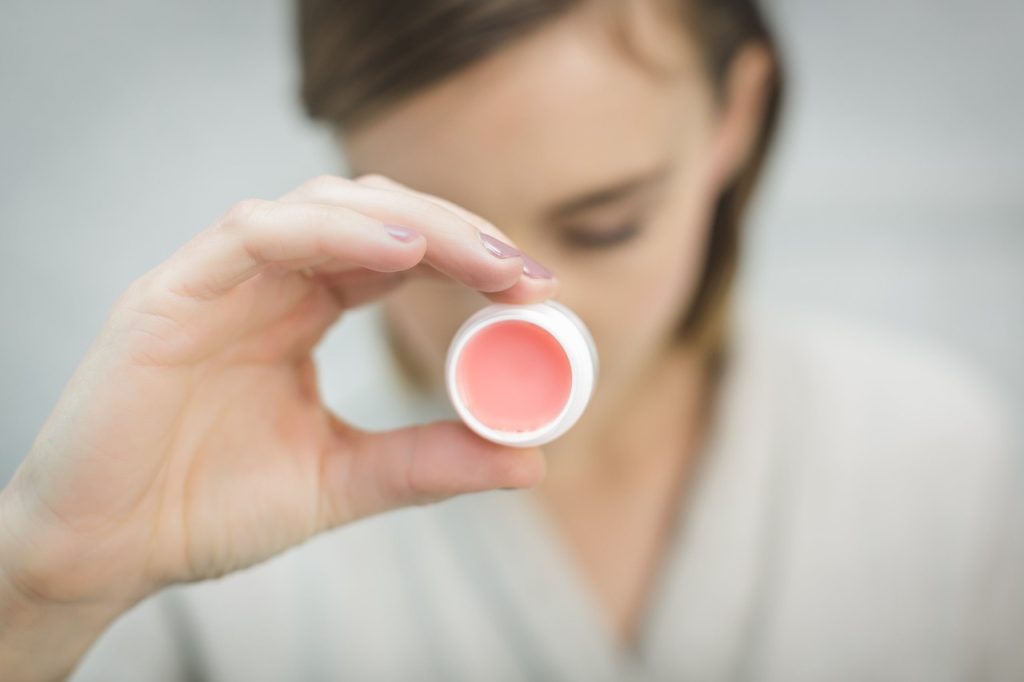
TL;DR: The lip vermilion hosts a microbial community distinct from facial skin and from inside the mouth. Twelve named genera dominate: Streptococcus, Staphylococcus, Corynebacterium, Cutibacterium, Rothia, Veillonella, Neisseria, Haemophilus, Granulicatella, Gemella, Prevotella, and Fusobacterium. Lip balm marketing pretends this surface is sterile and dry. It is neither.
A reader asked me last spring why her lip balm habit had gone from “useful in winter” to “I cannot stop applying it eight times a day or my lips feel like sandpaper”, and whether her lip balm was the problem. The short answer was probably yes. The longer answer is that the lip vermilion, that narrow strip of red between the skin of the face and the mucosa inside the mouth, is one of the most microbially interesting surfaces on the human body and almost nothing on the lip balm aisle treats it as such.
I want to walk through what is actually living on a human lip. This is a topic where almost every product claim is either ignoring the microbiome entirely or speaking about it in the vague abstract that means nothing. There are specific organisms. They do specific things. Disrupting the community changes how your lips behave, and most modern lip balms appear, when I read their formulations carefully, designed to disrupt the community rather than support it.
What the lip vermilion actually is
The vermilion zone is anatomically and microbially unusual. It has no hair follicles. It has no sweat glands. It has essentially no sebaceous glands except a small number of ectopic ones (Fordyce spots) that some people have visibly and some do not. The stratum corneum is thinner than on facial skin. The epithelium is highly vascularised, which is why lips are red. And the surface is constantly being wetted by saliva, dried by air, abraded by speech and eating, and rubbed by hands.
This means the lip microbiome sits in a chimeric zone between three different communities: facial skin (sebaceous and dry), oral mucosa (anaerobic and wet), and external environment (transient). The studies that have characterised it consistently find that the lip vermilion community looks like neither the cheek nor the gum but something specific to itself.
Costello et al.’s 2009 paper in Science (PMID: 19892944) was the first major topographical survey to include the lip explicitly. Findley et al. 2013 (PMID: 23698366) extended this with fungal sampling. Subsequent work (Oh et al. 2016, PMID: 27153496) confirmed the stability of these communities over time within an individual. The twelve genera I am going to walk through are the consistent dominators across studies.
The twelve genera
Streptococcus is the most abundant lip genus across nearly every study. Specifically, viridans group streptococci (S. mitis, S. salivarius, S. oralis) make up a meaningful share. These are the same organisms that dominate the oral cavity, and their abundance on the lip reflects the constant transfer of saliva and oral biofilm onto the lip surface. They are net protective. They metabolise sugars to lactate, lowering local pH and inhibiting more pathogenic organisms.
Staphylococcus is the second most abundant on most lips, dominated by S. epidermidis (commensal, protective) with smaller amounts of S. hominis, S. capitis, and occasionally S. aureus (which is variable and not necessarily pathogenic at low loads). S. epidermidis here behaves the same way it does elsewhere on facial skin: it secretes antimicrobial peptides, occupies adhesion sites, and competes with potential invaders.
Corynebacterium colonises the lip in moderate abundance, particularly the cooler outer edges. Corynebacteria are lipophilic, and they are doing more on the lips than the limited sebaceous output would suggest, partly because they utilise saliva lipids and partly because they tolerate the moisture cycling well.
Cutibacterium (formerly Propionibacterium, including C. acnes) is present at low to moderate abundance. Lower than on the forehead, higher than on the inner forearm. It produces propionic acid as a metabolic byproduct, which contributes to local pH stability.
Rothia is a genus that gets almost no attention outside microbiology circles but is consistently present on lips, particularly R. mucilaginosa and R. dentocariosa. Rothia species sit on the boundary between commensal and opportunistic. In healthy mouths they are part of the standard community. In immunocompromised hosts they can cause problems. On lips they are typically just there.
Veillonella is anaerobic and feeds on lactate produced by Streptococcus. This is one of the more interesting cross-feeding relationships in the human microbiome and it is happening on your lips while you read this. Veillonella species are abundant in saliva and they migrate onto the lip vermilion routinely.
Neisseria is present, particularly N. flavescens and N. subflava, and is one of the genera most disrupted by aggressive oral hygiene products. Heavy chlorhexidine or alcohol mouthwash use reduces Neisseria on the lip as a downstream effect.
Haemophilus species, particularly H. parainfluenzae, colonise the lip in modest amounts. Like Veillonella, they are obligate or facultative anaerobes that thrive at the moist interface.
Granulicatella is a small but consistent contributor. Granulicatella adiacens in particular shows up on most lip samples.
Gemella, including G. haemolysans, is present and behaves similarly to Streptococcus mitis in many ways: a low-virulence, lactate-producing commensal.
Prevotella is anaerobic and reflects the contribution from the oral mucosa. It is more abundant on the inner lip surface than the outer vermilion.
Fusobacterium, particularly F. nucleatum, is present in low abundance on most lips and higher in periodontitis. F. nucleatum is a bridge organism that mediates between early and late colonisers in oral biofilms, and some of its action plays out at the lip border.
That is the floor. The actual diversity is wider than this. Findley et al. also documented Malassezia species (M. restricta, M. globosa) on the lip, which complicates the picture for anyone with seborrhoeic dermatitis at the lip border. Other studies have picked up Lautropia, Capnocytophaga, and various Actinomyces species in varying amounts.
What lip balm marketing pretends is happening
Most lip balm copy treats lips as a stretch of dehydrated skin that needs occlusion, hydration, and sometimes “exfoliation”. The microbiome shows up nowhere in the marketing on any product I have read recently from the major drugstore brands. This is partly because the science is not in the place where you can confidently say “this prebiotic supports the lip community” without overclaiming. But it is also because acknowledging the microbiome would require acknowledging that several common lip balm ingredients are explicitly antimicrobial.
The relevant offenders are:
Phenol and menthol. Old lip balm formulations and some current “medicated” balms still contain phenol or its derivatives. Phenol is antimicrobial across the board. Menthol is also broadly antibacterial, less aggressively. These compounds are not selective. They reduce Streptococcus and Staphylococcus along with anything else. The cooling sensation is pleasant. The downstream is a disrupted community that responds with rebound colonisation by whatever opportunists are around, which is usually not what you wanted.
Camphor. Camphor is also broadly antimicrobial. Combined with menthol and phenol in classic medicated balms, it creates a triple antimicrobial action that can produce short-term symptomatic relief and longer-term dependence on the balm.
Salicylates in some chapped-lip products. Salicylic acid is keratolytic and at the concentrations used in lip products it is also mildly antimicrobial.
Fragrance and essential oils, particularly citrus oils (limonene, linalool), tea tree, peppermint, cinnamon, and eugenol-containing formulations. These are at minimum mildly antimicrobial and at high concentrations they are aggressive. Cinnamic aldehyde lip products are particularly notorious for both cheilitis and microbial disruption.
Preservatives. The preservation system of the balm itself, while necessary in the tube, transfers some antimicrobial activity onto the lip surface with each application. This is usually minor but not zero.
The reader I mentioned at the start was using a heavily mentholated balm with added camphor and a citrus oil base. Eight applications a day of a product like that is a sustained antimicrobial intervention, and the rebound disruption presents almost identically to chapped lips, which makes the user apply more. The loop is recognisable once you see it.
What disrupted lip microbiome looks like
The pattern is not subtle once you know to look for it. The lips feel dry within an hour of waking. They sting under any product application. Cold weather hits them harder than it should. Cracking at the corners (angular cheilitis) develops more easily, and the cracks colonise with Candida or S. aureus. The reflex is to apply more balm, which deepens the disruption. The cycle becomes self-sustaining.
There is no clinical test that you can run at home for “lip dysbiosis” the way you can test for vaginal dysbiosis. But the symptom pattern of constant balm dependence, sting on application of plain products, and angular cheilitis recurrence is consistent with community disruption.
What I changed about my own lip routine
I stopped using any lip product containing menthol, camphor, phenol, salicylates, or essential oils. This took me a week of looking at ingredient lists and discovering that most of my lip drawer had to go.
I switched to plain petrolatum (Vaseline, the original yellow kind, or the white pharmaceutical grade Aquaphor that adds lanolin and panthenol). Petrolatum is occlusive without being antimicrobial. It supports the existing community by maintaining barrier hydration. It does not feed anything in particular and it does not kill anything in particular. This is the closest thing to a microbiome-neutral lip product on the shelf.
I stopped lip-licking deliberately. The dehydrating effect of saliva on lip vermilion when it evaporates is real and Yosipovitch documented this years ago. Saliva is also alkaline relative to skin (around pH 6.5 to 7.5), and frequent saliva contact shifts the lip surface pH up, which favours certain organisms over others.
I dropped from eight applications a day to three. The first 10 days were uncomfortable. The next 30 days the lip surface re-equilibrated. By month 3 I was using lip balm at bedtime and occasionally during cold mornings and nothing else.
I want to be honest about the limit of this. I do not have my own pre- and post-microbiome sequencing data. I am extrapolating from published community composition data and from the symptom pattern. The intervention worked for me and for the readers who have tried versions of it and written back, but the mechanism I am describing is plausible rather than proven for the individual case.
FAQ
Is there such a thing as a “prebiotic lip balm”?
Sort of. Some products market with this language but the evidence base is thin. The most reasonable interpretation is that any non-antimicrobial occlusive (petrolatum, mineral oil, shea butter, lanolin) supports the lip community by maintaining barrier function and not actively disrupting the organisms there. You do not need a special prebiotic. You need to stop killing things.
Does Aquaphor really work better than plain Vaseline?
For most people, marginally. The added lanolin and panthenol in Aquaphor can help if you have any irritation, but lanolin is a moderate allergen (around 1 to 5 percent of the population reacts to it). If you have not tested it, patch first.
What about lip exfoliation products?
Mostly unnecessary and mildly disruptive. The lip vermilion exfoliates passively at a fast rate already. Scrubbing it adds mechanical disruption that can drive low-grade inflammation. If you have visible flaking, the right intervention is usually rehydration and occlusion, not abrasion.
Why do my lips get worse when I am sick?
Two reasons. Mouth breathing during congestion dries the vermilion at a rate that exceeds normal recovery. And cytokine elevation during viral illness shifts immune signalling at the lip border, which can let opportunists (HSV-1 reactivation, Candida) take advantage. The lip community itself also shifts under systemic inflammation.
Is angular cheilitis a microbiome problem?
Often yes, secondarily. The primary issues are usually mechanical (saliva pooling at corners), nutritional (iron, B vitamin, or zinc deficiency), or anatomical (dental occlusion changes in older adults). Once cracking is established, S. aureus and Candida colonise the cracks and sustain them. Treating just the colonisation without the underlying cause produces recurrence.
What this means for the routine
The lip vermilion hosts a real community of organisms doing real work, and the marketing on most lip balms either ignores this or actively undermines it. Pick a product that is occlusive but not antimicrobial. Apply it twice a day rather than eight times. Stop licking your lips. If you have a recurrent dependency on heavy medicated balms, expect the first two weeks of withdrawal to feel rough, and the community to take 30 to 60 days to re-equilibrate. The twelve genera will sort themselves out if you stop fighting them.
Related Elelaf tools
Sources
- Kong HH, Andersson B, Clavel T, et al. Performing Skin Microbiome Research: A Method to the Madness. J Invest Dermatol. 2017;137(3):561-568. PMID: 28063650
- Byrd AL, Belkaid Y, Segre JA. The human skin microbiome. Nat Rev Microbiol. 2018;16(3):143-155. PMID: 29332945
- Costello EK, Lauber CL, Hamady M, Fierer N, Gordon JI, Knight R. Bacterial community variation in human body habitats across space and time. Science. 2009;326(5960):1694-1697. PMID: 19892944
- Grice EA, Kong HH, Conlan S, et al. Topographical and temporal diversity of the human skin microbiome. Science. 2009;324(5931):1190-1192. PMID: 19478181
- Findley K, Oh J, Yang J, et al. Topographic diversity of fungal and bacterial communities in human skin. Nature. 2013;498(7454):367-370. PMID: 23698366
- Oh J, Byrd AL, Park M, Kong HH, Segre JA. Temporal Stability of the Human Skin Microbiome. Cell. 2016;165(4):854-866. PMID: 27153496
Related: Probiotic skincare vs prebiotic skincare: the lactobacillus vs xylitol debate.
References
- Grice EA, Segre JA. The skin microbiome. Nat Rev Microbiol. 2011. PubMed.
- Yu Y, Dunaway S, Champer J, et al.. Changing our microbiome: probiotics in dermatology. Br J Dermatol. 2020. PubMed.
Have a question about “Lip microbiome: the 12 species nobody mentions in lip balm marketing”?
Ask our editorial desk. Best questions become full follow-up articles, reviewed by our medical reviewer. No medical advice given in private — answers run as articles or not at all.