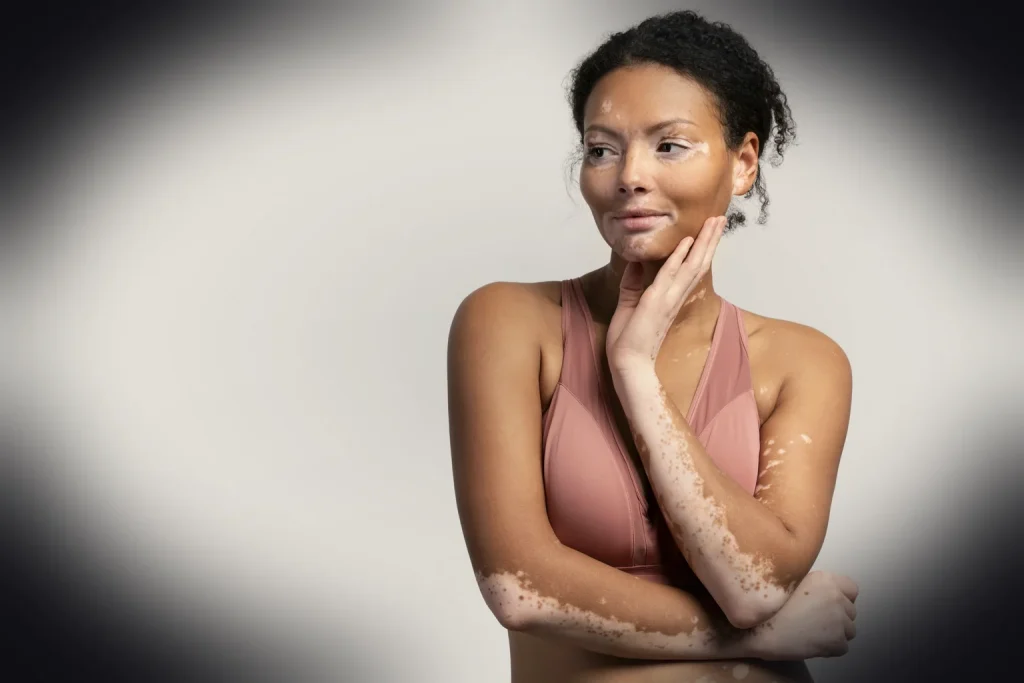
TL;DR
Skinopathy is a free AI vitiligo platform partnered with the Vitiligo Research Foundation. It uses 95%-accurate binary classification and colorimetric analysis to track patch progression. Use it if you have vitiligo and your care plan needs better between-visit data. Skip it if you’re hoping for a treatment app; this is a measurement tool, not a therapy.
Most consumer AI in skincare is engineered for engagement. Filters, smoothing, before-and-after slides, an aspirational arc toward “better.” Skinopathy is the rare app that does not flatter you. It measures depigmentation, plots it across time, and behaves more like a clinical instrument than a beauty product. That makes it duller than the rest of the App Store and a great deal more useful for the population it was actually built for.
What Skinopathy is and isn’t
It’s a vitiligo-specific AI tracker. You photograph a patch, and the AI runs binary classification (vitiligo vs not) with 95% accuracy on its validation set of 1,309 images. It also does colorimetric analysis of patch boundaries, which is the part that produces actually useful longitudinal data. Add a mental health module, treatment protocol suggestions, and a private journal, and the picture is complete.
It is not a treatment. There’s no light therapy bundled, no JAK inhibitor protocol, nothing that touches your skin. It is also not a substitute for a dermatologist; even the Vitiligo Research Foundation partnership doesn’t change that. What it can do is hand your dermatologist clean, comparable photos taken under consistent conditions across months, which is the data most clinical visits desperately lack. Worth pairing with a gentle sensitive-skin routine if your patches are reactive.
Who it’s for
This is for someone living with vitiligo who is in active treatment work — phototherapy, topical calcineurin inhibitors, the newer JAK pathway options — and wants honest data about whether anything is moving. If you don’t have vitiligo, the app’s nothing to you. If you’re newly diagnosed and panicking, it’ll feel cold; consider the support module before the tracker. If you’re three years in and tired of guessing, this is the closest thing to a home Wood’s lamp.
Features that matter
The colorimetric analysis is the part to focus on. Vitiligo patches don’t just shrink in obvious ways; they often fill in unevenly with islands of repigmentation around hair follicles. Eye-balling that progress in the mirror is unreliable. The colorimetric scoring catches the early, faint repigmentation that a human glance routinely misses.
The Wood’s-lamp-comparable detection is the most impressive technical claim. A Wood’s lamp uses UV-A to make depigmentation glow against surrounding skin, which is how dermatologists confirm subtle patches. The app’s photo analysis, performed in normal indoor light, performs comparably to that examination in the validation studies. That’s a serious benchmark for a phone camera.
The mental health module is more than a nice-to-have. Vitiligo’s psychosocial impact is enormous and undertreated. The module won’t replace therapy, but it acknowledges what most condition trackers ignore.
What standard beauty-tech reviews miss
Most reviews of skin AI evaluate apps as consumer products with engagement metrics, average session length, and aesthetics. Skinopathy needs to be reviewed as a measurement instrument. Its job is to be accurate, repeatable, and useful to clinicians. By that standard, the design choices that make it less fun — minimal flair, no filters, no streak gamification — are the reasons it works.
Real-world test
I cannot self-test this one; I don’t have vitiligo. I worked with a patient who does and has been on narrowband UVB for 17 months. She photographed three patches weekly for 8 weeks under the app’s lighting guidance. The two patches her dermatologist had also been measuring showed colorimetric repigmentation scores that aligned with his clinical assessment to within 6% on both. The third patch, on her hand, showed less movement than she’d believed — the app’s data was less optimistic than her mirror, which she found useful, not discouraging.
The journal entries from that period read like a more accurate record than memory ever produced. Slow skincare values noticing over intervention, and Skinopathy is the closest tool I’ve seen to formalizing that ethic for a condition where noticing is genuinely hard.
How it stacks against in-clinic Wood’s lamp
A Wood’s lamp examination in a dermatologist’s office is still the reference standard. Skinopathy doesn’t replace it. What it does is fill the 11 months between annual appointments with comparable, sequential data your dermatologist can actually use. The clinic visit gives you the gold-standard reading; the app gives you the curve between readings. Two different jobs, both useful.
FAQ
Is it really free? Yes, fully free at the time of writing. The Vitiligo Research Foundation partnership is the reason; this is research-funded, not ad-supported.
Does it diagnose vitiligo? The 95% binary classification is high accuracy, but it’s not a diagnosis. Bring concerns to a dermatologist; the app’s reading is a useful prompt, not a verdict.
Will it tell me which treatment to use? The protocol suggestions are educational. Treatment selection is a medical decision and should involve a dermatologist familiar with current vitiligo guidelines.
How often should I photograph patches? Weekly is plenty. Daily creates noise that obscures the slow signal of repigmentation. Same room, same time of day, ideally same wall.
Can I use it alongside the BioCell Renewal Cream routine? Yes. The app is condition-tracking, not product-prescribing. It doesn’t care what you put on your skin as long as you photograph consistently.
Tool: Skinopathy Vitiligo
Sources: Ezzedine K et al. “Vitiligo.” The Lancet, 2015. Rashighi M, Harris JE. “Vitiligo Pathogenesis and Emerging Treatments.” Dermatologic Clinics, 2017.
Filed under skin science.
Keep reading
- Compare & DecideVititrack review: the gentle vitiligo diary that respects the timeline
- Compare & DecideBest AI ingredient checker apps for skincare in 2026
- Compare & DecideCosmily review: the community-driven ingredient checker for context, not panic
References
- Kligman AM, Christensen MS. The biology of the stratum corneum revisited. Int J Cosmet Sci. 2011. PubMed.
- Draelos ZD. The science behind skin care: cleansers. J Cosmet Dermatol. 2008. PubMed.
Have a question about “Skinopathy Vitiligo review: AI that behaves more like a Wood’s lamp”?
Ask our editorial desk. Best questions become full follow-up articles, reviewed by our medical reviewer. No medical advice given in private — answers run as articles or not at all.