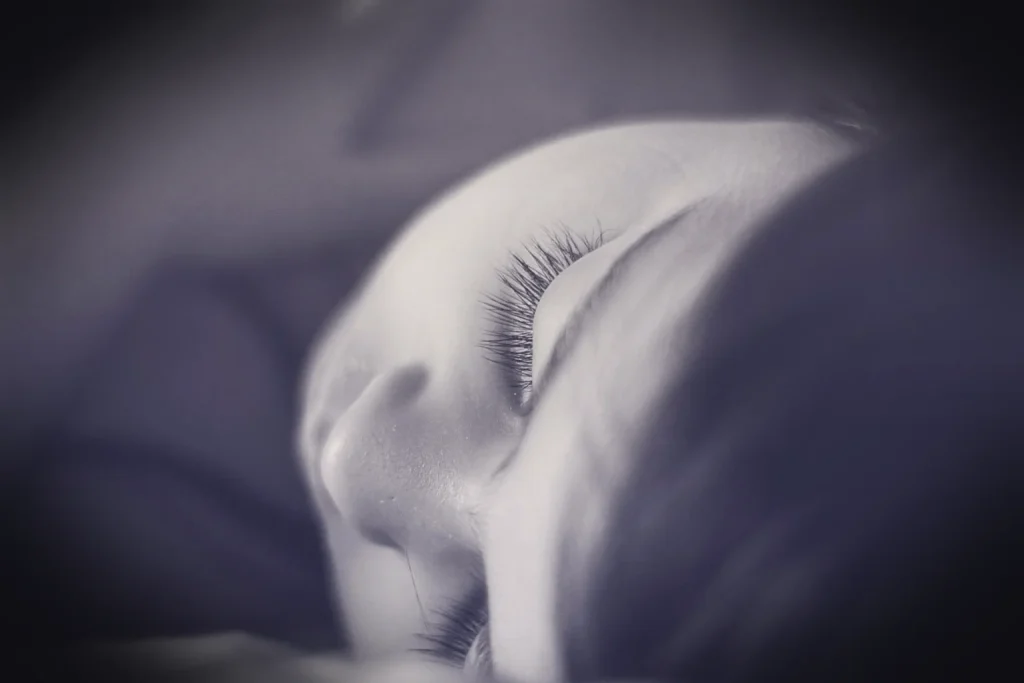
If you’ve slept on the same side most of your life, your dominant cheek probably shows deeper lines, more crepe, and a slightly looser midface than the other one. It’s not your imagination. Chronic compression during sleep produces measurable asymmetric aging. You cannot easily retrain sleep position, but silk pillowcases, retinoids, and a few practical adjustments make the trajectory less steep.
One of the more disorienting moments in skincare is looking at a recent close-up photo and realising your face is no longer symmetric in the way it used to be. The left cheek looks slightly heavier. The right has a crease running from the corner of the mouth that the left doesn’t. The usual explanation is sun exposure (driver-side window), but for a lot of people the more honest answer is sleep position.
What it is
Sleep compression is the chronic mechanical pressure your face experiences for six to eight hours a night, for decades, when you sleep on your side or front. Unlike sun damage, which can be blocked by sunscreen, sleep compression acts on deeper structures and has no convenient barrier you can apply.
A 2016 study in Aesthetic Surgery Journal documented what plastic surgeons had described anecdotally for years: side and stomach sleepers show characteristic patterns of sleep wrinkles distinct from expression lines. They run more vertical, sit on the cheek and forehead rather than around the eyes and mouth, and don’t fully disappear at rest.
Why it happens
Three things accumulate. Mechanical creasing folds the skin into the same lines, night after night, until the dermis remodels around the fold. Young skin springs back; older skin keeps the crease. Gravity acts differently on a face pressed against a pillow than on one lying flat, so soft tissue migrates with chronic compression. And repeated friction on the same surface compromises the barrier in that area over years.
Stomach sleeping is worse than side sleeping because the full weight of the head presses into the pillow. Back sleeping is best for the face. The catch is that back sleeping is not how most people naturally sleep, and few patients successfully retrain themselves.
What helps
If you cannot change your sleep position, you can change what your face presses into. Silk and satin pillowcases reduce friction compared with cotton. They do not eliminate compression, but they prevent the skin from being pulled across a rough surface for hours. Anecdotally, dermatologists have been recommending them for years. The mechanism is plausible even if the controlled trials are limited.
A specialised sleep pillow — shaped to support the head while keeping the face suspended off the surface — is more effective and significantly more expensive. Some plastic surgeons recommend these after facial procedures. They reduce wrinkle formation in trial data, but adherence is the limiting factor.
For the skin itself, the evening routine matters more than the morning one. Retinoids remain the best-supported tool for remodelling existing wrinkles, including sleep wrinkles. Tretinoin 0.025% to 0.05%, used three to five nights a week, produces measurable collagen reorganisation over six to twelve months. Peptides layered into the evening routine, like those in our BioCell Renewal Cream, support the same process more gently. Adding Microbiome Glow Serum in the morning supports the barrier integrity that compression chronically erodes on the dominant side.
The contrarian take
You will see content claiming you can correct sleep wrinkles with overnight tape, silicone patches, or specialised “face-up” sleep training. The patches do reduce wrinkle depth temporarily; they reform within hours of removal because the underlying cause is unchanged. Sleep retraining works for a minority of people and frustrates the rest. The realistic project is not to eliminate the asymmetry but to slow its progression. If both cheeks age, the goal is that they age at similar enough rates that the difference stays subtle.
When to see a dermatologist
Asymmetric aging is mostly a cosmetic concern, not a medical one. See a dermatologist if the asymmetry is sudden rather than gradual (sudden facial drooping can indicate Bell’s palsy or stroke and is an emergency), if one side has a new pigmented lesion that doesn’t match the other, or if you are considering procedural correction. Filler, focused on the deflated side, and microfocused ultrasound or radiofrequency can re-balance midface volume. Botox on the platysmal bands or masseter can shift the lower-face balance. These are useful tools if you’ve exhausted the topical route.
Real numbers
The 2016 Aesthetic Surgery Journal study by Anson G et al. assessed wrinkle patterns in 71 women across a range of ages and sleep positions. Side sleepers showed an average increase in dominant-side cheek wrinkle severity of about 25 to 40% versus the non-dominant side, increasing with age. By the seventh decade, asymmetry was visible to clinical assessors in roughly 70% of habitual side sleepers. Stomach sleepers showed similar or greater asymmetry, plus characteristic vertical forehead lines on the dominant side.
FAQ
Will switching to back-sleeping reverse existing damage? It may slow progression. It does not reverse remodelled dermal structure on its own. You need topical or procedural support for reversal.
Are silk pillowcases worth it? For friction reduction, yes. For wrinkle prevention specifically, mildly. For hair, they help more than they help skin.
Does sleeping on the same side affect under-eye bags? Yes. Fluid pools on the lower side overnight, which is partly why the morning under-eye looks puffier on the dominant side.
Can a high pillow help? Slight elevation reduces overnight fluid pooling and may reduce midface puffiness. Too high and you create new neck and posture issues.
Is sleep wrinkle research solid? The biomechanics are well-described. The interventions are studied but in small trials. Treat the recommendations as plausible rather than ironclad.
Related reading: starting a retinoid, peptides explained, and our PM routine for mature skin. The anti-aging tag hub gathers more.
Sources
Anson G, Kane MA, Lambros V. Sleep wrinkles: facial aging and facial distortion during sleep. Aesthetic Surgery Journal, 2016. Fisher GJ et al. Mechanisms of photoaging and chronological skin aging. Archives of Dermatology, 2002. Mayo Clinic. Wrinkles – symptoms and causes. mayoclinic.org, accessed 2026.
Keep reading
References
- Kligman AM, Christensen MS. The biology of the stratum corneum revisited. Int J Cosmet Sci. 2011. PubMed.
- Draelos ZD. The science behind skin care: cleansers. J Cosmet Dermatol. 2008. PubMed.
Have a question about “Sleeping on one side: why your side-sleeper cheek ages faster than the other”?
Ask our editorial desk. Best questions become full follow-up articles, reviewed by our medical reviewer. No medical advice given in private — answers run as articles or not at all.