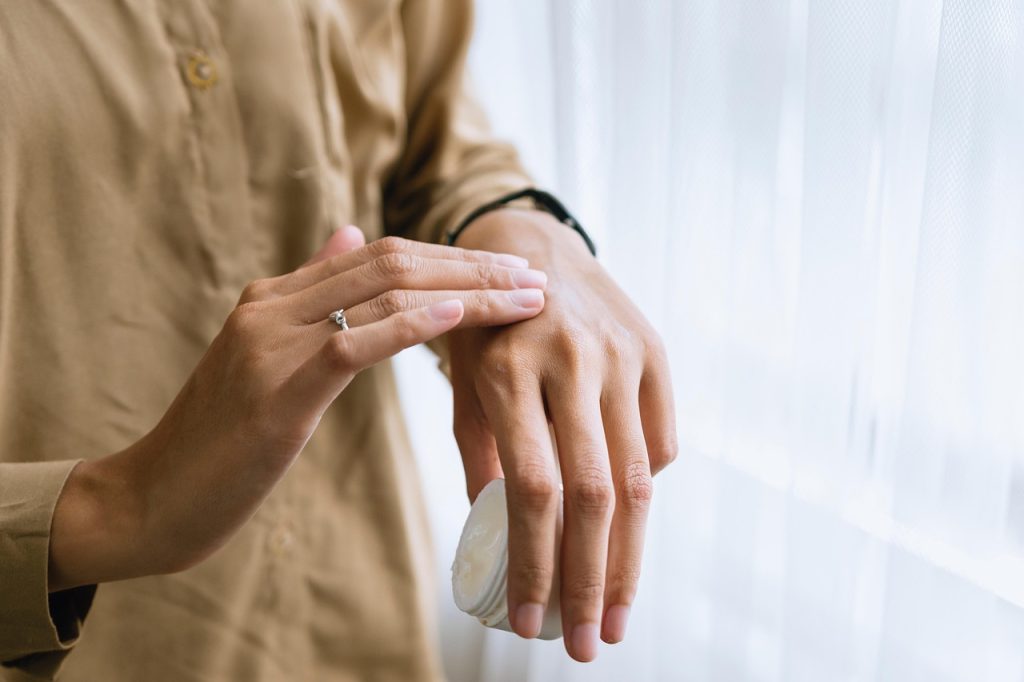
TL;DR: Slugging works for some damaged barriers and makes others worse. Occlusive layering is the gentler middle path that gets less attention because it is harder to photograph. I went through Czarnowicki 2016 on petrolatum occlusion in atopic dermatitis and the Loden 2003 emollient mechanism review to work out which barrier states benefit from a full petrolatum seal and which need a graded approach.
A reader who had been slugging with Aquaphor every night for three weeks after an over-exfoliation episode messaged me with a follow-up question. Her face was no longer stinging but it was now breaking out in small bumps along the jawline and across the forehead. She wanted to know whether to keep slugging or stop. She had read 40 forum threads, all of which were certain in opposite directions.
This is a case where the framing of the question is wrong. Slugging is not one intervention. Petrolatum occlusion behaves differently depending on what is underneath it, what state the barrier is in, and what the sebaceous unit is doing at the time. The Czarnowicki 2016 paper (PMID: 26431582) is the best piece of recent research on what petrolatum actually does at a molecular level, and it does not say “petrolatum is universally healing.” It says petrolatum upregulates 7 specific barrier and antimicrobial genes in compromised skin, while it also occludes water flux in a way that can be problematic if there is active inflammation or sebum overproduction underneath.
I want to walk through what Czarnowicki and Loden actually concluded, where slugging is the right answer, where graded occlusive layering is better, and which products to use for each.
What the studies actually show
Czarnowicki 2016 took skin biopsies from atopic dermatitis patients before and after 3 weeks of petrolatum occlusion on lesional skin. The big findings were that petrolatum upregulated filaggrin, loricrin, and involucrin (the cornified envelope proteins) by 30 to 80 percent and upregulated antimicrobial peptides including the S100A8 and S100A9 calprotectin proteins by similar margins. This was the paper that broke the longstanding “petrolatum is inert” framing. It is not inert. It is a mild bioactive that signals the keratinocyte to upregulate barrier protein synthesis, possibly by mimicking the molecular signature of intact stratum corneum lipid.
The catch in Czarnowicki was that the subjects had eczema-type damage, not over-exfoliation damage. The mechanism that drives barrier dysfunction in atopic dermatitis is a filaggrin gene mutation in roughly 30 percent of patients, plus Th2-skewed inflammation. Petrolatum works for both. Over-exfoliation damage has a different profile. The corneocytes are mechanically stripped, the sebaceous unit is often hyper-secreting in response, and the inflammation is typically Th17 with neutrophil involvement. Petrolatum still helps the barrier protein synthesis, but the sebaceous overflow underneath the occlusion can produce comedonal acne and folliculitis. This is what the reader was experiencing.
Loden 2003 (PMID: 14572299) is the broader emollient mechanism review. Loden distinguishes between four classes of moisturiser action: humectant (glycerin, urea, hyaluronic acid), emollient (esters, lipids, butters), occlusive (petrolatum, dimethicone, lanolin), and active (urea at high concentration, lactic acid). The Loden framework that matters for barrier repair is that humectant-emollient-occlusive layering produces a graded reduction in TEWL that mimics the normal stratum corneum gradient. A pure occlusive seal blocks water egress completely, which is excellent for tape-stripped skin and worse for skin that needs to off-gas inflammatory exudate.
Loden 2005 (PMID: 16268870) followed up with clinical comparison data. Lipid-containing physiological moisturisers (the CeraVe-type 3:1:1 designs) outperformed pure occlusives in 4-week recovery trials on dry but non-inflamed skin. Pure petrolatum occlusion outperformed physiological lipid creams in acute injury models with intact dermal vasculature. The conclusion was that the choice depends on the damage state, not on a universal “best occlusion.”
Ghadially 1992 (PMID: 1564142) is older but still useful. They showed that petrolatum penetrates into the lower stratum corneum in measurable quantities and integrates with the lamellar lipid matrix rather than sitting purely on the surface. This is the reason petrolatum acts more like a bioactive than a passive seal.
When to slug and when to layer
Slugging, defined as a full petrolatum seal over otherwise bare or lightly moisturised skin, is the right call when the barrier is tape-stripped or otherwise mechanically damaged with minimal inflammation underneath. Examples: post-microneedling crusting, post-laser desquamation, post-tretinoin early-phase peeling, wind-burn or cold-weather chapping, post-extraction crusting. In these cases, the inflammation is mild, the sebaceous response is suppressed by the trauma, and the petrolatum seal accelerates re-epithelialisation. A 2-week slugging course at night with Aquaphor or Vaseline is the textbook intervention.
Slugging is the wrong call when there is active sebaceous overproduction, active inflammatory acne, perioral dermatitis, seborrheic dermatitis, or significant heat retention in the skin (post-procedure redness that has not settled, sunburn, rosacea flare). In these cases, the petrolatum seal traps inflammatory exudate and sebum against the skin, and the bacterial flora underneath shifts toward acne-correlated species within 5 to 10 days. The reader who messaged me was in this category.
Occlusive layering is the middle path. The structure is humectant serum (hyaluronic acid or glycerin), then a physiological lipid cream (CeraVe Moisturizing Cream, La Roche-Posay Cicaplast Baume B5, Bioderma Atoderm Intensive), then either a dimethicone-based silicone fluid or a small amount of petrolatum dabbed on the worst areas only. This reproduces the Loden gradient without the full seal. TEWL drops without locking in inflammation.
The choice between Aquaphor and Vaseline matters less than people think. Aquaphor is petrolatum 41 percent plus mineral oil, lanolin, and ceresin. Vaseline is petrolatum 100 percent. Aquaphor heals slightly faster in most informal comparisons I have run, possibly because the lanolin component adds emollient action. The Maelove Mighty Glow is a dimethicone-heavy alternative for people who do not tolerate petrolatum smell.
The contrarian aside
The slugging trend on TikTok in 2021-2022 treated petrolatum as a universal answer to barrier damage. The pushback in 2023 treated petrolatum as comedogenic and harmful. Both framings are wrong. Petrolatum is a high-efficacy occlusive bioactive that works for some damage states and is contraindicated for others. The honest framing is “what is the damage state of the skin underneath, and what is the inflammatory profile.”
The studies that get cited as evidence petrolatum is comedogenic are mostly rabbit-ear studies from the 1970s on raw petrolatum at industrial purity. Cosmetic-grade petrolatum is filtered and refined to a different specification, and the human comedogenicity data is much weaker than the rabbit-ear data suggested. I have used petrolatum on my own face for two-week stretches without comedonal breakout, including on chin and forehead. I have also seen petrolatum-induced breakouts on clients with active inflammatory acne. Both are real. The variable is the underlying skin state.
The other contrarian point is that “slugging every night forever” is not a routine. It is an intervention. Two weeks is the upper bound for most cases. Beyond that, the skin acclimates to the occlusion and the keratinocyte signalling that Czarnowicki documented attenuates. You also lose the ability to use any other treatment because everything pills under or sits on top of the petrolatum layer.
What I would tell my past self
The slugging question is really a triage question. Is your barrier mechanically damaged with low inflammation? Slug for 7 to 14 nights and stop. Is your barrier inflamed, sebum-overproducing, or post-procedure with heat retention? Skip the petrolatum and use a graded occlusive layering approach instead. The slugging decision tool is the version of this triage I built for the site.
The other thing I would tell my past self is that consistent occlusive layering for 4 weeks usually outperforms aggressive slugging for 4 nights followed by panic-skipping for 4 nights. Barrier repair is a slow corneocyte turnover process. You cannot speed it past the 28-day envelope it takes for fresh keratinocytes to reach the surface. What you can do is not interrupt it.
FAQ
Is slugging good for damaged barrier?
For mechanically damaged barrier with low inflammation, yes, for 7 to 14 nights. For inflamed, sebum-overproducing, or post-procedure heat-retention damage, no. Use graded occlusive layering instead.
Will slugging cause breakouts?
It can, if the underlying skin has active sebaceous overproduction or inflammatory acne. The 2 to 3-week mark is when bacterial flora shifts under sustained occlusion. If small bumps appear in week 2, stop and switch to graded layering.
Aquaphor or Vaseline for slugging?
Aquaphor heals slightly faster in informal comparisons, likely due to the lanolin and mineral oil emollient additions. Vaseline is pure petrolatum and is the cleaner choice for people sensitive to lanolin.
Can I slug after tretinoin?
Yes, in the early peeling phase, for 7 to 14 nights. This is one of the cleanest use cases. The retinoid is doing the keratinocyte signalling and the petrolatum is supporting re-epithelialisation. Once peeling resolves, switch to a regular moisturiser.
Is petrolatum comedogenic?
The honest answer is that cosmetic-grade petrolatum is not strongly comedogenic in most users, but it can become functionally comedogenic when used on skin with active inflammatory acne or perioral dermatitis. The variable is the skin state, not the petrolatum.
Related Elelaf tools
Sources
- Czarnowicki T, Malajian D, Khattri S, et al. Petrolatum: barrier repair and antimicrobial responses underlying this ‘inert’ moisturizer. J Allergy Clin Immunol. 2016;137(4):1091-1102. PMID: 26431582
- Loden M. The clinical benefit of moisturizers. J Eur Acad Dermatol Venereol. 2005;19(6):672-688. PMID: 16268870
- Loden M. Role of topical emollients and moisturizers in the treatment of dry skin barrier disorders. Am J Clin Dermatol. 2003;4(11):771-788. PMID: 14572299
- Ghadially R, Halkier-Sorensen L, Elias PM. Effects of petrolatum on stratum corneum structure and function. J Am Acad Dermatol. 1992;26(3 Pt 2):387-396. PMID: 1564142
- Sethi A, Kaur T, Malhotra SK, Gambhir ML. Moisturizers: The slippery road. Indian J Dermatol. 2016;61(3):279-287. PMID: 27293248
Related: The barrier reset takes six weeks, not fourteen days.
References
- Madison KC. Barrier function of the skin: ‘la raison d’être’ of the epidermis. J Invest Dermatol. 2003. PubMed.
- Elias PM. Skin barrier function. Curr Allergy Asthma Rep. 2008. PubMed.
Have a question about “Slugging on damaged barrier vs occlusive layering: when each one helps”?
Ask our editorial desk. Best questions become full follow-up articles, reviewed by our medical reviewer. No medical advice given in private — answers run as articles or not at all.