TL;DR: Spironolactone is an off-label adult-acne treatment with decades of safety data in women, yet many people cycle through topicals for years before anyone mentions it. The threshold for raising it should be earlier than most patients realise: jawline pattern, premenstrual flare, failure of two adequate topical courses. The drug is not a first line for everyone, but the conversation is overdue when those criteria stack.
A reader emailed me last month with a question I get more often than any other in this category. She is 31. She has been on three different topical regimens since she was 26. Her acne is along the jaw and chin, it flares the week before her period, and her current dermatologist keeps adjusting her benzoyl peroxide percentage. She asked whether she should bring up spironolactone or whether that was a question for a different kind of appointment.
The answer is that the conversation should have happened two regimens ago. Not because spironolactone is the right drug for every adult woman with acne. Because the pattern she described is the pattern the drug treats, and the failure of adequate topical therapy is the trigger that the published guidelines name.
This is the piece I would send her if I had more than a paragraph.
What the studies actually show
The foundational paper most dermatologists were taught from is Shaw 2000 (PMID: 10954663), a retrospective look at 85 women treated with low-dose spironolactone for acne. Sixty-six percent had marked improvement or clearing. The doses were 50 to 100 mg daily, which is well below the doses used for blood pressure or heart failure. Side effects were the ones the drug class is known for: menstrual irregularity, breast tenderness, occasional dizziness, and the diuretic effect that the drug is actually marketed for.
The paper that changed the safety conversation is Plovanich 2015 (PMID: 25796612). The historical practice was routine potassium monitoring for any patient on spironolactone, because the drug is potassium-sparing and hyperkalemia is the theoretical risk. Plovanich and colleagues looked at 974 healthy young women taking spironolactone for acne and found a hyperkalemia rate of 0.72 percent, which was statistically indistinguishable from the baseline rate in the same age group not on the drug. The clinical implication is that the monitoring most clinicians had been doing was not catching anything that would not have been caught anyway. Many derm practices dropped routine potassium checks after this paper in healthy women under 45. Older patients and patients with kidney disease or on ACE inhibitors remain a different conversation.
Charny 2017 (PMID: 28560306) extended the efficacy picture in 110 patients and found 85 percent improvement at doses averaging 100 mg, with discontinuation rates around 15 percent driven mostly by menstrual irregularity rather than serious adverse events. Layton’s 2017 hybrid review (PMID: 28155090) is the most thorough synthesis and notes the same pattern across the literature: effect sizes are moderate to large in jawline and chin-distributed acne in adult women, the evidence base is mostly observational rather than randomized, and the safety profile is well characterised after decades of use.
The American Academy of Dermatology guidelines (Zaenglein 2016, PMID: 26897386) place spironolactone in the adjunctive systemic category, recommend it for women with acne resistant to topical therapy, and explicitly note its utility when hormonal patterns are present. The 2024 guideline update preserves this positioning. It is not buried language. It is in the algorithm.
The pattern that the drug treats
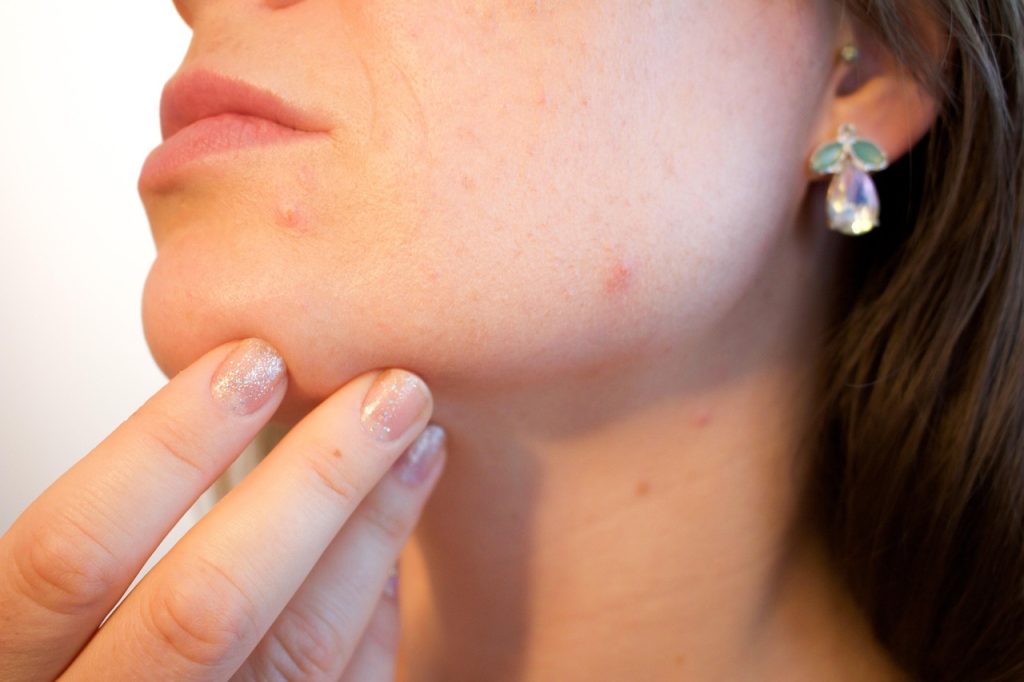
If you read the case series carefully, the patients who respond best share features. Acne is concentrated below the cheekbones, along the jawline, the chin, sometimes the neck. There is a cyclical pattern tied to the menstrual week. The lesions tend to be deeper, inflamed papules and nodules rather than comedones. Topical retinoids and benzoyl peroxide have been tried at adequate strength for adequate duration, and the response was partial or absent.
This is what most clinicians mean when they say hormonal acne, though the term is imprecise because most adult female acne has some hormonal component, and serum androgen levels are usually normal in the women who respond to spironolactone. The drug works at the receptor, not by changing circulating hormone concentrations, which is why it can help patients whose blood work is unremarkable.
If your pattern does not match this and your acne is comedonal across the forehead and cheeks with no menstrual signal, the drug is less likely to help and the conversation is different. That distinction matters more than most patients realise.
The contrarian section
The framing I disagree with is the one that treats spironolactone as a last resort. The published trigger is failure of adequate topical therapy, not failure of every topical, every combination, every percentage. Adequate means a retinoid plus a benzoyl peroxide or antibiotic, used consistently for three to four months. If you have done that and you are still flaring on the same schedule, the data does not support a fourth topical iteration. It supports asking about the drug.
The other framing I disagree with is the alarm around side effects. The published rates are real, they should be discussed, and the diuretic effect is genuinely annoying for some patients in the first month. But the way spironolactone is sometimes presented to patients makes it sound categorically more dangerous than the antibiotics those same patients have been on for six months. Long-term tetracycline use is also not without cost, and that conversation rarely happens with the same gravity.
Pregnancy is a real contraindication and the drug is contraindicated in patients trying to conceive. That is the one boundary that should be discussed clearly at the first appointment, not the third.
The third framing I would push back on is the idea that the conversation belongs in a specialist appointment only. General dermatologists prescribe spironolactone routinely for acne in many countries. The drug is generic, inexpensive, and the prescribing pattern is well established. If your dermatologist does not prescribe it, that is worth knowing, and it is worth asking whether they refer or whether a different practice in your area is more comfortable with it.
What I would tell my past self
I would tell her that the question is not whether spironolactone is the right drug for everyone with adult acne. It is not. The question is whether the pattern matches and whether you have done the prerequisite topical course honestly.
I would tell her that the published criteria are clearer than her appointments suggested. Adult woman, jawline pattern, cyclical signal, two adequate topical regimens behind her, no plan to be pregnant in the immediate term. That is the conversation, and the AAD guideline says so plainly.
I would tell her that the potassium monitoring question is mostly settled for her demographic, and that if a clinician is requiring monthly blood draws for a healthy 31-year-old without renal disease, that is a reasonable thing to ask about. The 2015 paper changed practice, and not all clinicians updated.
I would tell her that the most common reason patients discontinue is not safety. It is the menstrual irregularity, the breast tenderness in the first eight weeks, and the diuretic effect. Those are tolerable for many people and intolerable for others, and there is no way to predict which side you fall on except to try.
I would tell her, finally, that asking the question is not a confrontation. It is the next step in the algorithm her clinician already follows.
FAQ
Should I get hormone testing before asking about spironolactone?
Most of the published case series do not screen routinely. Serum androgen levels are usually normal in the women who respond, and a normal panel does not predict who will or will not improve. Testing makes sense if there are other signs of androgen excess like irregular cycles, hirsutism, or hair loss in a male-pattern distribution. In those cases the workup is broader than acne.
How long until I know if it is working?
The published response curve is slower than topicals. Most series report initial change at six to eight weeks and full response at twelve to sixteen weeks at the eventual maintenance dose. Judging at four weeks is too early. If the dose started low and is being titrated, the clock effectively restarts at each increase.
What about birth control instead?
Combined oral contraceptives are also in the AAD algorithm for hormonal acne in women and have a different evidence base. Some patients use them in combination with spironolactone. Some prefer one or the other for non-acne reasons. The choice is individual and is genuinely a conversation with the prescriber, not a default.
Is the dose the same as for blood pressure?
No. Acne doses are usually 50 to 100 mg daily, with some practices going up to 150 or 200 mg in resistant cases. Cardiac doses can be higher. The diuretic effect at acne doses is real but milder than at cardiac doses.
Can men take it for acne?
Men are not typically prescribed spironolactone for acne because of the antiandrogen effects on secondary sex characteristics. There is a small literature in transmasculine and cisgender male populations, but the standard answer is no, and the conversation is different.
Related Elelaf tools
Sources
- Shaw JC. Low-dose adjunctive spironolactone in the treatment of acne in women. J Am Acad Dermatol. 2000;43(3):498-502. PMID: 10954663
- Plovanich M, Weng QY, Mostaghimi A. Low usefulness of potassium monitoring among healthy young women taking spironolactone for acne. JAMA Dermatol. 2015;151(9):941-944. PMID: 25796612
- Charny JW, Choi JK, James WD. Spironolactone for the treatment of acne in women, a retrospective study of 110 patients. Int J Womens Dermatol. 2017;3(2):111-115. PMID: 28560306
- Zaenglein AL, Pathy AL, Schlosser BJ, et al. Guidelines of care for the management of acne vulgaris. J Am Acad Dermatol. 2016;74(5):945-973. PMID: 26897386
- Layton AM, Eady EA, Whitehouse H, et al. Oral spironolactone for acne vulgaris in adult females: a hybrid systematic review. Am J Clin Dermatol. 2017;18(2):169-191. PMID: 28155090
Related: Acne and self-image: when to add a therapist to the dermatologist appointment.
References
- Zaenglein AL, Pathy AL, Schlosser BJ, et al.. Guidelines of care for the management of acne vulgaris. J Am Acad Dermatol. 2016. PubMed.
- Mills OH Jr, Kligman AM, Pochi P, Comite H. Comparing 2.5%, 5%, and 10% benzoyl peroxide on inflammatory acne vulgaris. Int J Dermatol. 1986. PubMed.
Have a question about “Spironolactone for adult acne: when the dermatologist conversation should happen”?
Ask our editorial desk. Best questions become full follow-up articles, reviewed by our medical reviewer. No medical advice given in private — answers run as articles or not at all.