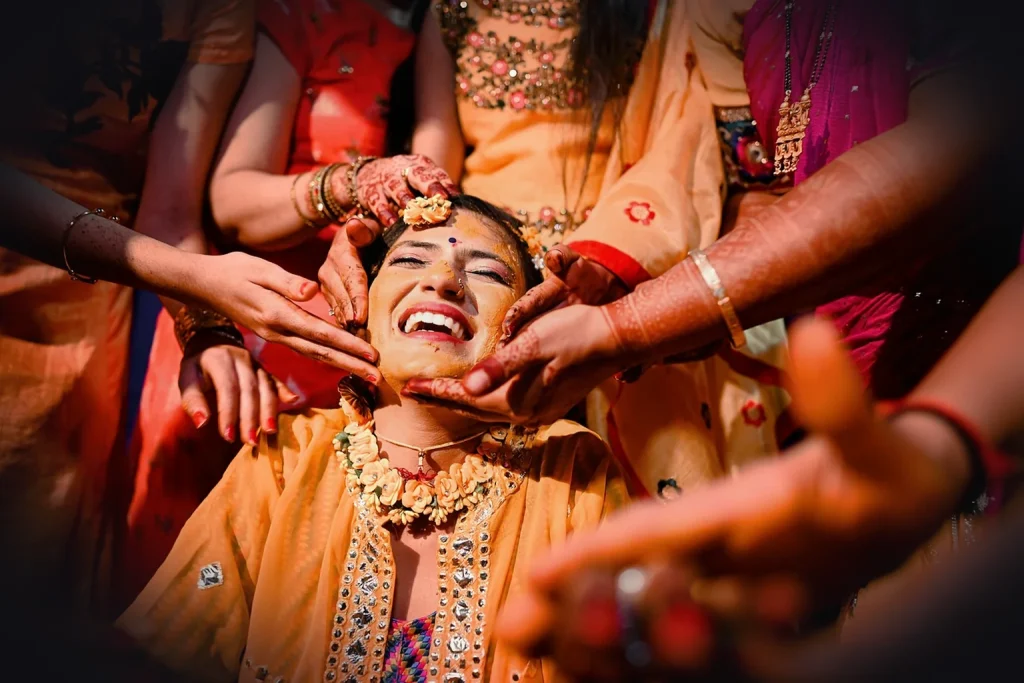
If you grew up Pakistani or Indian, ubtan is a sense memory before it is a skincare ingredient. The yellow stain on a cousin’s bridal dupatta. The warm, slightly nutty smell of chickpea flour mixed with rose water. The way your grandmother held your jaw still while she rubbed the paste into your cheekbones the week before exams, because she believed glowing skin was its own kind of luck. The ritual is older than the cosmetics industry by several thousand years, and it survived British colonization, partition, and the entire run of K-beauty essentially unchanged.
This piece is about what ubtan actually does, where the science backs it up, where the family lore overshoots, and how to fit the tradition into a modern routine without staining your pillowcases.
The ritual
Across Pakistan, North India, and Bangladesh, the bridal ubtan ceremony (called mayoun, ubtan, haldi, or gaye holud depending on the region and community) takes place in the days or weeks before the wedding. Female relatives gather, mix the paste, and apply it to the bride’s face, arms, hands, and feet. The mixture sits for fifteen to forty-five minutes, then washes off with cold water. In some traditions the ritual happens once. In others it happens daily for two to four weeks.
The traditional recipe varies by family, but the canonical ingredients are turmeric powder (haldi), chickpea flour or gram flour (besan), milk or yogurt, sometimes honey, sometimes sandalwood powder, sometimes rose water. The proportions are not measured. The aunties measure by hand.
The stated purpose is brightening, evenness, and ritual blessing. The actual mechanism is a four-active stack that pre-modern medicine arrived at empirically and that modern dermatology only recently caught up to.
The four actives
Curcumin, from turmeric, has been studied extensively for anti-inflammatory and tyrosinase-inhibiting effects. Topical curcumin at 1 to 5 percent reduces melanin synthesis in vitro and in small clinical trials. A 2018 paper in Phytotherapy Research (Vaughn et al.) reviewed 18 clinical trials of topical turmeric on various skin conditions and found measurable improvement in pigmentation, photodamage, and inflammation in most of them.
Chickpea flour provides physical exfoliation when rubbed wet on skin. The particles are angular but soft, and the protein content adds mild cleansing through saponin-like action. In effect, it is a gentle exfoliating cleanser that pre-dates the polyethylene microbead era by a few millennia.
Milk, particularly raw milk, carries lactic acid, an AHA that loosens the bonds between dead skin cells. The concentration in fresh milk is low (around 0.1 to 0.5 percent), but enough for cumulative effect when applied repeatedly. Lactic acid also hydrates, which is unusual for an AHA.
Sandalwood powder, when included, adds santalols (anti-inflammatory) and a small amount of additional brightening through unrelated mechanisms. Indian sandalwood deserves its own piece, which we have written.
Why it stains
Curcumin is fat-soluble and the molecule binds aggressively to keratin (the protein in your top skin layer) and to fabric. The yellow tint on Pakistani brides after ubtan is real curcumin staining, and it fades over three to seven days as the keratin sheds. On lighter complexions the stain is more visible; on deeper complexions it reads as a warm gold glow. Either way, it washes out.
This is why bridal ubtan is timed. The week before the wedding is the wrong week to apply yellow paste daily. The traditional protocol stops ubtan three to five days before the ceremony, allowing the curcumin to clear. Aunties know.
The contrarian case against modern ubtan kits
I am going to push back on the commercial ubtan industry that has appeared in the last decade. Many of these kits are turmeric powder mixed with fillers, in a sachet, sold at fifteen dollars for a single use, with marketing copy that names neither the curcumin percentage nor the chickpea ratio. The family-recipe ubtan that your aunt makes from scratch is almost certainly better, fresher, and a tenth of the price.
The kits that genuinely improve on tradition use tetrahydrocurcumin, a colorless derivative of curcumin with similar anti-inflammatory activity and no staining. These are worth the price difference if you have skin issues to address and a job interview on Friday.
What the science misses about the tradition
The studies on topical curcumin almost always test isolated curcumin in a vehicle, not a wet paste sitting on skin for thirty minutes with chickpea flour and milk. The combined effect is plausibly different from the sum of the parts. Chickpea proteins may improve curcumin penetration. Milk’s lactic acid may pre-prep the skin. Honey, when included, brings antimicrobial and humectant action that softens the chickpea grit.
This is what gets lost when Western brands isolate a single “active” from a traditional formula. The formula was the active. The Pakistani household ubtan has 4,000 years of empirical iteration behind it. Modern dermatology has tested isolated compounds for 60.
How to use ubtan in a modern routine
Once or twice a week, not daily. Use raw chickpea flour (not roasted), turmeric powder (a quarter teaspoon for the face), and milk or yogurt to make a wet paste. Apply, wait ten to twenty minutes, rinse with cold water. Follow with a hydrating serum like Microbiome Glow Serum and SPF if it is morning.
Stop using ubtan three to five days before any event where you need a clean color base. Stop using it entirely if you are on isotretinoin or any prescription pigmentation treatment without consulting your dermatologist. Patch test on the jaw before the first full-face application; turmeric can stain very fair skin visibly.
If you want the benefits without the yellow tint and the kitchen mess, Mindful Masks includes a turmeric-clay variant that uses tetrahydrocurcumin and stays on the schedule of a regular weekly mask.
FAQ
Will turmeric permanently stain my skin? No. The staining fades over three to seven days as keratin sheds. Very fair skin may see longer fade times. Curcumin does not penetrate to the dermis; it sits in the top epidermal layers.
Can I use ubtan if I have active acne? Generally yes. Curcumin has anti-inflammatory action that can help inflamed acne. The chickpea exfoliation is gentle. But avoid ubtan on broken or open lesions and avoid stacking it with prescription acne treatments without asking your derm.
Is ubtan culturally appropriative? Using ubtan is not. Selling “ancient Indian beauty secret” kits without crediting the South Asian traditions that originated them is. Buy from South Asian-owned brands when possible. Acknowledge the lineage.
Can I use ubtan during pregnancy? Topical turmeric in normal amounts is considered safe in pregnancy, but oral curcumin in high doses is not recommended. The ubtan paste is topical and small-volume; this is generally fine. Ask your obstetrician about your specific case.
Why does the family recipe vary so much? Because ubtan is not a product, it is a household practice. Each family adjusts for the bride’s skin type, the season, what is in the pantry, and what the grandmother believes. The variation is the tradition.
For more on culturally rooted skincare, see the skin-of-color tag hub. Related reading: Indian sandalwood covers another traditional South Asian ingredient with strong modern evidence.
Sources
Vaughn AR, Branum A, Sivamani RK. Effects of turmeric (Curcuma longa) on skin health: a systematic review of the clinical evidence. Phytotherapy Research, 2016. Heng MC. Curcumin targeted signaling pathways: basis for anti-photoaging and anti-carcinogenic therapy. International Journal of Dermatology, 2010. Nguyen TA, Friedman AJ. Curcumin: a novel treatment for skin-related disorders. Journal of Drugs in Dermatology, 2013.
Keep reading
References
- Davis EC, Callender VD. Postinflammatory hyperpigmentation: a review of the epidemiology, clinical features, and treatment options. J Clin Aesthet Dermatol. 2010. PubMed.
- Cestari TF, Dantas LP, Boza JC. Acquired hyperpigmentations. An Bras Dermatol. 2014. PubMed.
Have a question about “Pakistani turmeric ubtan: bridal brightening tradition decoded”?
Ask our editorial desk. Best questions become full follow-up articles, reviewed by our medical reviewer. No medical advice given in private — answers run as articles or not at all.