TL;DR: Argan is genuinely excellent for dry skin, mature face, body, and hair. It's also too heavy for most oily and acne-prone faces. The difference matters.
Quick answer
Argan oil comes from the kernels of the argan tree, which grows in a specific stretch of southwest Morocco. It’s high in vitamin E (about 1.5 times the level in olive oil), oleic acid, and linoleic acid. It works well for dry skin, body care, hair conditioning, and modest anti-aging support on mature faces. It’s heavier than jojoba or squalane, which is why it’s often too rich for oily or acne-prone facial skin. The best use case is dry, mature face skin, or body and hair for almost anyone.
What’s actually in it
The fatty acid profile is about 46 percent oleic acid (emollient), 31 percent linoleic acid (essential fatty acid, barrier support), 12 percent palmitic, and 6 percent stearic.
The bioactives are where it earns its reputation. High tocopherol (vitamin E) content for the antioxidant load. Polyphenols. A small amount of squalene, which mimics what your skin makes naturally. Sterols that support the barrier. The vitamin E concentration is what separates argan from most other plant oils on the shelf.
What it does
Provides antioxidant protection through that vitamin E.
Supports the barrier by replenishing the skin’s own lipids.
Moisturizes, with a heavier emollient feel than lighter oils.
Calms mildly. The anti-inflammatory effect is modest but real.
Conditions hair, especially the ends. This is genuinely one of the better oils for that.
Where it works best
Dry skin — it’s a rich emollient.
Mature skin — the vitamin E and fatty acid combination is supportive.
Body care — excellent across the whole body, especially elbows, knees, feet, hands.
Hair conditioning — particularly for damaged ends and as a pre-shampoo treatment.
Cuticles and nails.
Pre or post-shave lubrication.
Where it’s a bad fit
Oily facial skin tends to find it too heavy.
Acne-prone facial skin can react. Some people are fine, others break out.
Very humid climates make heavier oils feel suffocating.
The T-zone of combination skin, even when the cheeks would love it.
How it stacks up against other oils
Squalane is lighter, has negligible vitamin E, more stable, more versatile for face routines, and usually cheaper.
Jojoba sits between argan and squalane in weight. Stable. Versatile.
Rosehip oxidizes quickly, which is its main limitation. Useful for specific anti-aging concerns but less forgiving on the shelf.
For dry mature facial skin, argan often outperforms the lighter options. For most face routines across most skin types, jojoba or squalane is more flexible.
How to actually use it
As a face oil for dry mature skin: two or three drops warmed between fingertips, after moisturizer or as the final layer, morning or evening. Pairs with most actives without drama.
As a body oil: on damp skin after a shower, full body. Daily for very dry skin.
As a hair oil: on dry ends, as a pre-shampoo treatment, or a light final layer on dry hair.
Mixed into moisturizer: one or two drops to enrich the texture without going to a full oil layer. Less greasy than pure oil.
In cleansing oils: some include argan as part of the blend, which rinses off and doesn’t leave a heavy residue.
What to look for when you buy
Cold-pressed (preserves the nutrients), USDA organic if you care about that, Morocco as the origin (argan is region-specific), dark glass packaging, a recent harvest date if it’s listed, and smaller bottles you’ll actually finish during the stability window.
Avoid suspiciously cheap argan oil — it’s almost certainly diluted. Avoid refined argan, which has been stripped of most of what makes argan worth buying. Avoid clear packaging, which lets the oil oxidize.
Cosmetic-grade and culinary-grade argan are usually similar quality if the brand is reputable. Cosmetic-grade has been filtered for skin use; culinary may carry more impurities.
Specific products worth knowing
Pure argan oil: Josie Maran Pure Argan Oil, Acure Argan Oil, The Ordinary’s 100% Organic Cold-Pressed Argan Oil at around ten dollars.
Argan often shows up as 5 to 15 percent of moisturizers and serums for an emollient plus antioxidant boost. That’s a reasonable formulation choice.
Mistakes I see often
Buying very cheap “argan oil.” It’s almost always cut with cheaper oils.
Using it on an oily face and wondering why you broke out.
Storing it in light or heat, which kills the stability.
Treating it as a miracle ingredient. It’s useful, not transformative.
Dropping it into a routine without considering whether it fits — a heavy oil on top of a heavy moisturizer is a lot.
Argan vs other moisturizing approaches
For the face, argan is one option among many. A hyaluronic acid plus ceramide moisturizer plus a light oil often outperforms argan alone for most readers. Squalane is more versatile for everyday face use.
For the body, argan is excellent. Cocoa butter and shea butter are reasonable alternatives. Combinations are common.
For hair, argan is among the best, particularly on damaged ends.
A few practical notes
Topical argan oil is generally considered safe during pregnancy. Confirm with your OB if anything is unusual.
Allergic reactions are rare but possible. Patch test if you have tree nut sensitivities (argan is technically in a different family, but cross-reactivity does happen) or general oil sensitivities.
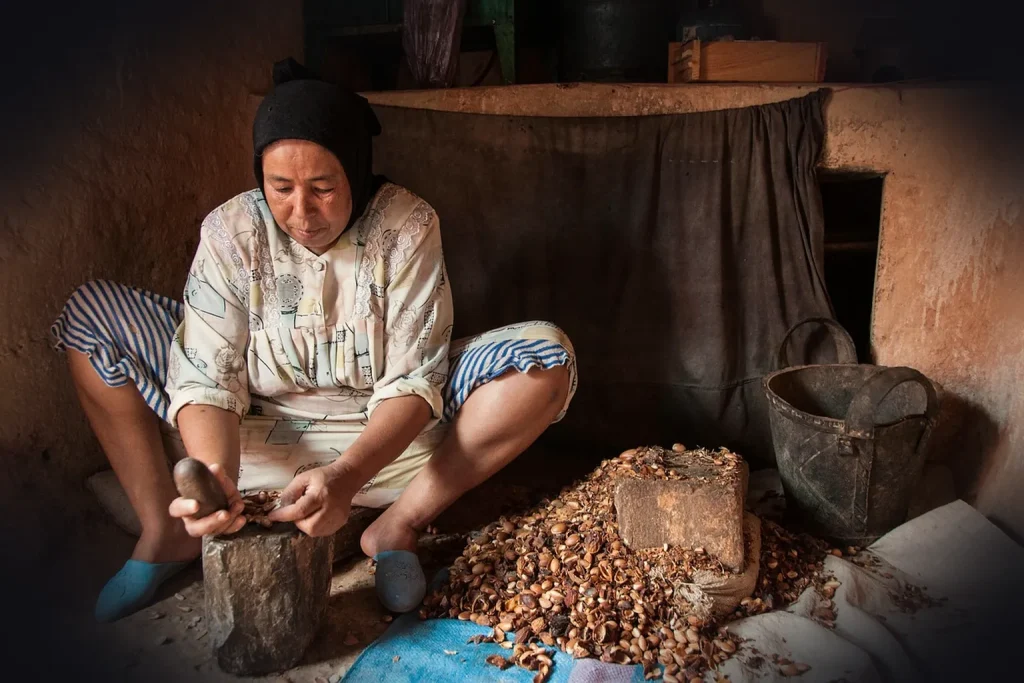
On sustainability: argan trees are endangered, so sourcing matters. Look for fair-trade certification. USDA Organic generally includes sustainable sourcing standards. The Berber women’s cooperatives that produce argan oil are economically important, and supporting ethical sourcing has knock-on benefits beyond your face.
What it can’t do
Replace sunscreen. Substitute for a retinoid. Transform skin quickly. Treat acne — it can make it worse. Replace targeted treatments for specific concerns.
FAQ
Is argan oil non-comedogenic? Mixed rating, around 2 to 3 out of 5. Fine for most readers. Can clog pores for some acne-prone skin.
Can I use argan on acne-prone skin? Test it first. Some tolerate it well, others don’t. There are better default choices for facial skin in this category.
Is it pregnancy-safe? Topically, generally yes. Confirm with your OB.
How long does it keep? Cold-pressed argan: six to twelve months, refrigerated. Refined versions last longer.
Is “Moroccan oil” the same as argan oil? “Moroccanoil” is a brand name. The product contains argan but also other ingredients. Not the same as pure argan oil.
Sources
Charrouf Z, Guillaume D. The cosmetic and pharmaceutical applications of argan oil. International Journal of Molecular Sciences, 2010.
Keep reading
Keep reading
Related: Sodium PCA: the humectant your skin already makes (and runs out of), and Dermatographia: when 'skin writing' is more than just a histamine quirk, and From Cradle Cap to Tween Skin: Why Infantile Seborrheic Dermatitis Echoes Later, and Dermatographia: when 'skin writing' is more than just a histamine quirk, and From Cradle Cap to Tween Skin: Why Infantile Seborrheic Dermatitis Echoes Later, and The Berber Argan Tradition: How a Moroccan Oil Reached Your Bathroom.
References
- Kligman AM, Christensen MS. The biology of the stratum corneum revisited. Int J Cosmet Sci. 2011. PubMed.
- Draelos ZD. The science behind skin care: cleansers. J Cosmet Dermatol. 2008. PubMed.
Have a question about “Argan oil for skin: when to use it (and when not to)”?
Ask our editorial desk. Best questions become full follow-up articles, reviewed by our medical reviewer. No medical advice given in private — answers run as articles or not at all.