TL;DR
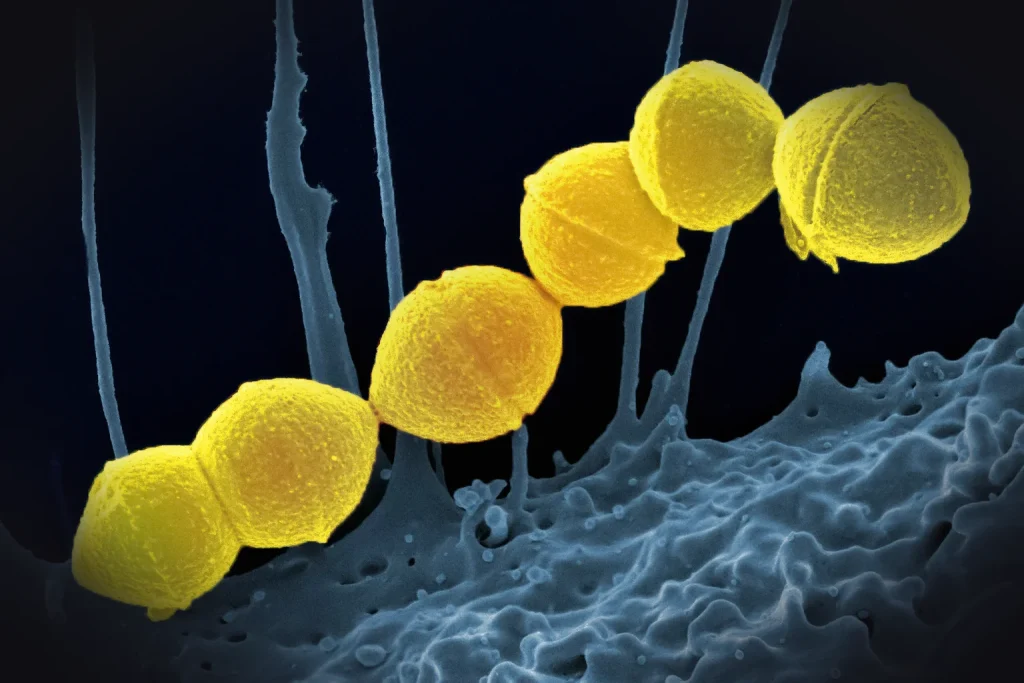
Streptococcus mitis is one of the dominant bacteria in the healthy human mouth and shows up densely on the lip vermilion border, where the wet inside of the mouth meets the dry outside. The lip microbiome bridges oral and skin biology in ways that lip balms, mouthwash, and perioral dermatitis all touch. The routine implication is that lip care is closer to oral care than face care, and treating it like face care can miss the point.
Tool: PD eliminator — zero-treatment protocol that often works in 6-8 weeks.
Lips are the strangest piece of real estate on the human face. The vermilion border, the line where the lip color meets the surrounding skin, is the meeting point of two very different biological zones. Inside, the mucosal surface is wet, salivary, and microbially dense in oral organisms. Outside, the cutaneous surface is dry, dryer than typical facial skin actually, and colonized by a different community. The lip itself is the border.
The dominant bacterium across that border, in healthy adults, is Streptococcus mitis. The implications for how to take care of lips are not obvious until you look at the biology.
What S. mitis actually is
Streptococcus mitis is a viridans group streptococcus, the largest genus of bacteria in the healthy human mouth. The viridans group as a whole accounts for roughly 30 to 60 percent of oral bacterial communities in healthy adults. S. mitis specifically is one of the most abundant species, alongside S. salivarius, S. sanguinis, and S. oralis.
On lip skin, S. mitis comes off the mucosal surface continuously. Saliva contact, talking, eating, breathing. The vermilion border is wet enough during normal activity to maintain a continuous lawn of oral organisms. The lower lip specifically gets more salivary contact than the upper lip and tends to have higher S. mitis density.
The Human Microbiome Project’s oral and skin data, published in Nature in 2012, showed clear community structure differences between lip vermilion, lip skin (just outside the border), and the broader facial cheek. The lip vermilion was intermediate between mouth and skin. The lip skin transitioned toward standard facial skin community within a few millimeters.
What this means clinically
Three connected conditions show up at this border.
Perioral dermatitis is the classic one. Small papules and erythema clustered around the lower face, often sparing a thin zone immediately around the lip itself. The classic onset is in young adults, often associated with topical steroid use, fluoride toothpaste, fragranced lip balms, or heavy facial moisturizers. The microbiome component is increasingly recognized: the eruption tends to involve disturbances in the perioral microbial community, with some studies showing altered Streptococcus profiles.
Angular cheilitis is the breakdown at the corners of the mouth. The wet-dry interface at the commissures gets macerated, the skin breaks down, and the resulting cracks are colonized by mixed oral organisms, Candida species, and sometimes S. aureus. The triggers are usually mechanical (lip licking, drooling at night, poorly fitting dentures) and the treatment is partly antimicrobial, partly barrier-protective.
Tool: chapped lips root-cause tool — finds the actual cause instead of cycling balms.
Chronic lip dermatitis, from over-use of lip balms or from allergic contact reactions to lip balm ingredients, is a third pattern. The cycle is well-known. The user applies balm, the lips feel better briefly, the balm contains a fragrance or flavoring or beeswax allergen, the lips react, the user applies more balm. The microbiome component is that the balm chemistry alters the resident community in ways that may favor opportunistic organisms.
The contrarian H2: lip care is closer to oral care than face care
The skincare industry has built a category around lip care that treats lips as a special case of face skin. Lip masks, lip serums, lip-plumping treatments, exfoliating lip scrubs. The framing is that lips are face skin with special needs.
The biology is closer to the opposite. Lips are mucosal tissue with a thin keratinized layer, sitting at the boundary of an organ system that is mostly bacterial-dominated and salivary-bathed. The dominant care variables for healthy lips are oral health (because the saliva delivers most of the local microbial input), hydration status (because the lip surface dehydrates faster than other facial skin), and avoiding the specific irritants that disrupt the local community (fragrance, flavoring, certain preservatives in lip balms).
The implication for routine is unflashy. Brush and floss properly. Drink enough water. Use a simple unflavored lip balm without fragrance, often petrolatum-based, applied sparingly. Avoid the cycle of frequent application that some marketing actively promotes. Treat lip licking as a behavioral pattern to interrupt, not a symptom to medicate.
None of this requires a lip-specific skincare category. The relevant levers are oral hygiene and barrier protection.
The real numbers
The Human Microbiome Project data found that the viridans group streptococci (S. mitis included) accounted for 25 to 45 percent of cultivable bacteria on healthy lip vermilion samples in their cohort, with the range varying by individual oral hygiene status and salivary flow.
A 2017 study in BMC Microbiology by Vesty and colleagues sequenced lip and oral samples from 25 healthy adults and found S. mitis among the top three most abundant species at the lip border in 22 of the 25 subjects. The bacterium is essentially ubiquitous on healthy adult lips.
The American Academy of Dermatology’s 2022 position on perioral dermatitis explicitly mentioned the role of disrupted local microbial communities in perioral eruptions and recommended a back-to-basics approach: discontinue topical steroids, stop fragranced products, use a mild non-fluoride toothpaste during flares, and consider a short course of topical metronidazole if the eruption persists.
What a sensible lip routine looks like
The list is short and unglamorous.
Use a fragrance-free, flavor-free lip balm. Petrolatum-based balms (plain Vaseline, Aquaphor, Cicalfate lip balm) are the most reliable. Avoid balms with menthol, camphor, eucalyptus, or peppermint, which produce a tingling sensation by mildly irritating the lip and are common contact allergens.
Apply sparingly. The frequent reapplication cycle that marketing promotes can drive a dependence pattern. Twice a day at most for healthy lips. More if you are in a dry climate or have a specific reason.
Keep oral hygiene reasonable but not aggressive. Fluoride toothpaste is fine for most people but if you get recurrent perioral eruptions, try a fluoride-free toothpaste for a few weeks and see whether it changes the pattern. Some users react to specific flavoring compounds in toothpaste.
Skip lip exfoliation. The lip vermilion does not need scrubbing. The skin is thin and the resident microbial community is delicate. Most lip scrub use is unnecessary and some of it is actively counterproductive.
For broader context on facial skin biology and microbiome routines, see the microbiome skincare explainer, the barrier repair routine, and the sensitive skin routine guide.
FAQ
Is S. mitis dangerous? Almost never on healthy lips and oral tissue. It can become pathogenic in specific clinical contexts (bacterial endocarditis in patients with cardiac risk factors, particularly after dental procedures) but this is unrelated to ordinary skincare.
Can I get perioral dermatitis from using too much lip balm? Yes, in some cases. Heavy occlusive use around the lip border can drive perioral eruptions, especially with fragranced or flavored balms. The pattern is well-documented.
Does mouthwash affect lip skin? Indirectly. Antimicrobial mouthwashes (chlorhexidine, alcohol-based) shift the oral microbiome and can produce dry lips, altered taste, and sometimes mild local irritation. Daily long-term use of strong mouthwashes is not necessarily harmless.
Why do my lips peel in winter? Cold dry air, less salivary contact (people breathe through dry mouths in cold weather), reactive lip licking, and indoor heating that drops ambient humidity. The fix is fragrance-free balm applied sparingly, not aggressive exfoliation.
Should I worry about kissing transferring oral bacteria to my face? No. The oral and skin microbiomes have been exchanging organisms for the entire history of human social contact. Healthy populations of S. mitis are not a face-skin concern.
Tag hub: More on microbiome biology and slow skincare
Sources
Human Microbiome Project Consortium. Structure, function and diversity of the healthy human microbiome. Nature 2012. Vesty A et al. Microbiomes of the saliva and lip. BMC Microbiology 2017. AAD position on perioral dermatitis, 2022.
Keep reading
References
- Grice EA, Segre JA. The skin microbiome. Nat Rev Microbiol. 2011. PubMed.
- Yu Y, Dunaway S, Champer J, et al.. Changing our microbiome: probiotics in dermatology. Br J Dermatol. 2020. PubMed.
Have a question about “Streptococcus mitis and lip flora: the oral-skin microbiome crossover worth knowing”?
Ask our editorial desk. Best questions become full follow-up articles, reviewed by our medical reviewer. No medical advice given in private — answers run as articles or not at all.