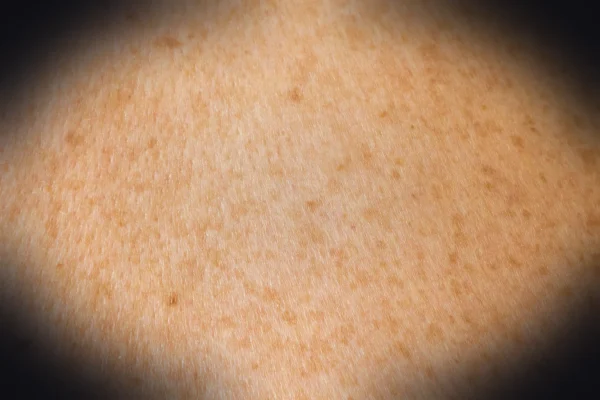
Tranexamic acid started its life as a clotting medication — it’s prescribed to control heavy bleeding by blocking plasmin. Dermatologists noticed that melasma patients on oral tranexamic acid for unrelated reasons had visibly lighter pigmentation, and a decade of research later it’s established as one of the most promising depigmenting agents in the field. The mechanism is unusual: rather than blocking melanin production directly, it interrupts the inflammation signals that tell melanocytes to overproduce in the first place. That’s why it works on the kind of pigmentation that resists everything else.
The melasma case
Melasma is driven by a feedback loop: UV and hormones trigger inflammation, inflammation triggers vascular factors, vascular factors signal melanocytes, melanocytes produce pigment, pigment makes the skin more reactive. Tranexamic acid breaks the loop near the start by inhibiting plasmin in keratinocytes. Comparative trials show topical tranexamic acid 5% performs comparably to hydroquinone 2% in melasma, with a substantially better safety profile and without the cycling-off requirements that make hydroquinone routines difficult to sustain.
Topical vs oral
Topical 2–5% works for surface pigmentation, post-inflammatory marks, and mild-to-moderate melasma over twelve to twenty-four weeks. Oral tranexamic acid (typically 250 mg twice daily, prescription-supervised) treats moderate-to-severe melasma faster but carries the clotting-medication side-effect profile — DVT risk, contraindicated with certain hormonal contraceptives, requires medical screening. Most users get adequate results from topical alone. The full pigmentation protocol is in melasma: a routine that actually moves it. Don’t self-prescribe oral tranexamic acid based on internet protocols; the screening is for real reasons.
Tranexamic acid vs hydroquinone
Hydroquinone is the long-standing first-line treatment but carries real risks with prolonged use: rebound pigmentation, exogenous ochronosis (a paradoxical darkening) on certain skin types, and regulatory restrictions in many countries — the EU restricts it to prescription only, and several other jurisdictions are tightening. Tranexamic acid has none of those issues at standard concentrations. It’s slower for severe cases but safer for long-term use, and you don’t cycle off it the way hydroquinone protocols require every three months. The full comparison is in tranexamic acid vs hydroquinone: the modern brightening comparison.
The contrarian take on “tranexamic acid for everyone”
It’s genuinely effective, but the marketing has overshot. Tranexamic acid will not fade general dullness or one-off dark spots from a healed pimple as effectively as the brand copy implies. For diffuse pigmentation, melasma, and stubborn PIH with an inflammatory origin, it earns its place. For garden-variety post-pimple marks, niacinamide and azelaic acid work as well at significantly lower cost. The honest ingredient case is in tranexamic acid: the quiet star of pigmentation treatment. Diagnosing the type of pigmentation first matters more than buying the trendiest active.
Skin of color specifically
This is where tranexamic acid is most useful. Darker skin tones are more prone to post-inflammatory pigmentation from any irritant — retinoids, acids, even spot treatments. Hydroquinone’s ochronosis risk is concentrated on darker skin and is the reason many dermatologists serving Black, South Asian, and Hispanic patients now reach for tranexamic acid first. It carries none of that baggage and is the modern default for melasma and PIH on skin of color. The specifics are in skincare for skin of color: what actually changes and the long-game timeline is in sun spots and age spots: treatment timelines that actually work, with melasma’s particular stubbornness covered in melasma: why it’s stubborn and what’s new in 2026.
How to layer it
Morning or night, after cleansing, before moisturizer. Pairs cleanly with niacinamide (the combination outperforms either alone for melasma), vitamin C, azelaic acid, and sunscreen. Avoid stacking with strong AHAs the same morning — the irritation defeats the anti-inflammatory mechanism the ingredient relies on. Microbiome Glow Serum with tranexamic acid plus niacinamide is the layering pattern that consistently works for pigment-prone skin. Sunscreen is not optional with this ingredient; UV undoes the work in a matter of days no matter how diligent the rest of the routine.
Frequently asked questions
- How long does tranexamic acid take to work?
- Twelve to twenty-four weeks for visible improvement in melasma and PIH at topical 2u20135%. Oral tranexamic acid under medical supervision can produce changes in eight to twelve weeks but requires screening. Donu2019t evaluate at week four u2014 pigmentation is one of the slowest skincare problems to move, and the timeline reflects skin biology, not formula quality.
- Is tranexamic acid safe for daily use?
- Topical tranexamic acid at 2u20135% is well-tolerated for daily long-term use with no documented rebound or ochronosis risk u2014 a real advantage over hydroquinone. Oral tranexamic acid is a prescription medication with clotting-related contraindications and should never be self-prescribed. Always pair topical use with daily broad-spectrum SPF; UV undoes the progress.
- Tranexamic acid vs hydroquinone?
- Hydroquinone is faster for severe cases but carries rebound pigmentation, ochronosis on darker skin, and regulatory restrictions in many countries. Tranexamic acid is slower but safer for long-term use and doesnu2019t require cycling off. For most home users u2014 especially on skin of color u2014 tranexamic acid is the better default, with hydroquinone reserved for short prescription courses.
- Can I use tranexamic acid with vitamin C?
- Yes, and they pair well. Vitamin C inhibits melanin production at the enzyme level, tranexamic acid interrupts the inflammation signal that triggers production in the first place. Together they target the cascade at two points. Use vitamin C morning, tranexamic acid morning or evening; if both at once, vitamin C first, then tranexamic acid.
- Does tranexamic acid work on freckles?
- Not particularly well. Freckles are genetic, UV-activated pigment with a different driver than melasma or PIH u2014 theyu2019re not inflammation-mediated, which is what tranexamic acid targets. Vitamin C and laser treatments are more effective for true freckles. Tranexamic acid shines on melasma, PIH, and the diffuse pigmentation that follows chronic inflammation.